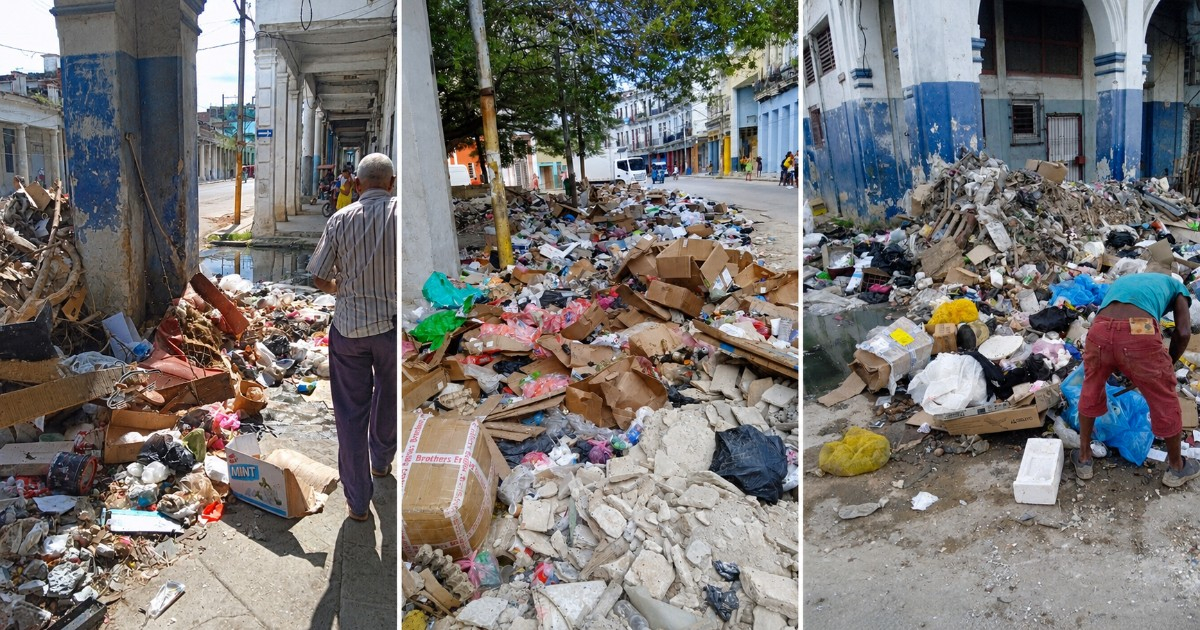
Cesáreo Navas y Morlanes, a Cuban resident, took to Facebook to raise awareness about the severe garbage crisis plaguing Havana. His post included images depicting large heaps of waste littering the streets, set against a backdrop of decaying colonial architecture, overflowing sewage, and open drains.
"Havana has turned into a massive dump," Navas y Morlanes lamented. "Streets like Montes, Infanta, and Reina are notorious for their numerous, stinking, and hazardous garbage dumps on every corner. It's a health risk for both the community and passersby!"
He specifically pointed out areas like the corner of Montes and Castillo, where trash piles have grown both in height and spread, with sewage spilling over them. Additionally, he highlighted the former park at Montes and Estévez, where waste almost reaches the center of the green space.
Navas y Morlanes criticized the role of state-operated front-end loaders, which exacerbate the situation by breaking curbs, damaging sidewalks, digging deep holes, and even harming building structures during trash collection operations.
"What incompetence, apathy, and negligence from our national and municipal leaders!" he exclaimed. "Epidemics loom over us like the 'Sword of Damocles'."
He posed a critical question, "Do the leaders of this highly controversial social-political project have these painful trash dumps in front of or beside their homes? Surely, they don't suffer from this additional disgrace, nor are they affected by the lack of medications or exclusive hospitals and clinics. Power outages and water shortages barely touch them, while transportation and fuel are someone else's problem. And as for food, just look at their well-stocked pantries, evident from their large bellies and rosy faces, filled with a variety of fine products. 'There is plenty, but not for us!'"
Navas y Morlanes further criticized, "It's ironic and audacious that in their relentless and overwhelming rhetoric, often draped in questionable patriotism, they demand our support for maintaining their privileges: their climate-controlled homes with pools, international travels, family members with residences and properties in Europe and the Americas, and their well-protected and sanctioned businesses."
Earlier this year, only 44 of Havana's 106 garbage trucks were operational — a mere 41.5% of the fleet — due to diesel shortages and mechanical issues, while the city produces between 24,000 and 30,000 cubic meters of solid waste daily.
The health implications are dire. Residents of Neptuno Street reported that "rats look like cats" due to their size among the trash, worms, and rodents. Meanwhile, locals between Ayestarán and Infanta warned of a rat infestation threatening homes and a nearby food processing facility.
In response to the collapse of the state-run service, an official newspaper suggested that Havanans pay 100 pesos for each private garbage collection, thereby shifting the burden of this responsibility, which the state cannot — or will not — manage, onto the citizens.
Insights into Havana's Garbage Crisis
What is causing the garbage crisis in Havana?
The garbage crisis in Havana is primarily due to a lack of operational garbage trucks, diesel shortages, and mechanical failures, leading to a significant backlog of uncollected waste.
How does the waste problem affect Havana's residents?
The waste problem poses a severe health risk to Havana's residents, with infestations of large rats and other pests. It also threatens public areas and food processing facilities.
What solutions have been proposed for the garbage issue?
One proposed solution is for residents to pay for private garbage collection services, as the state is unable to handle the situation effectively.