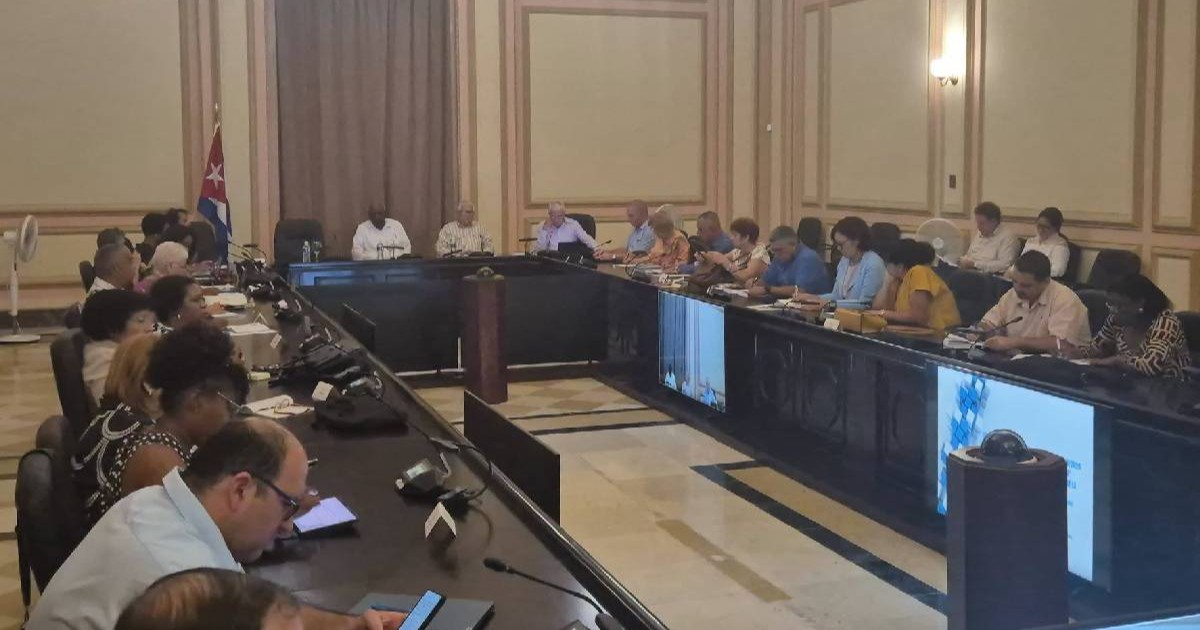
This Wednesday, parliamentary committees from Cuba's National Assembly of People's Power gathered to assess the progress of agreements made in previous sessions, with an eye on the upcoming Ordinary Session of the 10th Legislature set for December.
According to an official announcement on Facebook by the Cuban parliament, the meeting was led by Esteban Lazo Hernández and included participation from ministers, lawmakers, and other authorities.
The central focus of the day was to examine the impact of economic and social changes on the Cuban business system, covering both state and non-state sectors.
This review is part of the ongoing assessment of the 176 Economic and Social Transformations (TES) package, which the parliament approved during an extraordinary session on June 18 and 19, 2026. The regime has touted this as the most significant set of structural reforms since the Special Period of the 1990s.
By the end of Wednesday, the Presidency reported that 172 out of the 176 measures already had approved policies and procedures, resulting in 231 legal norms, 131 of which had been published in the Official Gazette.
Prime Minister Manuel Marrero Cruz had initially warned that implementing the package would require amending more than 148 legal provisions, repealing existing regulations, and approving 32 new ones, including bills, decree-laws, and decrees.
Reforms to the business system aim to provide greater autonomy to state-owned enterprises in terms of salaries, investments, and profit allocation; remove the cap of 100 employees for small and medium-sized enterprises; and allow state enterprises to transition into commercial companies.
However, this parliamentary review occurs amidst an unprecedented economic crisis. The Economic Commission for Latin America and the Caribbean (ECLAC) projects a 10.3% contraction of Cuba's GDP in 2026, the worst in Latin America and the Caribbean, with a cumulative decline of nearly 26% since 2020.
Official annual inflation reached 28.44% in September 2026, while food and beverage prices surged by 42.66% over twelve months.
The official minimum wage remains at 3,210 pesos per month, equivalent to less than five dollars at the informal exchange rate. Independent estimates suggest a family requires about 96,000 pesos monthly to meet basic needs.
The Cuban Observatory for Human Rights estimated in August 2026 that 94% of the population lives in extreme poverty, and eight out of ten Cubans have gone without food at some point due to lack of money or resources.
In this context, President Miguel Díaz-Canel acknowledged on Wednesday that the Cuban people expect "fewer blackouts and more food," a statement that contrasts with the regime's triumphant presentation of its reforms.
The Eighth Ordinary Session of the 10th Legislature, scheduled for December, will include the evaluation of the Ministry of Labor and Social Security's accountability report, marking the first significant parliamentary test of the real impact of these transformations on Cuban lives.
FAQs on Cuba's Economic Reforms and Crisis
What are the 176 Economic and Social Transformations (TES) in Cuba?
The 176 TES are a set of reforms approved by the Cuban parliament aimed at restructuring the country's economic and social systems, touted as the largest since the 1990s Special Period.
How has the economic crisis in Cuba affected its GDP?
The Cuban GDP is projected to contract by 10.3% in 2026, according to ECLAC, marking the worst economic performance in Latin America and the Caribbean, with a cumulative decline of nearly 26% since 2020.
What is the current inflation rate in Cuba?
As of September 2026, Cuba's official annual inflation rate reached 28.44%, with food and beverage prices increasing by 42.66% over the past year.
What changes are included in the business system reforms in Cuba?
The reforms aim to grant state-owned enterprises more autonomy regarding salaries, investments, and profits, eliminate the 100-worker cap for small and medium enterprises, and enable state enterprises to become commercial companies.