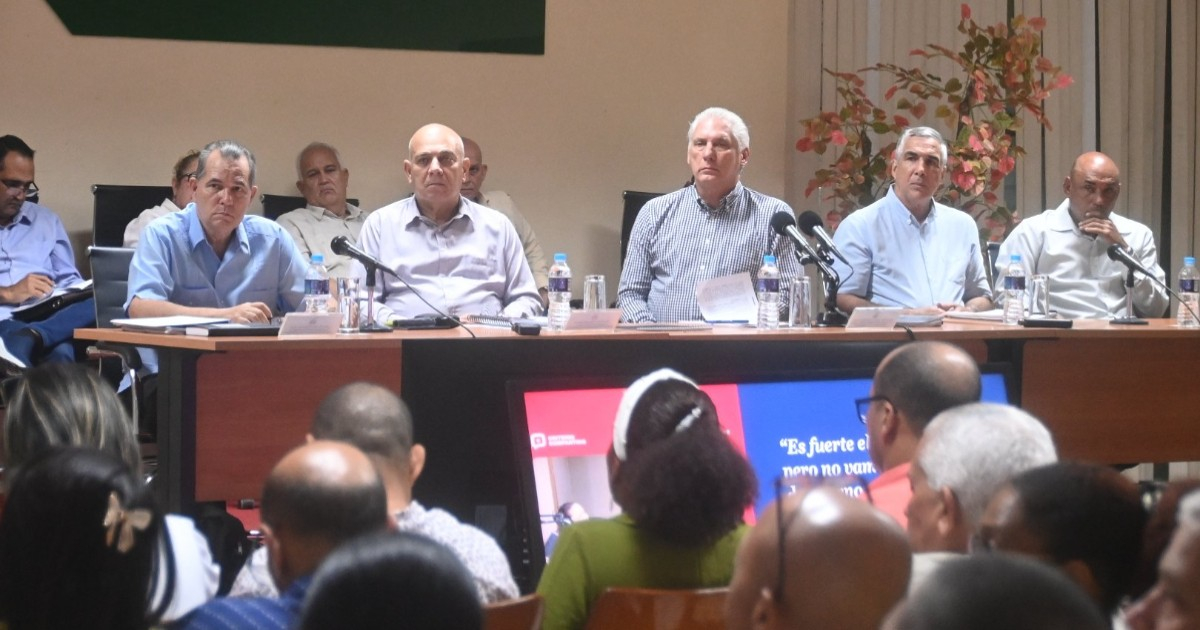
On Wednesday, Miguel Díaz-Canel once again placed the onus on members of the Communist Party of Cuba (PCC) to revitalize the island's food production. This came during the conclusion of the Central Committee Secretariat's visit to the state-run food industry sector, where he addressed party members and workers.
Through his social media account on X, Díaz-Canel reiterated the leading role expected of party militants in this critical endeavor for Cuba.
The gathering marked the culmination of a series of visits by the Secretariat and auxiliary structures of the Central Committee to key ministries such as Energy and Mines, the National Institute of Hydraulic Resources, Agriculture, Public Health, and the Central Bank. These visits follow a methodology established during the PCC's 11th Plenum in June 2026, which approved a comprehensive package of 176 Economic and Social Transformations.
Challenges in the Food Industry
Alberto López Díaz, Minister of the Food Industry, stated that his sector is responsible for implementing 100 of these 176 measures, organized into 23 thematic areas. He highlighted a direct link between energy and food production, asserting that "more kW means more food."
López Díaz admitted to internal limitations within the sector and called for a shift in attitude among leaders, urging them to seize the opportunities presented by the reforms: "We must treat these transformations like a sugarcane mill and extract all the opportunities they offer to the business system."
Economic Crisis Intensifies
This address comes amid one of Cuba's most severe energy and food crises. On Wednesday, the Electric Union reported only 1,000 MW available against a demand of 2,250 MW during the early hours, with a projected deficit of 1,820 MW for the evening peak. The Felton thermoelectric plant has been offline since Tuesday for a scheduled 21-day maintenance.
In informal markets, prices are soaring: local rice costs between 480 and 500 Cuban pesos per pound in Villa Clara, eggs are priced at 130 pesos each, and cooking oil exceeds 2,550 pesos per bottle. This is in a country where the average state salary was 7,354 pesos per month in August, equating to less than five dollars at the informal exchange rate.
The Economic Commission for Latin America and the Caribbean (CEPAL) forecasts a 10.3% contraction of Cuba's GDP in 2026, marking the steepest decline in Latin America and an overall drop of approximately 26% since 2020. A study by the Cuban Observatory of Human Rights released in August indicated that 94% of Cubans live in extreme poverty, with 84% skeptical that the reform package will improve their circumstances.
Persistent Calls for Action
Díaz-Canel's recent plea is part of a recurring theme throughout 2026. In January, he called on militants to lead in resolving issues, and in October, during a visit to the Ministry of Agriculture, he warned that "without food, there is no social stability." Each of these appeals has sparked waves of criticism on social media, where many Cubans argue that the Communist Party is part of the problem rather than the solution.
Prime Minister Manuel Marrero Cruz acknowledged in October that the effects of the 176 measures wouldn't be felt until 2027. Meanwhile, Cuba continues to import 70% to 80% of its consumed food, and rice production has plummeted from 304,000 tons in 2018 to just 79,000 tons in 2025.
Understanding Cuba's Food Production Crisis
What is the role of the PCC in Cuba's food production?
The Communist Party of Cuba (PCC) is tasked with leading efforts to enhance the country's food production, as emphasized by Díaz-Canel's recent calls for action.
Why is Cuba facing a food and energy crisis?
Cuba is grappling with one of its worst food and energy crises due to limited energy availability and high demand, coupled with economic challenges and dependence on food imports.
How are economic reforms impacting Cuba?
Economic reforms in Cuba are intended to address systemic issues, but their effects are not expected to be felt until 2027, amidst a backdrop of steep GDP contraction and widespread poverty.