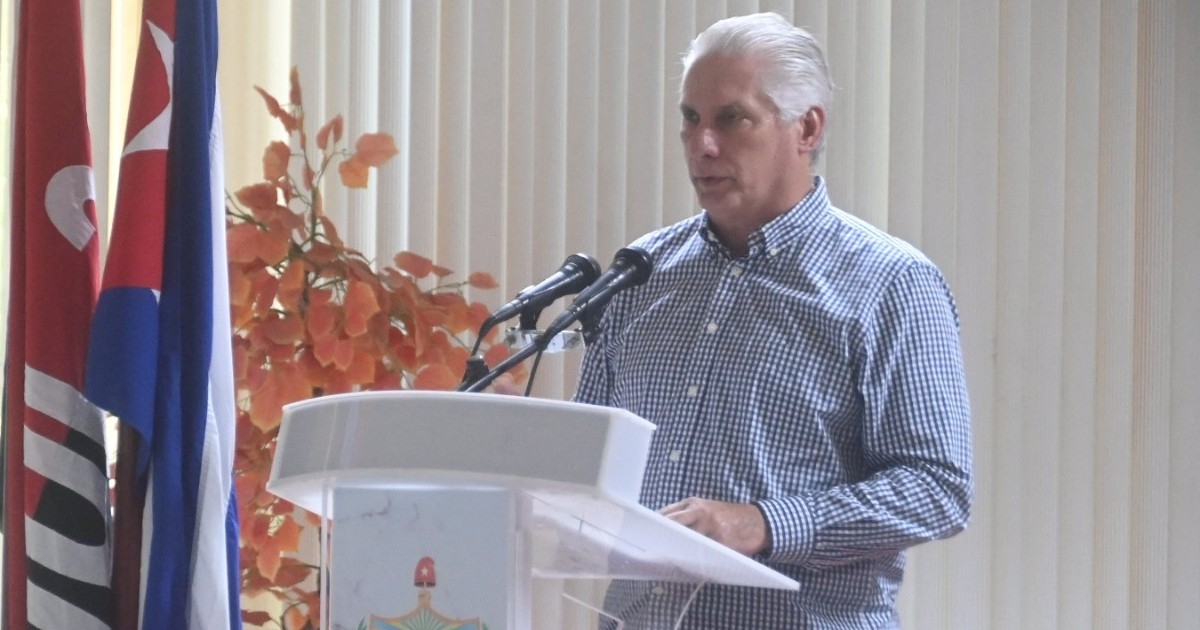
On Wednesday, Miguel Díaz-Canel acknowledged the urgent expectations of Cubans for tangible improvements in two critical areas affecting their daily lives: power outages and food shortages. This admission came during the closing remarks of the visit by the Secretariat of the Central Committee of the Communist Party to the state and business system of the Ministry of the Food Industry (MINAL), as reported by the official presidential site.
The Cuban leader directly linked electricity generation with food production, echoing a sentiment summarized by MINAL Minister Alberto López Díaz: “More kW means more food.” He also mentioned that the sector plans to implement 100 of the 176 Economic and Social Transformations (TES), organized into 23 thematic axes, urging a shift in attitude among system leaders: “Transformations must be leveraged like a sugar mill, extracting all the opportunities they offer to the business system.”
This acknowledgment comes amid one of Cuba’s most severe electrical crises of the year. On Wednesday, the Electric Union reported only 1,000 MW available against a demand of 2,250 MW in the early hours, with an expected deficit of 1,820 MW during the evening peak. The previous day saw a maximum shortfall of 1,816 MW. The Felton thermoelectric plant will be offline for three weeks due to maintenance.
In terms of food supply, the situation remains dire. Following the price liberalization outlined in Decree 156/2026, local rice prices have soared to between 480 and 500 Cuban pesos (CUP) per pound in Villa Clara, eggs have reached 130 CUP each, and oil has exceeded 2,550 CUP per bottle. This is in a country where the average state salary was 7,354 CUP in August 2026, amounting to less than five dollars at the informal exchange rate, while the minimum cost of basic needs is estimated to be about 13 times that amount.
Díaz-Canel's narrative is part of a recurring theme seen over recent months. In October, Prime Minister Manuel Marrero Cruz conceded on the official podcast “From the Presidency” that the impact of the 176 TES—approved in June as the most significant structural reform since the Special Period—would not be felt until 2027: “We have already opened the path for progress; in fact, progress is being made and results can be seen, although they are not yet evident in improving the population's quality of life.”
Independent data, however, contradicts this official optimism. The IX Report from the Cuban Observatory of Human Rights, released in August 2026, estimated that 94% of Cubans live in extreme poverty, 80% have skipped meals due to lack of money or food, and 95% have a negative view of the government's economic management. Furthermore, 84% doubt the 176-measure package will bring any change.
The Economic Commission for Latin America and the Caribbean (CEPAL) forecasts a 10.3% contraction of Cuba’s GDP in 2026, the worst in Latin America, contributing to an approximate 26% decline since 2020. Official year-on-year inflation stood at 28.44% in September, with food and beverage prices rising by 42.66% compared to the same month the previous year.
Yaxys Cires, the Director of Strategies at the OCDH, was blunt in presenting the report: “The widespread demand for political and economic transformations confirms that Cubans do not want mere adjustments or new promises, but rather a profound change that brings political, economic, and social rights.”
Understanding Cuba's Current Economic and Energy Challenges
What are the main challenges facing Cuba's energy sector?
Cuba is currently grappling with severe power shortages, with a significant gap between electricity supply and demand. This issue is exacerbated by outdated infrastructure and plants like the Felton thermoelectric plant being out of service for maintenance.
How is the food situation impacting Cuban citizens?
The liberalization of prices has led to a steep increase in food costs, making basic necessities unaffordable for many, given the low average state salary. This has resulted in widespread food insecurity and hunger among the population.
What do independent reports say about the Cuban people's living conditions?
Independent reports paint a bleak picture, with a large majority of Cubans living in extreme poverty and lacking confidence in governmental measures to improve their situation. Many have had to skip meals due to economic hardships.
What economic reforms are being promised by the Cuban government?
The Cuban government has introduced 176 Economic and Social Transformations, aiming for structural reform. However, results are not expected to be visible until 2027, and skepticism remains high among the populace.