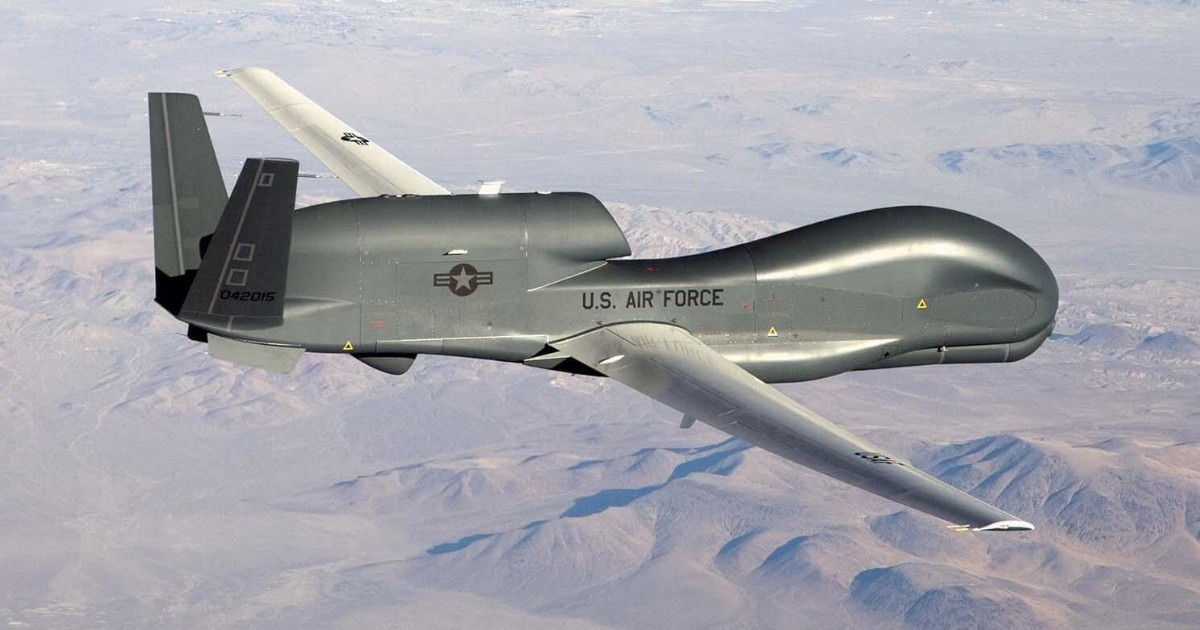
A U.S. Navy drone, identified as the MQ-4C Triton with the callsign BLKCAT6, was tracked on Tuesday executing multiple flights over international waters off the northern coast of Cuba, according to public records from the air tracking platform ADS-B Exchange.
The aircraft, bearing ICAO code AE7817 and registration number 16-9806, was observed flying at an altitude of 26,550 feet (approximately 8,093 meters) and traveling at 236 knots (437 km/h) heading east. At the time of data capture, the drone was already positioned off the northeastern coast of Florida, not over Cuban territory.
The recorded flight path indicates the drone completed several passes over the maritime area between Havana and the Bahamas before returning to Florida.
Analysis of the flight data suggests a pattern consistent with reconnaissance operations, although it does not definitively confirm the collection of intelligence on Cuban facilities.
There has been no official confirmation regarding the mission's objective or whether the drone entered the 12-nautical-mile territorial sea of Cuba, which would determine the true scope of the operation.
The MQ-4C Triton, a naval variant of the RQ-4 Global Hawk, is manufactured by Northrop Grumman and utilized by the U.S. Navy for persistent maritime surveillance missions. It is equipped with a 360-degree coverage X-band AESA radar and can remain airborne for up to 24 continuous hours, operating above 50,000 feet.
The altitude noted on Tuesday—significantly lower than its usual operational ceiling—could correspond to a transit phase or a mission profile differing from previous operations.
This is not the first instance of the same aircraft operating near Cuba. In April 2026, BLKCAT6 completed a mission exceeding 12 hours near Havana, Santiago de Cuba, and Guantanamo, at an altitude of approximately 49,000 feet. In August of that year, it was tracked again on a route covering the Florida Strait, the Gulf of Mexico, the Yucatan Channel, and the southern part of the island.
Tuesday's flight occurred just four days after the Cuban regime concluded its Moncada 2026 Strategic Exercise, a national military mobilization held from November 4 to 6 that involved tanks, special forces, anti-aircraft defense drills, and urban combat exercises.
General Roberto Legrá Sotolongo, chief of the General Staff of the Revolutionary Armed Forces, declared at the time that Cuba would defend the country "house by house, neighborhood by neighborhood."
The flight is part of an ongoing escalation in U.S. aerial intelligence activity around Cuba. Since February 2026, at least 25 reconnaissance missions have been documented near the island, totaling more than 150 flight hours, involving platforms such as the MQ-4C Triton, RC-135 Rivet Joint, and P-8A Poseidon.
In this context of heightened tension, Defense Secretary Pete Hegseth stated in August 2026 from the USS Gridley destroyer that "all options, including military, are on the table" concerning Cuba, while President Trump suggested in October the possibility of moving warships closer to the island's shores.
Key Questions About U.S. Drone Surveillance Near Cuba
What type of drone is the MQ-4C Triton?
The MQ-4C Triton is a naval variant of the RQ-4 Global Hawk, used by the U.S. Navy for persistent maritime surveillance. It is equipped with a 360-degree coverage X-band AESA radar and can stay airborne for up to 24 continuous hours.
Has the MQ-4C Triton previously operated near Cuba?
Yes, the MQ-4C Triton with callsign BLKCAT6 has previously conducted missions near Cuba, including a 12-hour mission in April 2026 near Havana, Santiago de Cuba, and Guantanamo.
What is the significance of the drone's flight path?
The flight path suggests reconnaissance operations, as the drone flew over maritime areas between Havana and the Bahamas. However, it does not specifically confirm intelligence gathering on Cuban facilities.