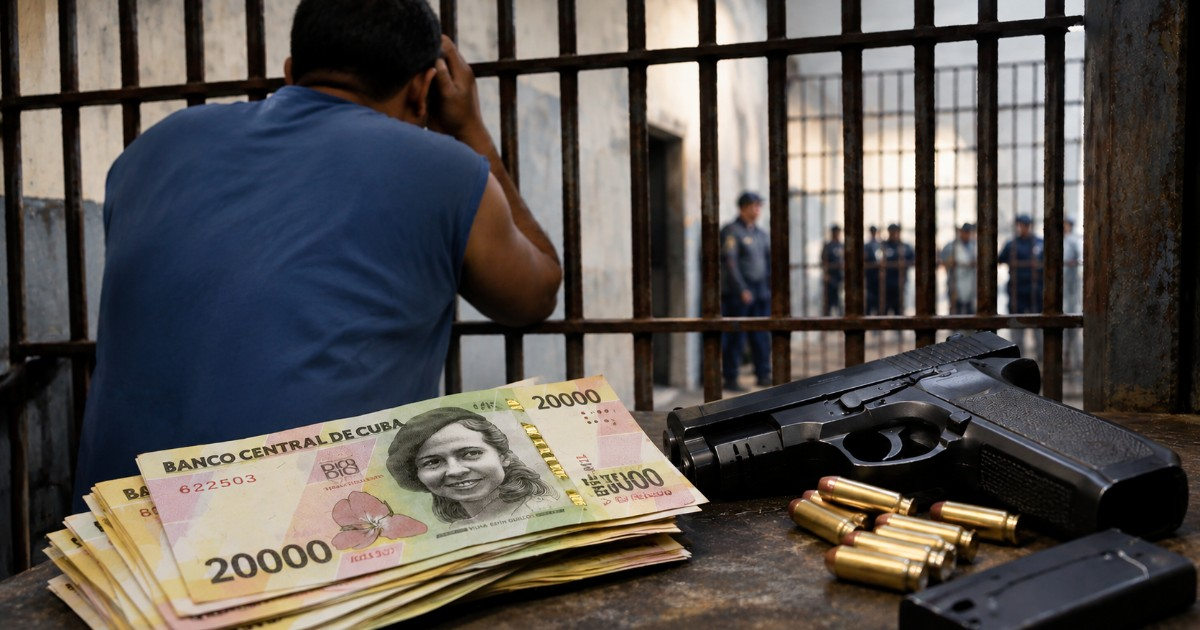
Families of prisoners in Cuba are reportedly purchasing firearms on the black market for between 130,000 and 180,000 Cuban pesos, handing them over to prison officials in hopes of securing sentence reductions, transfers, or regime changes. These transactions occur without any assurance that the deals will be honored, according to a report by the human rights organization Cubalex released in late October.
The report, based on testimonies from 13 prisons and forced labor camps across six provinces, highlights the desperate measures taken by families. The cost of a pistol on the black market is equivalent to 20 to 28 months of the average Cuban salary, which is approximately 6,500 pesos.
This financial burden forces many families to sell their most valuable possessions. Eliober Sosa, a former prison re-educator interviewed by Cubalex, recounted instances where relatives have sold their homes or cars in an attempt to free an imprisoned family member.
Laritza Diversent, director of Cubalex, shared the story of a mother who had already sold her refrigerator and other appliances and was considering buying a weapon to secure her son's release. This practice, informally known as "The Agreement" within prison circles, lacks any legal foundation.
Legal and Ethical Concerns
Decree-Law 74/2023, which governs prison benefits, provides for sentence reductions of up to 60 days per year, with an additional 60 days in exceptional circumstances. However, it does not include the exchange of firearms as a condition. This illegal scheme can backfire, warned Julio Ferrer Tamayo, a jurist and former political prisoner. Authorities might use the weapon exchange to arrest the family member for possession while failing to deliver on promises of prisoner benefits.
Juan Luis Bravo Rodríguez recounted to Cubalex that prisoners who were transferred from Havana to Guantánamo and later offered benefits after delivering weapons sometimes regained their freedom, choosing to stay in provinces where they were unknown.
Potential for Corruption
Cubalex suggests a circular business model where weapons provided by families might be resold in the illegal market by the very officials receiving them. The report cites a 2024 ruling by the Military Tribunal of the Havana Region, where an officer was convicted of stealing six Makarov pistols from his unit, and four civilians were sentenced for purchasing and reselling them.
The investigation implicates officials from the Ministry of Interior, prison authorities, investigative agents, prison directors, and, in some cases, prosecutors and Communist Party officials. Cubalex argues that this practice could infringe upon the Penal Code’s provisions on illicit arms trafficking, leading to charges of corruption, abuse of power, and concealment.
Broader Context of Structural Corruption
This pattern is part of a broader issue of structural corruption documented by Cubalex. In September 2026, the organization released a report noting 115 deaths in custody in Cuban prisons from February 2024 to June 2026.
Earlier, in August, 11J political prisoner Fernando Michael Bárzaga Mompié revealed that in Granma prisons, "discipline monitors" control access to medical care, food, and communication, with transfers and benefits going to the highest bidder.
The Cuban regime has remained silent regarding the allegations contained in the report "State Business: Arms and Prison Benefits in Cuban Prisons."
Understanding the Implications of Illegal Arms Trade in Cuban Prisons
What is the average cost of a black market pistol in Cuba?
A black market pistol in Cuba costs between 130,000 and 180,000 Cuban pesos, equating to 20 to 28 months of the average Cuban salary.
What potential risks do families face when engaging in these illegal exchanges?
Families face the risk of arrest for possession of illegal weapons, while prisoners may not receive the promised benefits due to a lack of formal agreements.
How does this practice relate to structural corruption in Cuba?
This illegal arms exchange is part of a larger pattern of corruption, with officials possibly recycling weapons back into the black market and exploiting prisoners and their families for financial gain.