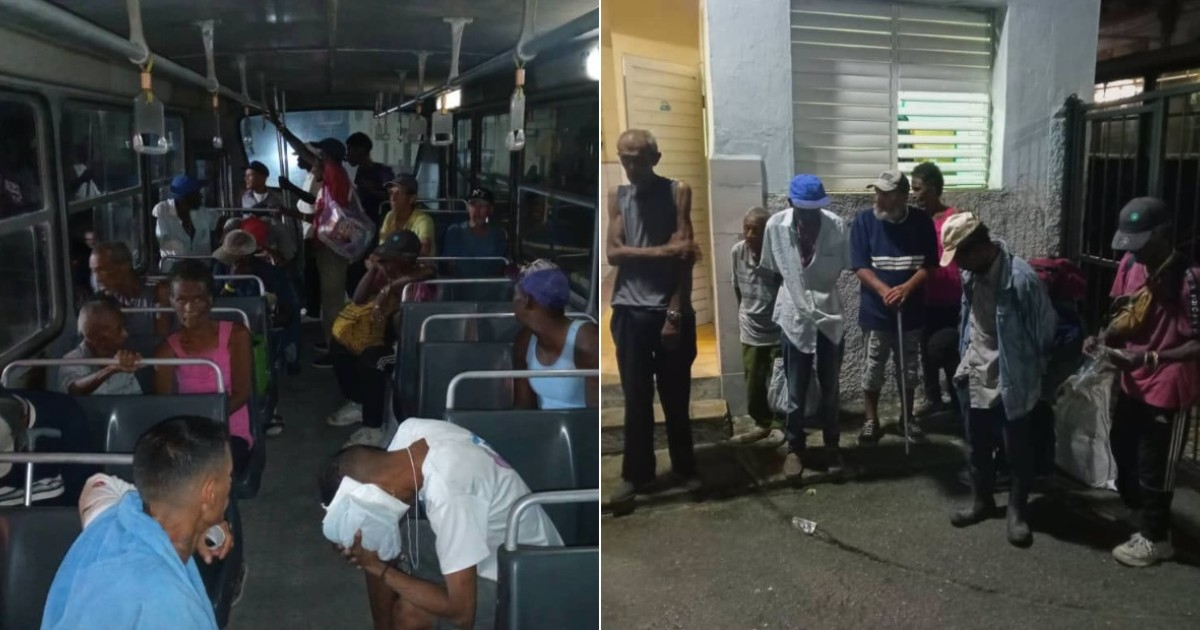
In a controversial move, the Revolutionary National Police (PNR) and the local government of Centro Habana carried out a sweeping operation in key streets of the capital, such as Galiano, Reina, Belascoaín, and Infanta. This effort targeted homeless individuals under the guise of a "sanitation" initiative, as reported by Habana Noticias, a publication with close ties to the government and police forces.
According to social media updates from Habana Noticias, the operation identified numerous homeless people, referred to as "wanderers" in official jargon, who were accused of carrying "useless objects" and allegedly "tarnishing the city's image." The individuals were subsequently taken to unspecified "care facilities for people in such conditions," though details about these centers and their conditions remain vague.
Summarizing the day's events with the phrase "clean streets, beautiful neighborhood, and properly attended people," Habana Noticias failed to provide the exact date of the operation or the number of individuals relocated.
Among those rounded up were likely Cubans from other provinces who live in Havana without official housing or residency permits. These individuals are often labeled as "illegal" by authorities, facing potential detention and forced return to their provinces of origin.
Background of the Recent Crackdown
This recent operation is part of a series of similar actions in Havana over the past few weeks. Earlier in November, a MININT operation in San Miguel del Padrón resulted in 71 detainees, including individuals from other provinces deemed "undocumented and illegal in the capital."
Journalist Yoani Sánchez reported hearing frequent references to "illegals" and "deportation" during nearly nine hours of detention at a police station in Cerro. She described the forced relocation of people without registered addresses in Havana back to their home provinces.
Activist Rolando Fidel Pérez Lora, known as "Pregonero de Cristo," was forcibly deported from Havana to Las Tunas last Friday, according to activist reports.
Legal and Social Implications
These actions are justified under Decree-Law 217 of 1997, which mandates administrative authorization for residency in the capital and permits the return of individuals lacking such permissions to their home provinces. Many affected are from eastern provinces, migrating to Havana in search of better conditions.
In April 2025, the regime established a state protocol to manage homelessness through mixed teams of social workers, healthcare personnel, and police, with a specific focus on returning wanderers to their provinces of origin.
The homelessness crisis in Cuba mirrors a severe societal collapse. Data from the Ministry of Labor and Social Security reveals that the number of homeless individuals surged from 1,100 in 2012 to 3,690 by 2023. The situation has worsened by 2026, with the Cuban Observatory for Human Rights estimating that 94% of surveyed Cubans live in extreme poverty, and seniors over 70 comprise 44% of the homeless population.
Historical Context and Criticism
The practice of rounding up homeless individuals ahead of significant events or dates is well-documented. In December 2019, Cuban police collected homeless people in Havana just before International Human Rights Day, using dogs and forcing them onto buses. Activist Modesto Hernández criticized the move as a "farce," noting that "the Government only pays attention to the homeless when expecting a visit from foreign dignitaries or on notable dates."
Frequently Asked Questions About Homelessness in Cuba
What is Decree-Law 217 of 1997?
Decree-Law 217 of 1997 requires administrative approval for residency in Havana and allows authorities to return individuals to their home provinces if they lack such authorization.
How has the homeless population changed in Cuba in recent years?
The number of homeless individuals in Cuba has tripled from 1,100 in 2012 to 3,690 by 2023, with a significant increase in elderly individuals among this population.
Why are there so many homeless people in Havana from other provinces?
Many individuals from eastern provinces move to Havana seeking better living conditions, as these areas often suffer from even more dire economic circumstances.