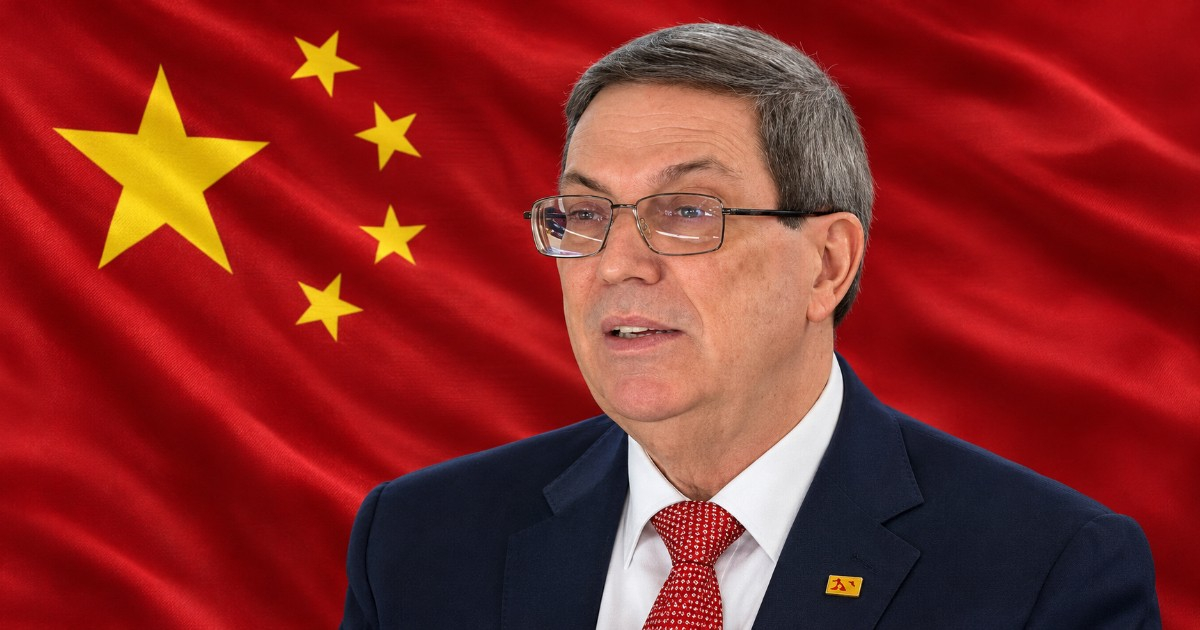
On Tuesday, Cuban Foreign Minister Bruno Rodríguez Parrilla began an official visit to the People's Republic of China, which will last until November 13. He is acting as a special envoy for the Cuban Communist Party and government, as confirmed by Chinese Foreign Ministry spokesperson Guo Jiakun on Monday.
The Cuban Ministry of Foreign Affairs (MINREX) reaffirmed the visit through an official statement on social media, indicating that Rodríguez, a member of the Political Bureau of the Central Committee of the Communist Party of Cuba (PCC), will engage in "official talks with high-ranking Chinese officials." However, no specific agenda or agreements have been disclosed.
The designation of "special envoy" suggests that Rodríguez carries a direct message from Miguel Díaz-Canel to Xi Jinping, and the lack of detailed plans indicates that the trip involves high-level political discussions beyond routine diplomacy.
Guo Jiakun characterized the bilateral relations with the usual rhetoric of the Chinese regime: "China and Cuba are good friends, good comrades, and good brothers," emphasizing that the visit underscores "the high level of mutual political trust between the two countries." He added that Beijing is eager to "enhance coordination" and "continue building a China-Cuba community with a shared future."
Recent Diplomatic Activity Amidst Tension
This marks Rodríguez's second visit to China in 2026. Earlier in February, he traveled to Beijing on an unannounced tour, where he met with Foreign Minister Wang Yi and Chinese Communist Party officials, later returning via Madrid to meet with Spanish Foreign Minister José Manuel Albares. In March, he held a phone conversation with Wang Yi to reaffirm bilateral commitments.
The timing of this visit is particularly sensitive: just five days prior, the U.S. Department of State imposed sanctions on two Chinese state-owned companies—China National Electronics Import and Export Corporation (CEIEC) and Beijing H&C Technologies—for providing surveillance technology and military components to the Cuban Ministry of the Revolutionary Armed Forces (MINFAR) through the entity Duna S.A.
Beijing denounced these sanctions, calling them an attempt to "sabotage" bilateral cooperation. Rodríguez himself reacted on social media, condemning them as a "sickening policy of economic strangulation" and accusing Washington of attempting to "obstruct and sabotage the existing strategic, multifaceted, and legitimate cooperation between China and Cuba."
The Urgency of China's Support
Rodríguez's diplomatic engagements have been intense. In October, he repeatedly interrupted U.S. Ambassador Mike Waltz during the UN debate on the embargo. Earlier this month, he led the Cuban delegation at the Ibero-American Summit in Madrid in place of Díaz-Canel, where he denounced the sanctions as "collective punishment." Now, he heads to Beijing.
The Cuban regime's expectations from China contrast with what it has received so far. The concrete aid—$80 million in emergency funds approved by Xi in January, 60,000 tons of rice with the last shipment arriving this Tuesday, solar panels, and bus parts—proves inadequate given the scale of the crisis.
Cuba is facing its worst energy crisis of the year: electricity availability meets only 38% of demand, some areas experience blackouts exceeding 20 hours a day, and the island has suffered at least eight national grid collapses in 2026. The regime relies on imports to cover about 60,000 barrels of oil daily, which it does not produce domestically. According to Russian sources, Cuba has "barely imported fuel" since August.
Beijing has not committed to direct oil supply or a formal renegotiation of bilateral debt, describing its support as "within its capabilities," reflecting China's caution against the risk of secondary sanctions from Washington. The outcome of Rodríguez's negotiations will determine if Chinese assistance goes beyond symbolic gestures to provide the urgent support the dictatorship desperately needs.
Understanding China's Role in Cuba's Crisis
What is the purpose of Bruno Rodríguez's visit to China?
Bruno Rodríguez's visit to China aims to engage in high-level political discussions as a special envoy carrying a message from Miguel Díaz-Canel to Xi Jinping, seeking support amidst Cuba's severe crisis.
How has China responded to U.S. sanctions on its companies?
China has denounced the U.S. sanctions on its companies as an attempt to sabotage bilateral cooperation, emphasizing its commitment to its relationship with Cuba.
What challenges does Cuba face in its energy sector?
Cuba is experiencing its worst energy crisis, with electricity covering only 38% of demand, frequent long blackouts, and a significant reliance on imported oil.