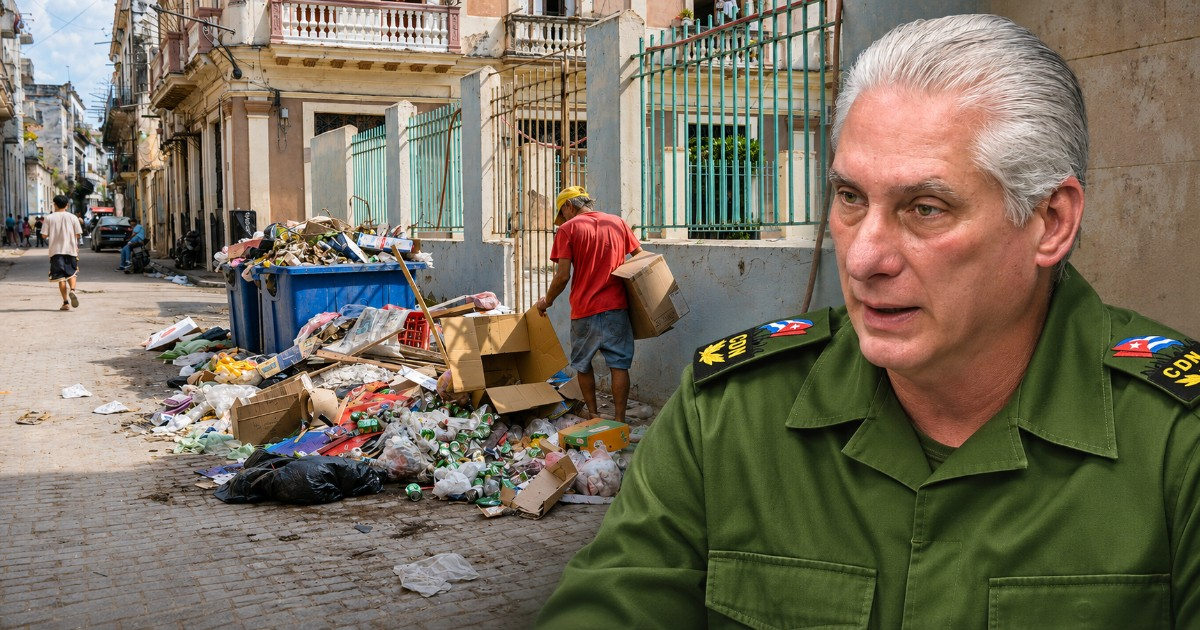
In a recent statement, Miguel Díaz-Canel asserted that "Cuba's future will never be decided by the North," sparking a wave of criticism from Cubans who turned his words against his own government. The public demanded free elections and highlighted the ongoing crisis they endure daily.
Díaz-Canel's comments came in response to remarks by former President Donald Trump, who labeled Cuba a "failed nation" and predicted its imminent downfall. U.S. Secretary of State Marco Rubio, speaking at the G7 foreign ministers' meeting in Paris, emphasized Washington's commitment to fostering political and economic change on the island. Díaz-Canel condemned U.S. energy restrictions as a "criminal fuel blockade" and "collective punishment" against the Cuban people, accusing the U.S. of justifying its policies with "ridiculous lies."
The Cuban public's response was unequivocal. The most common demand was for free, multiparty elections with a direct vote for the president, a position not currently provided for in Cuba's Constitution.
"Cubans should determine their future at the ballot box, with opposition and fair elections, exercising their rights freely," one commenter wrote.
Another was more blunt: "What future? You have left no future behind!"
Many Cubans used Díaz-Canel's own words against his administration. "Two very true phrases from the statement: 'It is perverse not to take responsibility' and 'The lies are increasingly ridiculous,'" one critic remarked, applying them to the regime's management.
The contradiction between the rhetoric of sovereignty and external dependency was also a target of criticism: "We rely on the United States for food, Venezuela for electricity, Chinese charity to keep equipment running, and the Russians for anything else. I don't see sovereignty in that, Limoncín."
The island's energy crisis served as a backdrop for many reactions. In early November, Cuba's Electric Union was only meeting 38% of national demand, with circuits in Havana experiencing over 52 consecutive hours without power.
"It's perverse to go 21 hours a day without electricity," one user responded.
Another sarcastically added: "Poor thing, he's also been without power for 24 hours and is waiting to see if the water comes today after six days without it."
Material shortages surfaced in numerous comments: lack of medicines in pharmacies, food spoiling due to outages, and skyrocketing prices. "Stop looking north so much and look down here, soap is already 700 pesos, we're going to die," one Cuban lamented.
The divide between leaders and the governed was another recurring theme: "Let the leaders live like the people and then tell me if they 'bend' or not. Living as you do, I would be willing to 'resist' for a hundred years."
Some questioned the historical legitimacy invoked by Díaz-Canel when mentioning January 1, 1959: "I didn't know that there were general elections in Cuba on January 1, 1959."
The pattern is familiar: throughout 2026, each of Díaz-Canel's anti-imperialist rhetoric has been met with similar criticism, from comments on sanctions and wage increases to National Defense Day, where Cubans summed up their rejection with a phrase: "The war is not for all the people. The war is yours."
"The American people are not going hungry; Cubans are. That's the big difference. Keep resisting, and you'll end up without a people," concluded one of the most cited commenters in the thread.
Understanding Cuba's Political Climate
What did Díaz-Canel mean by "Cuba's future will never be decided by the North"?
Díaz-Canel's statement suggests that he believes Cuba should maintain sovereignty and not succumb to foreign influence, particularly from the United States.
Why are Cubans demanding free elections?
Cubans are calling for free elections as a way to exercise their democratic rights and have a direct say in their leadership, which contrasts with the current political system in Cuba.
What are the main criticisms of Díaz-Canel's government?
Critics of Díaz-Canel's government point to the lack of political freedom, economic hardship, and the contradictions between the government's statements on sovereignty and its reliance on foreign aid.