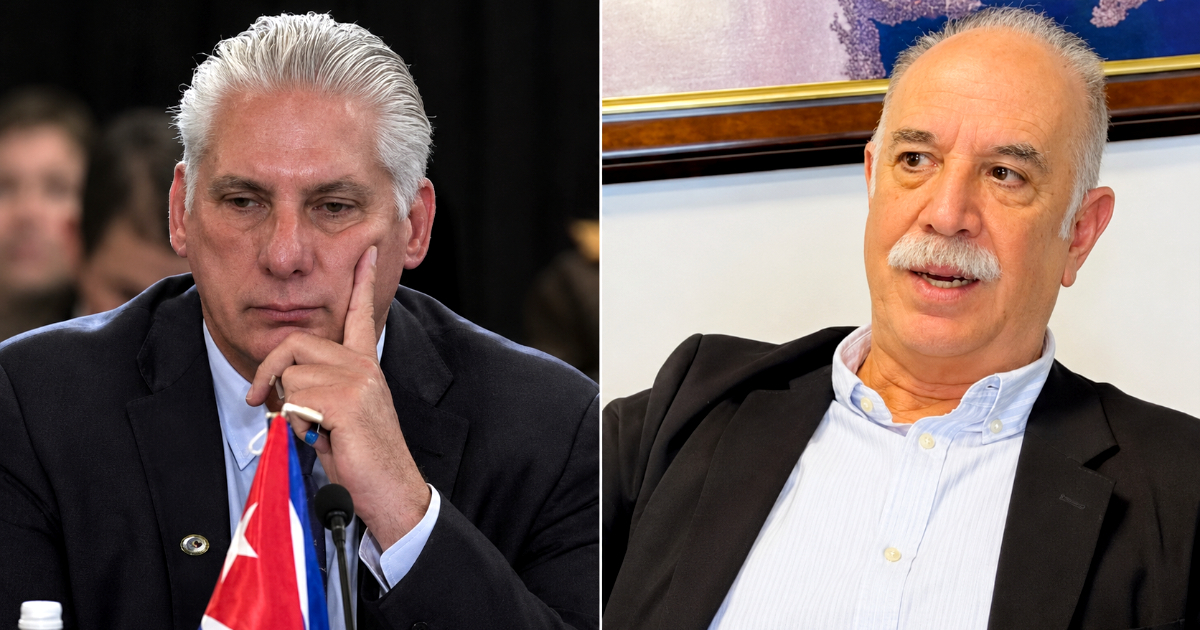
Cuban economist Pedro Monreal made an unexpected political move this Sunday by advocating for a democratic state in Cuba. In a detailed article, he dismisses the arguments that compare the island's situation to the flawed democracies of Latin America, emphasizing the need for democratic reform.
The piece, titled "The Democratic State of Law in Cuba and the Pessimism of Comparing with the Imperfect," was shared on his X account (@pmmonreal) and on his Substack platform. Followers of Monreal are accustomed to his focus on technical issues like inflation, wages, monetary policy, and state enterprises. Thus, this article marks a significant departure from his usual discourse.
A Shift from Technical Analysis to Political Commentary
Monreal's main assertion is straightforward: "I once again hear criticism of those who propose economic transformations envisioning a democratic state of law in Cuba. The critique argues it's pointless to promote this because democratic governments in Latin America fail. This is an analytical and priority error."
He clearly draws a line between the challenges faced by Latin American countries—such as corruption, populism, and inequality—and those uniquely experienced in Cuba: "the constitutional monopoly of a single party, the complete absence of electoral competition, and the systematic repression of peaceful political dissent for over six decades."
To Monreal, using the former to avoid discussing the latter is akin to "wallowing in the pessimism of comparing with the imperfect."
Questioning the 'Socialist State of Law'
Monreal critically dissects the official concept of a "socialist state of law," a term enshrined in the 2019 Constitution that defines the Communist Party of Cuba as "the superior political force guiding society and the state." He argues that this is merely a rhetorical device used to maintain power rather than limit it.
From this structural foundation, Monreal extends his critique to the package of 176 measures approved by the National Assembly in June 2026. Previously described by him as a "monster" or "misshapen hybrid," these measures incorporate market elements without fully recognizing private property.
He suggests that such policies reflect a recurring pattern of grand plans—such as "ordering," model updates, and distortion corrections—designed by the central political party. When these plans fail, there are no significant consequences for those in power.
The Call for True Political Reform
Monreal concludes that no economic reform can succeed without altering the political framework: "Without institutional opposition and judicial independence, there's no pressure to reconsider the principle of standing above everything. The result is a series of ambitious plans that exacerbate poverty and decline without the political actor responsible losing the ability to continue making decisions."
Monreal's article aligns with his role as one of the five authors of the "Cuba Transformation" project—a 120-page proposal co-authored with Mauricio de Miranda Parrondo, Omar Everleny Pérez Villanueva, Ricardo Torres Pérez, and Pavel Vidal Alejandro, and supported by the Cuba Study Group and the Cuban Economy Observatory.
This roadmap advocates replacing the centralized model with a social market economy linked to a democratic state of law, explicitly rejecting the Chinese or Vietnamese models of economic reform without equivalent political democratization.
"What exactly is negative," Monreal asks, "about having sovereignty reside in the people instead of the PCC, in terms of democratic principles and institutional efficiency?"
He extends this inquiry to other issues: what's wrong "with parties representing citizens without holding power or appropriating the state?"
What's wrong "with exercising power through temporary mandates obtained in free and multiparty elections?" Or with ensuring "that no majority decision can suppress dignity, equality before the law, or the guarantees protecting minorities?"
Finally, what's wrong "with inalienable freedoms not being government concessions, but rights the power cannot abolish (although it may regulate their exercise), including freedom of thought, conscience, religion, opinion, expression, information dissemination, academic freedom, peaceful assembly, association (including parties, unions, and civil organizations), and the right to due process, defense, and an independent and impartial judge?"
Monreal ends with a direct challenge to those opposing democratization:
"Cuba systematically fails to meet these criteria. It would be beneficial for this to be clearly expressed if any of the above-listed items are harmful to citizen welfare, national sovereignty, and development. Let's address these first, then we can discuss historical experiences in Latin America and elsewhere."
Understanding Pedro Monreal's Vision for Cuba
What is Pedro Monreal's stance on Cuba's current political system?
Pedro Monreal advocates for a democratic state of law in Cuba and criticizes the current single-party system that lacks electoral competition and represses political dissent.
What does Monreal propose as an alternative to the current Cuban model?
Monreal suggests replacing the centralized model with a social market economy tied to a democratic state of law, rejecting models like those of China or Vietnam that implement economic reforms without political democratization.
Why does Monreal criticize the 176 measures approved by the National Assembly?
He criticizes these measures for incorporating market elements without fully recognizing private property rights, indicating a pattern of failed plans designed by the central political party without consequences for those in power.
How does Monreal address the comparison between Cuba and Latin America's democracies?
Monreal argues that comparing Cuba to the flawed democracies of Latin America is an analytical error. He emphasizes the unique issues in Cuba, such as its single-party system and lack of electoral competition, that aren't present in those democracies.