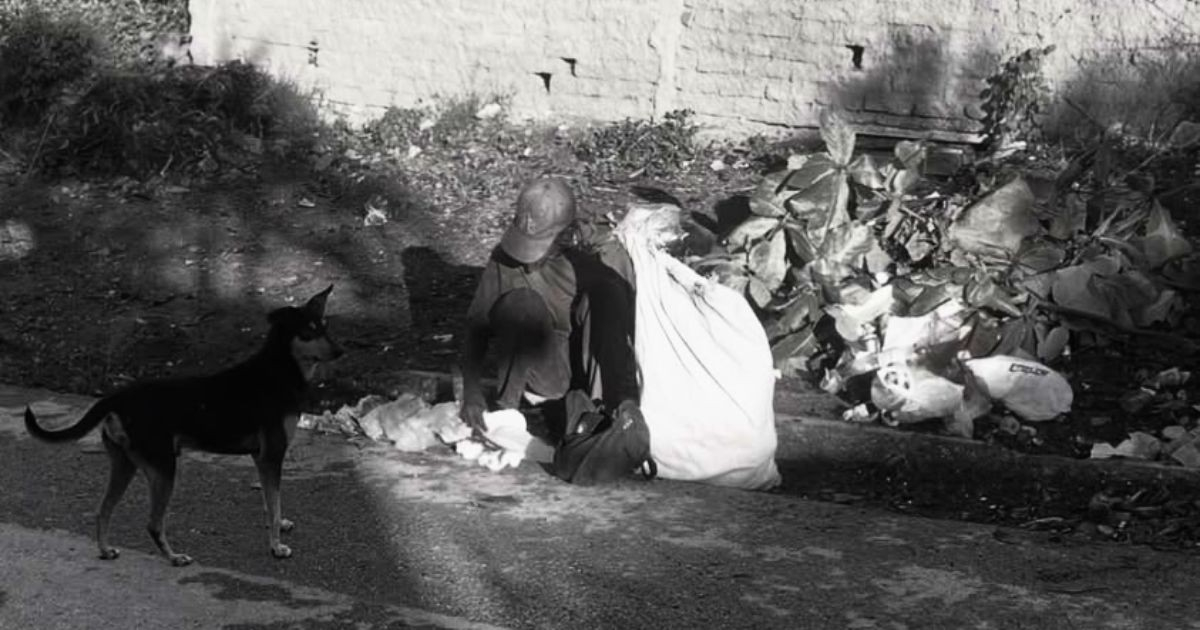
On Sunday, legal scholar and professor René Fidel González García, based in Santiago de Cuba, shared a thought-provoking piece titled "The Hunger, the Man, and the Little Dog." In it, he highlights the stark divide between the privileged few and the impoverished majority in Cuba, describing it as a "vicious cycle of inequality."
The article is accompanied by a poignant black-and-white photo showing a person scavenging through trash alongside a black dog, an image the author uses to symbolize the deep-seated social crisis he discusses.
The Erosion of State Responsibilities
González García, who holds a Ph.D. in Legal Sciences and previously served as a professor at the University of Oriente, identifies two key aspects of this issue: the deterioration of state functions that should ensure citizens' economic, social, and cultural rights, and the exclusive grip on political power by a select elite.
In his examination, the jurist points to the rise of "a new social class, subservient to the elite controlling power in Cuba." This class acts as a barrier to political equality, democratization, and the rule of law, maintained through "the machinations and levers that corruption and lack of transparency in the Cuban political system offer in exchange for its obedience and subordination."
The State's Diminishing Assets
He further warns that state assets are being "deliberately reduced, dismantled, neglected, and privatized," while power struggles over positions with significant discretionary power mirror contests over contracts, funding, and impunity. This process, he asserts, is neither "insignificant nor apolitical."
González García's Continued Critique
This publication is part of a series of critical statements González García has made throughout 2026. In August, he introduced the concept of "political indigence" to describe the exclusion of the majority. By October, he cautioned that "we no longer have time to waste."
After publishing critical articles in independent media, González García was dismissed from his teaching position at the University of Oriente in November 2016, an action he and human rights organizations condemned as political retaliation.
The article emerges amidst an unprecedented social crisis. In August 2026, the Cuban Observatory of Human Rights estimated, based on 1,318 interviews across 79 municipalities, that 94% of Cubans live in extreme poverty, up five percentage points from 2025.
The accompanying image resonates with other recent documented scenes. Independent journalist José L. Tan Estrada shared a photo on Saturday of an elderly man sitting alone in a garbage dump in Camagüey. "Behind this image is more than accumulated dirt. There's poverty, vulnerability, institutional neglect, and people surviving in conditions no human should endure," wrote Tan Estrada.
Government Acknowledgment and Ongoing Challenges
Prime Minister Manuel Marrero Cruz acknowledged the existence of 876,522 people in highly vulnerable situations, a figure presented during the review of 176 economic transformations approved in June 2026. Analysts caution that this package may primarily benefit officials and entrepreneurs with privileged ties, deepening the divide González García criticizes.
González García concludes his reflection with a stark warning: "All of this is a pit, sticky and foul-smelling, growing deeper and more dangerous each day, placed directly before the walls that citizens must tear down in Cuba to achieve political equality and fulfillment, and to have a chance to decide our happiness and fate."
Understanding Cuba's Social Inequality
What does René Fidel González García mean by "vicious cycle of inequality" in Cuba?
He refers to the entrenched disparity where a small elite controls political power, while the majority remains impoverished and excluded from economic, social, and cultural rights, perpetuating ongoing inequality.
How does González García view the role of the new social class in Cuba?
He views this new class as subservient to the elite, blocking political equality and democratization, sustained by corruption and lack of transparency in the Cuban political system.
What are the implications of the state's asset reduction in Cuba?
The deliberate reduction and privatization of state assets lead to increased power struggles and disparities, benefiting those with privileged connections, while exacerbating inequality and social tension.