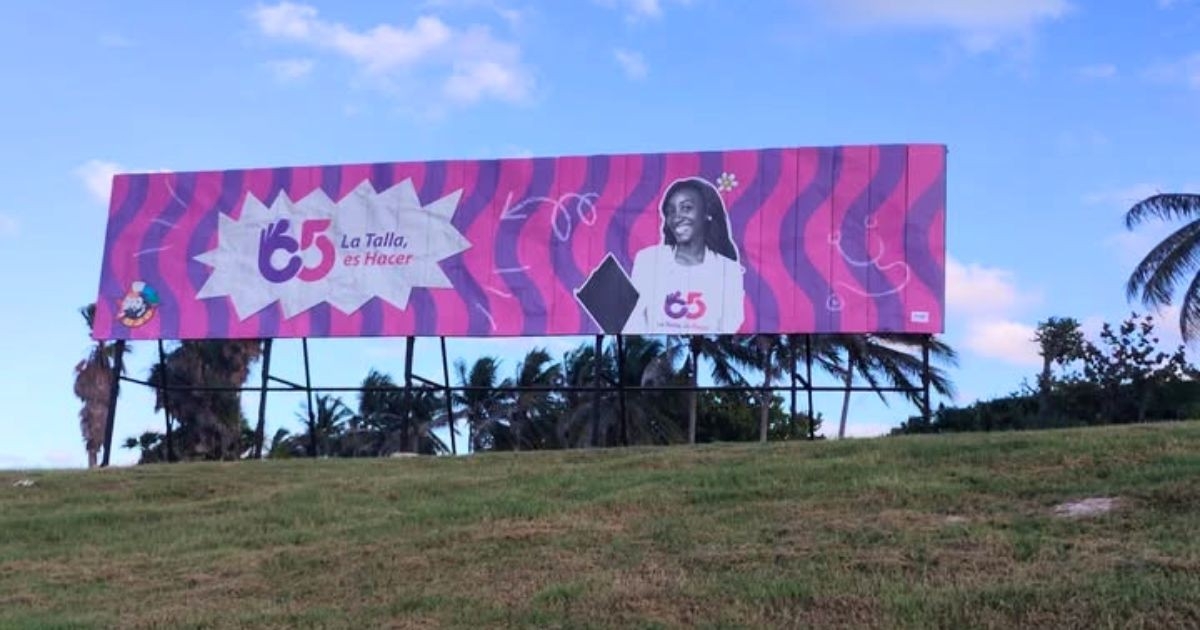
The Cuban Communist Youth Union (UJC) recently unveiled a series of billboards throughout Havana bearing the slogan "The Real Deal is Doing," as part of their 65th-anniversary celebrations. However, the reaction on social media was far from what they anticipated, as their Facebook post was overwhelmed by a deluge of sarcasm, irony, and challenging questions.
The billboards, featuring a design in bright pink and purple hues with the image of a smiling young woman and the stylized number 65, invite the public to engage: "When you come across one, snap a photo and share it with us!" the UJC encouraged.
These signs are a component of the activities marking the UJC's 65th anniversary celebration, slated for April 4, 2027. The slogan was officially launched on October 21 at Mariana Grajales Park in Havana's Plaza de la Revolución, accompanied by book fairs, health, employment, and trade expos. Meyvis Estévez Echevarría, the organization's national first secretary, also promoted the campaign in Las Tunas, urging young people to join the Community Youth Network.
Yet, the official enthusiasm quickly collided with reality. Online users wasted no time in reinterpreting the slogan. One commented, "The real deal is they should leave! Or be kicked out!" Another questioned, "Are there any young people left in Cuba?" A third critic pointed out the disparity: "There's money for propaganda, but not for school repairs. Is it the embargo? Young people with differing views are still Cuban youth."
Questions regarding the financial resources allocated for the billboards surfaced repeatedly across numerous comments. One user asked, "How many children could have had breakfast with the cost of that sign?" Another was more blunt: "You should be providing power, not billboards." A further comment encapsulated the general sentiment with a suggestion: "Why not celebrate by doing something productive? If you are truly the future, start now by ditching propaganda and doing more for the people."
The campaign's launch comes at a particularly challenging time for the Cuban regime. The nation has experienced eight nationwide blackouts in 2026 alone, with some areas enduring up to 90 consecutive hours without electricity.
The Economic Commission for Latin America and the Caribbean (CEPAL) has forecasted a 10.3% contraction of Cuba's GDP in 2026, the steepest in Latin America. In such a context, the irony of spending on propaganda while essentials like medicine, food, and electricity are scarce did not go unnoticed: "There's always money for this," one person noted. Another questioned, "Is there fuel to transport those billboards?"
The disconnect between official rhetoric and the reality faced by Cuban youth is starkly evident in the numbers. The UJC's membership dropped by over 194,000 between 2007 and 2024, from 609,000 to 415,000 members, a 32% decline acknowledged at the organization's XII Congress. In 2025 alone, Cuba saw a net migration loss of 245,264 individuals, predominantly those under 35.
"Cuban youth remain steadfast in defending the homeland," the political organization's post declared on Saturday. Yet, the social media response delivered a sharp counter: "So steadfast that half have left, and the rest stay only because they can't leave," remarked one user critically.
Understanding the Backlash to UJC's Billboard Campaign
What was the UJC's intention with the billboard campaign?
The UJC aimed to celebrate their 65th anniversary by engaging young Cubans with the slogan "The Real Deal is Doing," featured on billboards across Havana.
How did social media users react to the UJC's campaign?
The campaign was met with irony and sarcasm, with many users criticizing the UJC for spending on propaganda instead of addressing pressing issues like power outages and lack of resources.
Why is the timing of this campaign considered problematic?
The campaign coincides with severe economic challenges in Cuba, including prolonged power outages and a projected GDP contraction, raising questions about the priorities of the regime.
What statistics highlight the disconnect between the UJC and Cuban youth?
Since 2007, the UJC has seen a 32% decline in membership, and significant net migration losses among young people, indicating a growing disillusionment with the current regime.