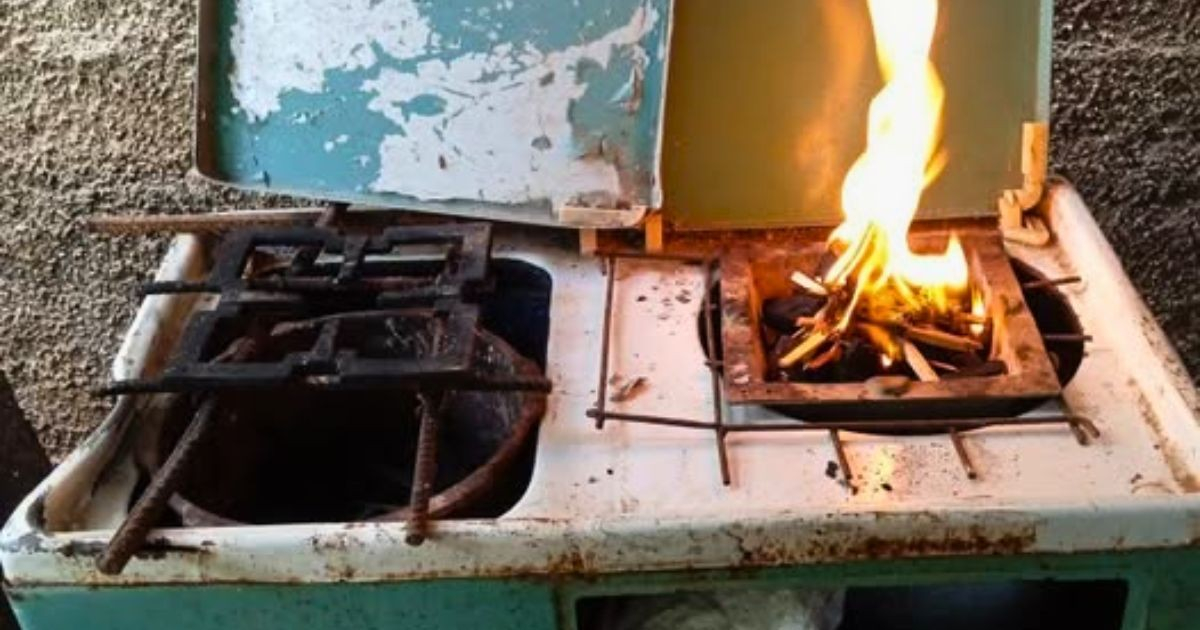
A Soviet-era Aurika washing machine—green, rusted, with peeling paint and an open lid—unexpectedly became a social media sensation in Cuba last Saturday. This came after Cuba Denuncia Now shared an image of the appliance repurposed into a multifunctional wood and charcoal stove, accompanied by the caption: "Creative resistance at its peak, Russian washing machine turned into a wood and charcoal stove, now the Americans are truly stunned."
The timestamp on the camera indicates that the photo was taken at 12:49 PM on Saturday, November 7, and it hit the social networks just hours later. The image shows the machine propped against a wall of rough gray cement, with a vibrant flame flickering on the right burner—fed by wood and branches—while the left burner sits empty and sooty. There's no gas, no electricity: just ingenuity and fire.
The Aurika machines arrived in Cuba during the mid-1970s as part of the cooperative efforts between Havana and Moscow. Their robust construction has allowed them to outlast the fall of the Soviet Union by decades. During the Special Period, many of these machines had their motors converted into homemade fans, and their metal casings were used for unexpected purposes. The viral image from this weekend is merely the latest chapter in the ongoing saga of Cuban inventiveness in the face of an energy crisis.
Resourcefulness Born Out of Necessity
The background of this transformation is far from humorous: In late September 2026, CUPET announced a new interruption in the supply of manufactured gas affecting seven municipalities in Havana, due to a pipeline failure that cut off raw materials to production plants. This disruption added to the existing energy supply issues in Cuba, including previous suspensions of liquefied gas distribution due to product shortages in several provinces.
In response, Cubans have been creatively repurposing rice cookers, empty fire extinguishers, and metal tanks into makeshift stoves. The multifunctional Aurika is a spectacular—and viral—example of this string of forced improvisations brought on by the decades-long structural scarcity plaguing the island.
Viral Reactions and Historical Context
Reactions ranged from genuine admiration to sharp irony and barely contained indignation. "A blazing innovation. You can't beat the Cuban spirit," one user commented. Another responded more succinctly and sharply: "Surviving the revolution, but it's all the blockade's fault."
Some praised the Aurika's versatility: "These Aurikas are the best, they've been used for so many things... take that, LG, Daitron, Yamaha, and all the modern washing machines, haha." Others even joked about NASA: "If NASA gets hold of this!!!!!"
Many took the opportunity to highlight Cuba's history of survival inventiveness. "The movement of innovators and rationalizers is still alive," one noted. "In the Special Period, there was a lot more of this. Condom pizzas, plant leaf soap, floor rag steaks... soy picadillo, cerelac, and meat paste were inventions of that era. They almost killed us," they added with a crying emoji summarizing the sentiment.
The fact that a Soviet washing machine has been repurposed into a wood stove in 2026 speaks volumes about the depth of the Cuban energy crisis, and very little about the supposed achievements the regime continues to boast.
Understanding Cuba's Energy Crisis and Innovation
What led to the transformation of the washing machine into a stove?
The transformation was driven by ongoing energy shortages in Cuba, exacerbated by a recent pipeline failure that disrupted gas supplies to several areas.
How have Cubans historically coped with resource scarcity?
Cubans have a long history of repurposing everyday items to overcome resource shortages, especially during the Special Period, when creativity in using available materials was essential for survival.
What does the viral image of the washing machine stove signify?
The image highlights the extreme measures Cubans take due to persistent shortages, reflecting both their resilience and the severity of the ongoing energy crisis.