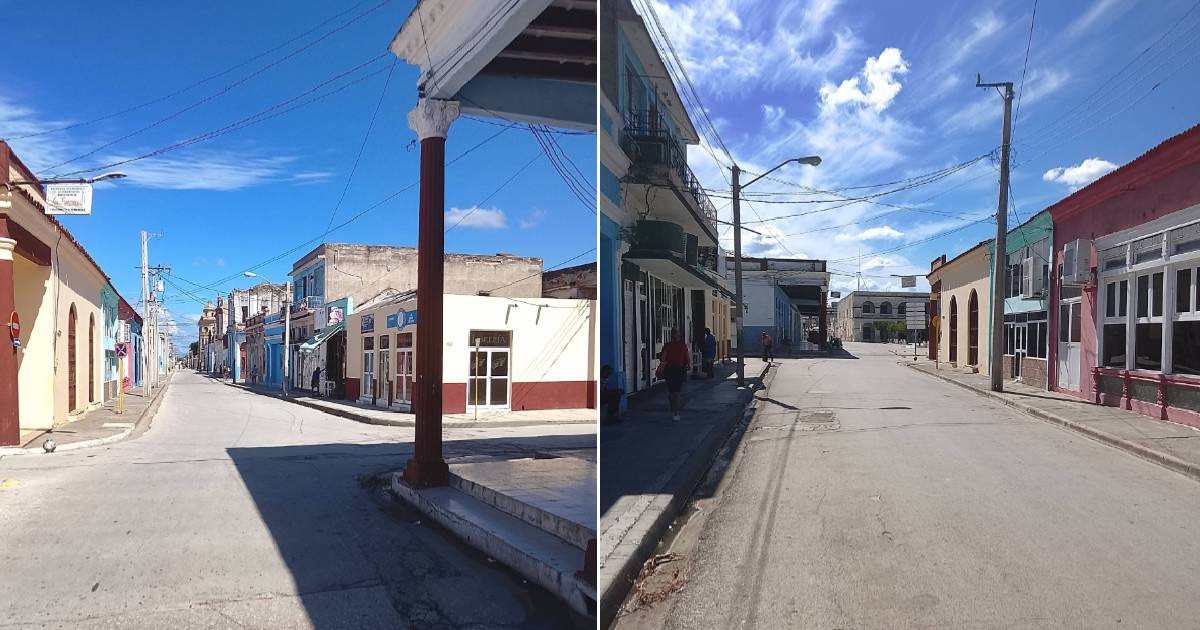
Recent images shared on social media platforms highlight the stark emptiness of Manzanillo's streets in the Granma province. This noticeable quietness contrasts sharply with the bustling activity that once defined the city, sparking concern among its residents.
"There used to be a constant buzz of people at all hours, but now the streets are deserted no matter the time," expressed the author of a post on the Facebook page "vivencias." After being away from his hometown for two years, he returned to find a striking transformation, as he admitted in earlier posts.
The photographs reveal colonial-style avenues with few pedestrians, dilapidated buildings, and poorly maintained roads. This stark difference was also documented in June by a local named Claudia Manzanillo. As part of her series "Caminando mi tierra," she explored the city and found streets devoid of cars and people, piles of debris, accumulated garbage, and a drain leaking dirty water.
"There was a time when this area was known for its vibrancy, family gatherings, the life you found on every corner... Today, the silence is what stands out the most," she described in a video that stirred reactions from Cubans both on and off the island.
Widespread Silence Across Cuba
Similar scenes have emerged in recent months in various locations across Cuba, including Limonar in Matanzas, Trinidad in Sancti Spíritus, El Vedado in Havana, and Gibara in Holguín.
This phenomenon is symptomatic of a severe demographic crisis. According to the National Office of Statistics and Information (ONEI), Cuba's population decreased from 11,113,215 in 2022 to 9,434,593 by the end of 2025, amounting to a staggering loss of over 1.67 million people in just three years.
Demographic and Economic Challenges
The net external migration figure for 2025 was -245,264 people, with 317,320 leaving the country. Between 70% and 80% of those emigrating are under 40, while 26.7% of the remaining population is over 60.
Manzanillo, too, has seen a significant decline in its population. From approximately 123,610 residents in 2021, projections indicate a drop to around 105,610 by 2026, a decrease of roughly 14.6% over five years.
In addition to emigration, everyday life is hampered by challenging living conditions. In October, parts of Manzanillo had gone up to 22 months without a regular water supply.
In September 2025, residents of the Gutiérrez neighborhood confronted Government Vice President Inés María Chapman during an official visit, voicing their grievances about service disruptions that also affected the local hospital.
With power outages lasting 20 hours a day and gasoline prices soaring to 4,000 pesos per liter, mobility is severely restricted, exacerbating the hardships faced by families.
"These images have a profound impact on those who grew up here. They’re not just seeing a street; they're comparing cherished memories with the harsh reality," summarized Claudia Manzanillo during her June exploration.
Understanding Manzanillo's Silent Streets
Why are Manzanillo's streets empty?
Manzanillo's streets are empty due to significant demographic changes, including high emigration rates and challenging living conditions that deter everyday activities.
What demographic changes are affecting Cuba?
Cuba is experiencing a population decrease, with a drop from over 11 million in 2022 to around 9.4 million in 2025, mainly due to high emigration rates and an aging population.
How are living conditions impacting Manzanillo's population?
Living conditions in Manzanillo, including long-term water shortages and frequent power outages, are contributing to the decline in population and decreased street activity.