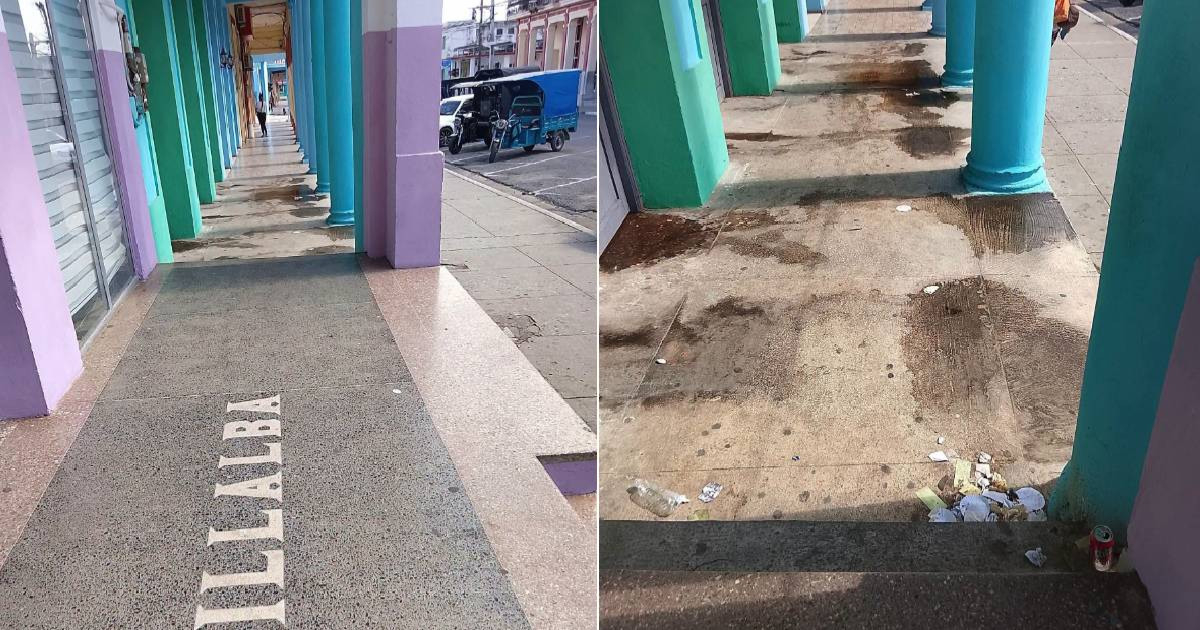
The pervasive stench of urine fills sections of Real Street in Pinar del Río, largely due to a lack of public restrooms and the use of a closed facility as an impromptu toilet. This unsanitary situation affects nearby food-selling establishments.
The issue was spotlighted on Facebook by Ogilvie Serrano Rodríguez, a broadcaster for Radio Guamá, who recounted his experience last Saturday after noon. "Walking through that part of Real Street today was practically a test of courage," he noted.
Particularly impacted is the area next to the Ilusión hair salon, a site intended for the National Institute of Sports, Physical Education, and Recreation (Inder) to build a Sports Museum, a project that never materialized.
The facility remains closed, and according to a local resident's comment on the post, it's being used as a makeshift urinal. "That foul stench of urine is coming from the site designated for the Inder Sports Museum, which was never built and got shut down," the resident explained.
Nearby, a business selling sweets and other ready-to-eat products is also affected. Serrano mentioned that the unpleasant odor invades the establishment whenever the door opens.
Local Businesses Struggle with External Odors
Despite maintaining sanitary conditions inside, workers in the shop also face the consequences of external pollution. "They suffer because of these inconsiderate individuals, but they aren't responsible for others' actions," a local stated.
Some residents blame patrons from the Bola 13 disco, located across from the entrance, who allegedly urinate nearby after leaving the club late at night. They also criticized the lack of police presence in the area.
Widespread Sanitation Concerns
Complaints extend beyond this section of the street. Neighbors report that foul odors are present in various parts of Martí Street, stretching from the malecón to Rosario, as well as near the pharmacy at the corner of Recreo Street and around the Globo hotel.
"The stench is unbearable across most of the city. This isn't a one-night issue; it's been ongoing for months," reported another resident.
The disappearance of public restrooms is cited as a cause, forcing people to seek alternatives. One resident recalled there used to be sanitary facilities at Coppelia, the bus terminal, and Independence Park, but noted that the latter has been shut down.
"Public bathrooms are non-existent in Cuba. There was a time when they cared, but they vanished as quickly as a snowflake in the sun," a resident summarized.
Water Shortages and Health Risks
Compounding these sanitation issues is a severe water shortage. As of October 10, a local confirmed that the area had been without water supply for over two months.
By early November, authorities confirmed that approximately 170,000 residents in Pinar del Río lacked regular access to potable water, with several pumping stations out of service and power outages lasting more than 16 hours daily.
The epidemiological situation adds to the concern. As of late August, the province faced three active outbreaks of hepatitis A in the municipalities of Jagüey Cuyují, Los Palacios, and San Luis. The disease primarily spreads through fecal-oral transmission, often via contaminated water or food.
Understanding Pinar del Río's Sanitation Crisis
What are the main causes of the sanitation issues in Pinar del Río?
The primary causes include the lack of public restrooms and the use of closed facilities as toilets, coupled with a severe water shortage affecting the region.
How are local businesses affected by the sanitation problems?
Businesses, especially those selling food, are plagued by the foul odors which infiltrate their premises, impacting both workers and customers despite efforts to maintain cleanliness inside.
What health risks are associated with the current situation in Pinar del Río?
There is an increased risk of disease transmission, particularly hepatitis A, which spreads through contaminated water and food, exacerbated by the unsanitary conditions.