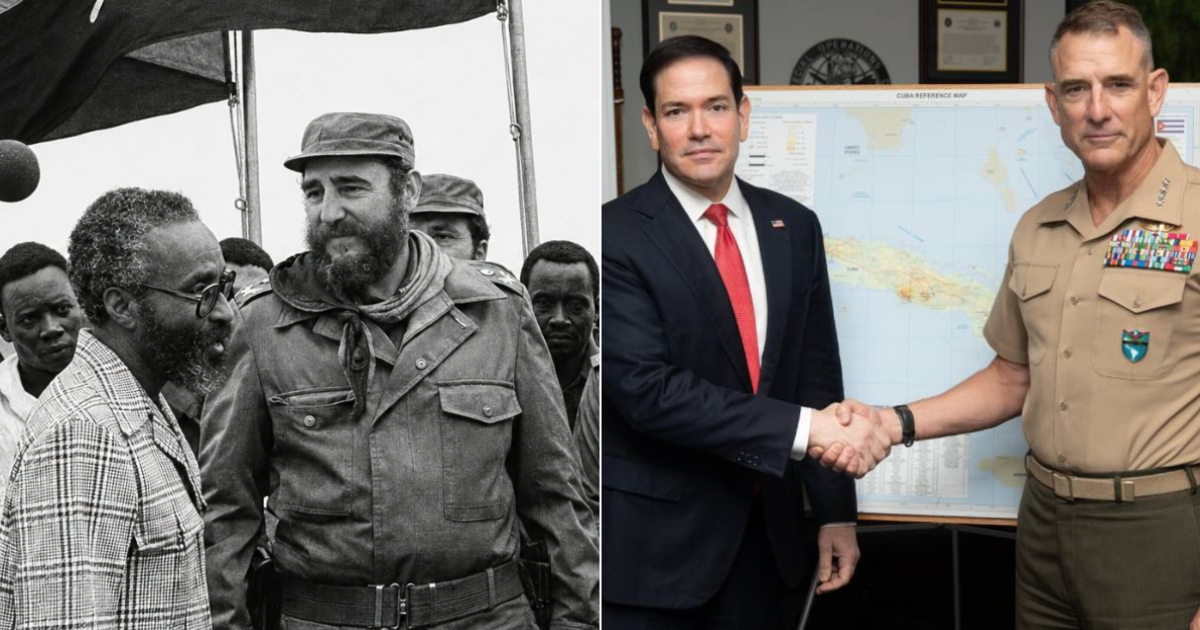
The Ministry of the Revolutionary Armed Forces (MINFAR) in Cuba has recently defended its military engagement in Angola, known as Operation Carlota, initiated in 1975. They hailed it as a testament to Cuba's commitment to justice and the self-determination of nations.
This assertion is particularly notable as the Cuban regime frequently condemns foreign interference in its own internal affairs, while the Trump administration has accused Havana of engaging in international interventionism for decades.
The statement also contrasts with recent remarks by Deputy Foreign Minister Carlos Fernández de Cossío, who stated on October 26th that Cuba "does not threaten or interfere in the internal affairs of any country." This claim has been challenged by CiberCuba, citing numerous historical instances.
Operation Carlota: A Historical Perspective
Operation Carlota saw the mobilization of hundreds of thousands of Cubans over more than fifteen years to provide military support to the Popular Movement for the Liberation of Angola (MPLA), led by Agostinho Neto. Their intervention helped halt the advance of apartheid South African forces and later influenced Namibia's path to independence.
However, it also helped the MPLA consolidate power during Angola's struggle for independence from Portugal. Cuba's military involvement was not merely about defending against external aggression but also taking sides in an internal conflict at the request of the MPLA, against other factions that also received foreign support.
Cuban Interventionism Beyond Africa
Cuba's interventionist actions were not limited to Africa. In 1964, the Organization of American States condemned Fidel Castro’s government for promoting subversive activities against Venezuela, labeling them as aggression and interference in Venezuela's internal matters.
This history aligns with accusations made by the U.S. State Department in July 2026. A report presented by Secretary Marco Rubio described nearly seven decades of espionage, infiltration, and revolutionary exportation as components of the Cuban regime's international strategy.
Havana dismissed the report, calling it propaganda aimed at justifying hostile policies and potentially military aggression by the United States.
Questioning Sovereignty and Intervention
The MINFAR's endorsement of its past actions raises an uncomfortable question: if military intervention in another country to defend justice and self-determination is legitimate, could the United States claim similar principles to justify intervening in Cuba?
Washington might argue its actions aim to restore political freedoms, human rights, and the ability of Cubans to democratically choose their leaders—rights curtailed by a constitutional system that enshrines the Communist Party as the superior guiding force of society and the state.
However, invoking a just cause does not automatically make military intervention lawful. The United Nations Charter sets clear limits on the use of force, highlighting historical and legal differences between Angola and any hypothetical U.S. operation in Cuba.
These standards must be applied universally, regardless of the intervener or the affected government's ideology. Neither Havana's proclaimed international solidarity nor Washington's defense of democracy alone justify the use of force.
The political contradiction lies in the Cuban regime's assertion of its right to intervene in defense of foreign causes it deems legitimate, while equating national sovereignty with the maintenance of its political monopoly.
Yet Cuban sovereignty belongs not to the Communist Party but to the Cuban people. The self-determination celebrated by MINFAR in recalling Angola also includes the right of a nation to freely decide who should govern it—an enduring right that remains unfulfilled through plural political competition on the island, more than fifty years after Operation Carlota.
Key Questions About Cuban Interventionism
What was Operation Carlota?
Operation Carlota was a Cuban military intervention in Angola, initiated in 1975, aimed at supporting the Popular Movement for the Liberation of Angola (MPLA) against apartheid South African forces and during Angola's struggle for independence.
How has Cuba been accused of international interventionism?
Cuba has been accused of international interventionism through actions such as supporting subversive activities in Venezuela and engaging in espionage and infiltration strategies globally, as highlighted in a U.S. State Department report.
What are the implications of MINFAR's justification for Operation Carlota?
MINFAR's justification for Operation Carlota raises questions about the legitimacy of military intervention under the guise of defending justice and self-determination, and whether similar principles could be applied by other nations to justify their interventions.