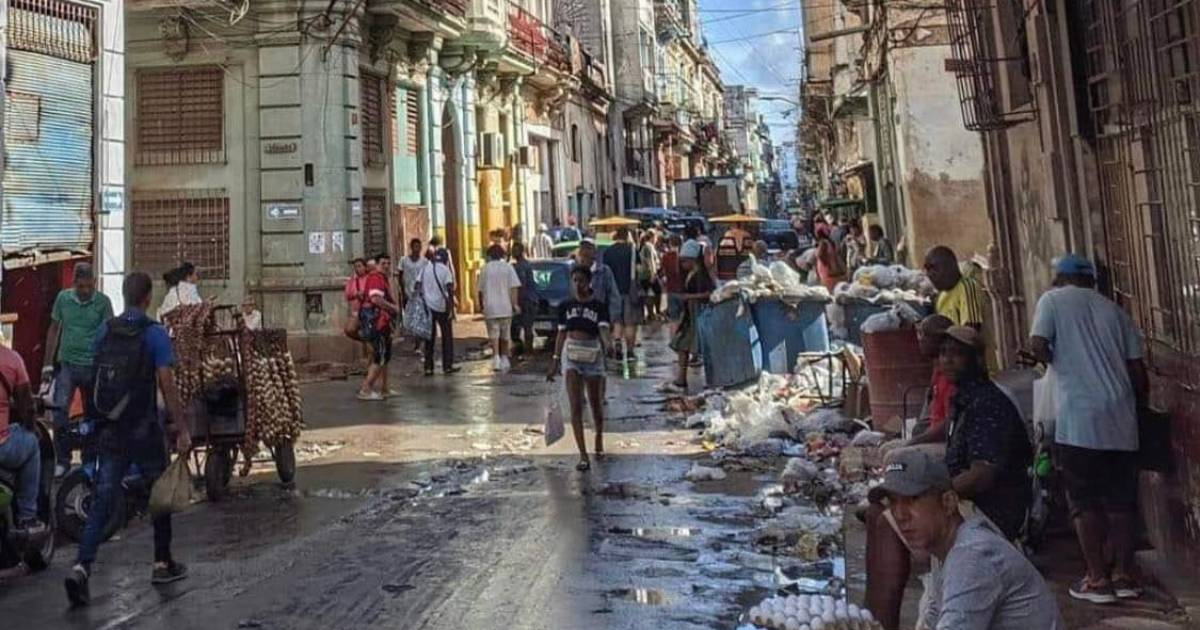
An article published by the Italian daily Domani on Saturday, penned by Jaime Ondarza, offers a stark portrayal of present-day Cuba. The piece quotes a Cuban source declaring, "It feels like hell now," capturing the dire circumstances on the island.
The report begins with Ondarza’s arrival at Havana's airport, enveloped in a "thick and surreal" darkness, dimly lit by the headlights of a few passing cars. His transport to the historic center—a dilapidated bus bearing the Region Veneto logo—has its door precariously held in place with wooden beams.
In Havana, the scene is equally bleak: families struggle to find food even on the black market, milk is nonexistent, bread lines stretch endlessly, and people are visibly losing weight.
The Fan: A Symbol of Cuba's Energy Woes
One of the most poignant details from the report is the use of a fan as an indicator of electricity. Women leave it plugged in overnight, and if they hear the blades spinning in their sleep, they know power has returned, prompting them to get up and do laundry.
This everyday scene aptly encapsulates the reality of Cuba’s ongoing energy collapse. On that specific Saturday, the National Electric System had only 1,070 MW available to meet a demand of 2,830 MW, covering just 38% of the required capacity. Some circuits in Havana faced over 52 continuous hours without electricity in early November, and the island endured at least seven nationwide blackouts throughout 2026.
The Economic Struggles of Cuban Professionals
The Domani article also highlights the meager earnings of Cuban doctors, who earn the equivalent of just four dollars a month. Although the official base salary for a newly graduated doctor was set at 7,045 Cuban pesos (about 10 to 14 dollars at the informal exchange rate) since July 2026, this income remains woefully inadequate against a basic basket of goods for two people that exceeds 41,000 pesos monthly in Havana.
This economic paradox is even sharper when considering that over 200 Cuban doctors are employed in Italy's Calabria region, where the regime claims up to 76% of their salaries through the Cuban Medical Services Provider.
International Media Focus on Cuba's Crisis
The Domani article emerged just three days after Il Manifesto—a publication historically sympathetic to the Cuban Revolution—released its own report from Havana titled "No Way Out, Cuba on Its Last Breath in Trump’s Grip," authored by Roberto Livi. The acknowledgment of the crisis by a communist Italian outlet was seen as particularly noteworthy.
This surge in Italian media coverage coincides with a week of intense international scrutiny of Cuba's crisis. In October, journalist Jon Lee Anderson described the situation as "perhaps worse than the Special Period of the 1990s," estimating that nearly 20% of the population had left the island since 2021.
The Domani piece attributes the crisis to the U.S. embargo and the halt of Venezuelan fuel shipments following Nicolás Maduro's capture in January 2026. Nonetheless, Cuba's energy crisis stems from deeper issues: decades of underinvestment in infrastructure, power plants over forty years old, and the management of the military conglomerate GAESA, which hoards economic power without reinvesting in public services.
According to Cuban officials cited by CBS News, Cuba received only one oil tanker from the beginning of 2026 until November, worsening a structural collapse that predated Venezuela's cessation of fuel supplies.
Understanding Cuba's Current Crisis
What is the current state of Cuba's energy crisis?
Cuba is experiencing a severe energy crisis, with the national electricity system meeting only 38% of the country's demand. Some areas have endured prolonged power outages, highlighting the extent of the issue.
How are Cuban doctors affected economically?
Cuban doctors face significant economic challenges, earning a monthly salary equivalent to just four dollars, which is insufficient to cover basic living costs in Havana.
What factors contribute to Cuba's ongoing crisis?
The crisis is attributed to the U.S. embargo, the cessation of Venezuelan fuel supplies, and deeper systemic issues such as underinvestment in infrastructure and the management practices of the military conglomerate GAESA.
How has international media responded to Cuba's situation?
International media, including Italian outlets like Domani and Il Manifesto, have increasingly focused on Cuba's crisis, highlighting the severe conditions and drawing comparisons to the hardships of the past.