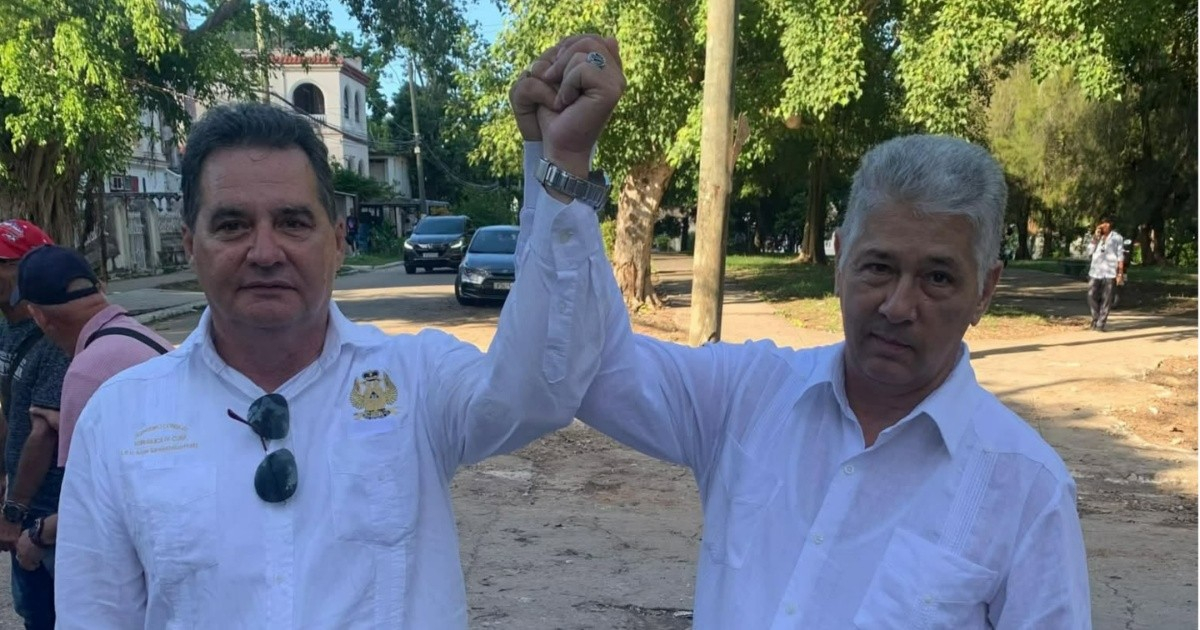
Author and dissident Ángel Santiesteban Prats has accused the Diez de Octubre Municipal Popular Court of prematurely releasing the names of defendants and details of their sentences to the pro-government media outlet Razones de Cuba, suggesting that the verdict was predetermined. Santiesteban Prats argued that this action is proof the decision was made long before the judge finished reading it in court.
"The court that 'judged' us handed over our names and sentences to official media outlets. They actually knew the sentence before we did. We were still listening to the judge in the courtroom when, in their rush to tarnish our reputation, our names were broadcast on official media," Santiesteban Prats shared on his Facebook page on Friday.
Last Wednesday, the court sentenced four Cuban masons, accusing them of illegal currency trafficking. José Ramón Viñas Alonso, former Sovereign Grand Commander of the Supreme Council of the 33rd Degree, received a four-year restriction of freedom and a 25,000-peso fine. Fernando Marcos García, accountant for the National Masonic Asylum "Llansó," was given a three-year sentence and fined 20,000 pesos. Meanwhile, Santiesteban Prats and Osvaldo Ernesto Villegas Digat each received two years of restricted freedom and fines of 20,000 pesos.
Additionally, all four defendants face loss of rights, a travel ban, and disqualification from holding any positions or jobs.
Background of the Case
The accusations stemmed from two currency exchange operations totaling 300 dollars—funds belonging to the asylum—conducted at the informal market rate: 200 dollars in September 2023 and 100 dollars in June 2025. According to their defense, the first transaction was to purchase powdered milk for elderly residents, while the second enabled Villegas Digat to buy medicine for his son.
Santiesteban Prats emphasized that leaking information to state media highlights that the verdict was not a judicial decision but rather a political directive: "This proves even they don’t believe it. Especially when the verdict was already foretold by state security operatives who had warned us."
Allegations of Intimidation and Irregularities
The writer recounted an encounter with a State Security lieutenant colonel known as "Kenia," who offered him the opportunity to leave Cuba if he resigned from his position as Sovereign Grand Commander—an office he had been elected to on September 26 with 19 votes. After his refusal, the officer warned him of impending trial and sanctions. "Everything State Security threatened came true. They said, 'Step down, or we will remove you,'" he declared in a video released by CubaNet.
During the trial, Santiesteban Prats pointed to procedural irregularities: "I couldn’t understand why, after all those hours there, they couldn’t prove I committed a crime. The officer lied, saying things that weren't in my statement." He also noted the presence of Lieutenant Colonel Kenia and the head of Villa Marista among those attending the trial.
Cubalex's Critique of the Trial's Legitimacy
The legal organization Cubalex questioned the trial's legitimacy in an analysis published prior to the hearing, noting that both currency exchanges were recorded in the asylum’s accounting books—disproving any clandestine activity—and that the investigation was handled by the Ministry of the Interior's Specialized Organ on Crimes Against State Security, an unusual choice for a currency exchange case. The indictment further contained ideological assessments of Santiesteban Prats, including criticisms of his opposition to the revolutionary process and lack of engagement in socially beneficial activities.
The judge overseeing the trial, Zamira Marrero Morgado, is the same who sentenced content creator Anna Bensi and her mother to two years of restricted freedom each in October 2026.
Despite the conviction, Santiesteban Prats concluded with a note of defiance: "We never made a deal, never accepted anything, and I will not compromise the dignity of the Supreme Council, neither for a sentence nor for pressures, nor for anything." Both the convicted individuals and the prosecutor have the right to appeal, which will be addressed by the Havana Provincial Popular Court.
Key Questions About the Masons' Trial in Cuba
Why was the trial of the Cuban masons controversial?
The trial was controversial due to alleged political motivations, procedural irregularities, and the premature leak of verdicts to pro-government media, suggesting the outcome was predetermined.
What were the charges against the four masons?
They were charged with illegal currency trafficking related to two foreign exchange transactions totaling 300 dollars, conducted at informal market rates.
What were the additional penalties imposed on the convicted masons?
Besides fines and restricted freedom, they were also stripped of certain rights, banned from leaving Cuba, and barred from holding official positions.