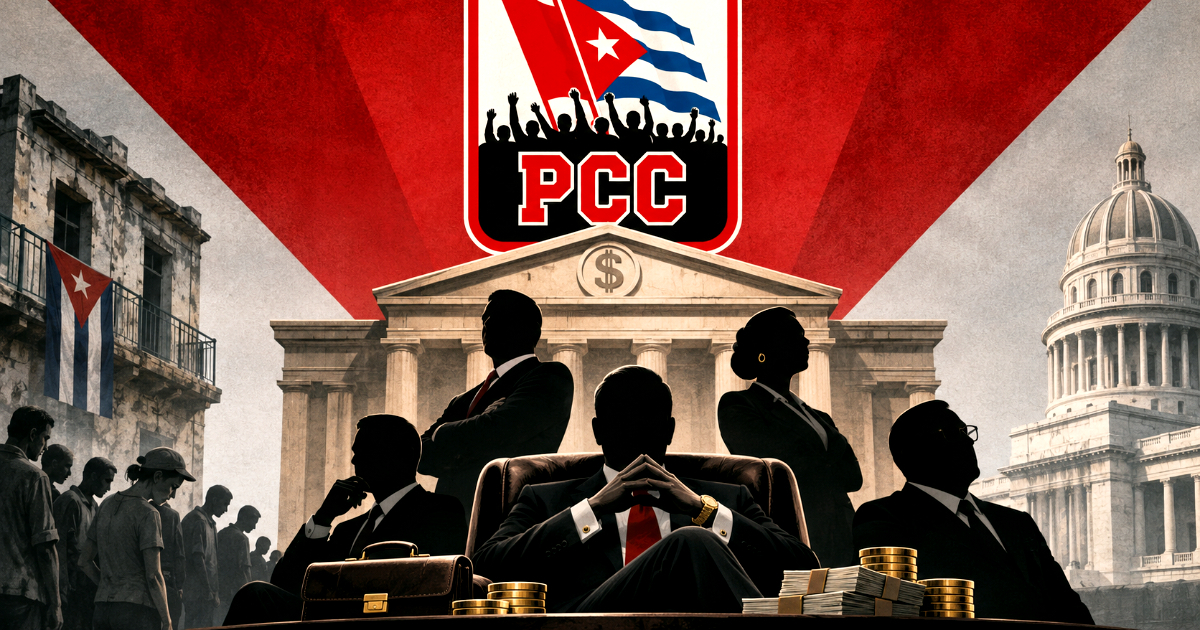
For decades, the Cuban regime has touted the state monopoly on banking as a cornerstone of socialism. Now, however, it seeks to transform the financial sector into a catalyst for economic change. This shift raises an uncomfortable question: who in Cuba possesses the wealth to establish private banks?
Miguel Díaz-Canel, Cuba's appointed leader, revisited this topic during a recent meeting with banking executives and employees, as reported by Granma, the official publication of the Communist Party of Cuba.
Juana Lilia Delgado Portal, head of the Central Bank, identified key priorities, including the expansion and capitalization of the financial system, credit, currency exchanges, and remittances.
While Díaz-Canel emphasized restoring customer trust and strengthening the banking sector, he also stressed the importance of reinforcing the political and ideological direction of the sector, even invoking Che Guevara and the creation of the "new man."
The Communist Party is thus reaffirming its ideological orthodoxy while simultaneously opening the door to private banks, financial ventures, and new forms of capital accumulation.
The Potential Beneficiaries of Financial Reforms
In June 2026, the regime announced 176 economic measures, including the authorization of private banks and financial institutions, and provisions for private investors to engage with state enterprises.
While this opening does not represent a wholesale privatization of existing banks, it does create new business opportunities previously reserved for the state.
Theoretically, Cuban entrepreneurs and international investors can participate. Practically, establishing a bank requires significant financial resources, foreign currency access, experience, and international relations.
In a country where most citizens struggle to meet basic needs, the pool of entrepreneurs who can meet these requirements is inevitably small.
Meanwhile, a substantial portion of Cuba's national resources remains concentrated in state and military structures, especially in the conglomerate GAESA, which has long controlled significant tourism, commercial, and financial interests.
A report by El Nuevo Herald, based on leaked internal documents, attributed approximately $18 billion in current assets to GAESA as of March 2024. Although these figures have been debated due to potential currency conversion issues, the report highlights the conglomerate's opacity and the absence of independent public audits.
This concentration of resources presents an obvious problem: independent entrepreneurs are unlikely to compete on equal footing with those already wielding capital, infrastructure, and commercial connections.
The Risk of a "Russian-Style" Economic Shift
Economist Emilio Morales, from Cuba Siglo 21, has long warned of the ruling elite potentially transforming into a new class of major private property owners.
In his January 2023 study on GAESA, Morales described the concentration of economic power around the military conglomerate and the Castro family.
Later, in the report "Entrepreneurship in Cuba Strangled by GAESA," he suggested that small and medium-sized enterprises (SMEs) could facilitate a future transfer of state companies and assets to those connected with power.
This hypothesis echoes what occurred in Russia after the Soviet Union's dissolution, when entrepreneurs and former Soviet officials acquired significant public assets through privatizations that resulted in powerful oligarchs.
There is, however, a critical distinction: in Cuba, this potential process is unfolding without the Communist Party losing its grip on power.
The ruling elite could convert part of its economic control into private ownership while retaining the political and administrative institutions that determine who can conduct business.
Current reforms offer reasons to scrutinize this risk.
In October, economist Pedro Monreal warned about the transfer of state assets to private control, following CIMEX's calls for leasing establishments and conducting business with private entrepreneurs.
Monreal questioned the transparency of these procedures and highlighted the danger of officials, relatives, or related companies gaining advantages in the allocation of business opportunities.
Meanwhile, in a report published on November 3, Morales argued that GAESA uses intermediaries and private companies in the fuel business while retaining control over essential infrastructure and financial mechanisms.
These studies do not prove that all private activity in Cuba is subordinate to the regime. Independent entrepreneurs exist, and economic openness could present genuine opportunities. However, they also reveal the risks of selective privatization, where political connections may outweigh business acumen.
Economic Capitalism Under Communist Control
The financial liberalization introduces a particularly delicate dimension to this process. Private exchange service operators and foreign capital entities have already been authorized, while the Central Bank retains the authority to grant licenses and oversee their operations.
The identity of the ultimate beneficiaries, the origin of their capital, and potential links to political or military leaders are crucial to understanding who is taking advantage of these reforms.
However, the opaque nature of Cuba's system makes it difficult to access this information. The same institutions authorizing businesses control much of the data needed to investigate their owners.
This lack of transparency does not prove the existence of figureheads or irregular transfers of public assets but creates favorable conditions for concealing potential conflicts of interest.
The issue extends beyond banks. New licenses, the leasing of state facilities, and business partnerships can enable certain groups to amass economic benefits and control without formally acquiring all properties.
In this context, the financial opening could help revive productive activities while simultaneously consolidating a business elite dependent on political power.
This paradox is reflected in Díaz-Canel's rhetoric: while promoting financial instruments characteristic of a market economy, he insists that banking must remain subject to the ideological principles of the Party to "build socialism the Cuban way."
The regime increasingly embraces capitalist mechanisms to manage the economy, yet it does not foresee an equivalent opening of the political system.
Hence, it is crucial to understand who will own the new banks, what capital they will manage, and how they will secure authorizations.
The Russian experience shows that privatization does not necessarily equate to democratization or wealth distribution. Research on GAESA suggests that Cuba may be undergoing an even more unique transformation: part of those already controlling the national economy could become its private owners, without relinquishing the political power that enabled such concentration.
Unpacking Cuba's Economic Reforms: Key Questions and Answers
What changes are being made to the financial sector in Cuba?
Cuba is introducing private banks and financial institutions, allowing private investors to participate in state enterprises. This marks a significant shift from the historical state monopoly over banking.
Who is likely to benefit from Cuba's financial reforms?
The reforms could benefit entrepreneurs with significant financial resources, access to foreign currency, and international connections. However, existing state and military entities, such as GAESA, may also stand to gain considerably.
What risks are associated with these economic changes?
There is a risk of selective privatization, where political connections could be more beneficial than business competence. This could lead to a concentration of economic power among those already close to the political elite.
How does the Cuban regime maintain control over the economy?
The regime retains control by overseeing the licensing and operation of financial entities, ensuring that economic activities align with the ideological principles of the Communist Party.