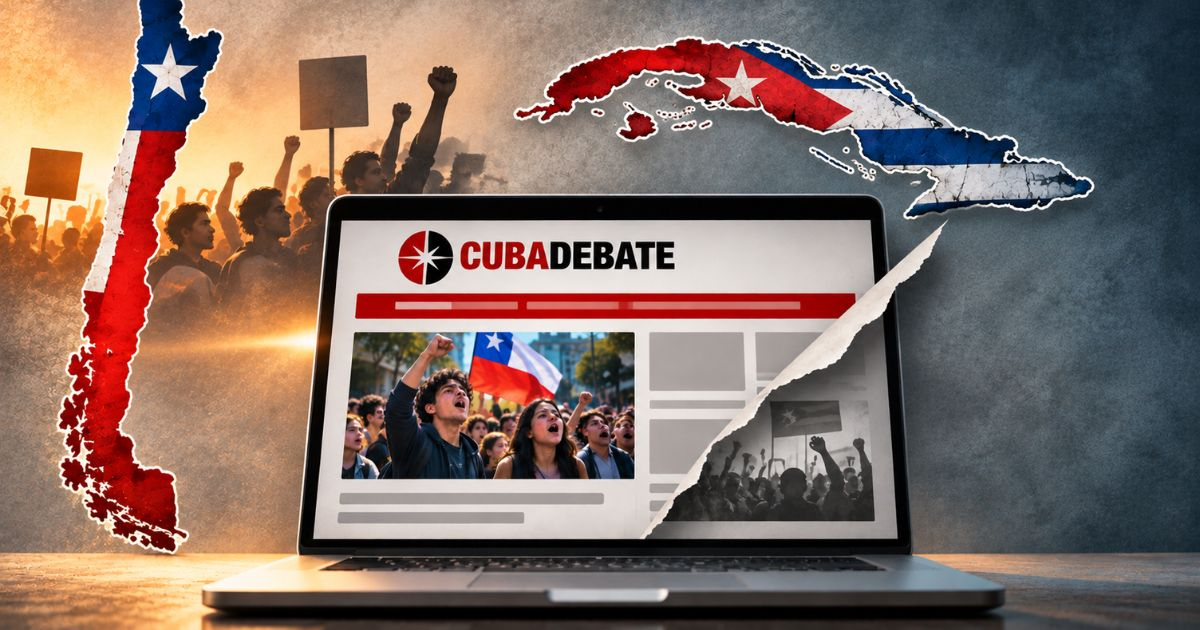
The state-run media outlet Cubadebate swiftly published a report on Friday covering the student protests from the previous day in Santiago, Chile. High school students there had disrupted traffic to demand the resignation of Justice and Human Rights Minister Fernando Rabat, criticized for reducing sentences of individuals convicted of sexual offenses against minors.
The Cuban Communist Party's propaganda platform didn't anticipate the backlash it would face on social media after sharing the article. The post sparked a wave of ironic comments on Facebook, where numerous Cubans pointed out the glaring contradiction of a media outlet that highlights the right to protest abroad while remaining silent when any protest on the island results in arrests, summary trials, and lengthy prison sentences. One comment summed up the collective sentiment: "At least they can protest without getting arrested."
Other comments were equally blunt. "This shows that Chile has democracy, where you can protest if you disagree with the government, something you can't do in Cuba, not even online, because you'll end up in jail. Example: July 11, 2021. Congratulations to the Chileans...," a user remarked. Another commenter was more succinct: "You can protest anywhere in the world except in Cuba."
Public Reaction to Media Double Standards
Uncomfortable questions were also abundant. "When will students in Cuba be able to protest like in Chile?" one person asked. "It's great to protest against wrongdoing, it's great to at least vent; in Cuba, you either bite your tongue or lose it forever," another added.
Some were even more direct: "Hypocrites, talk about the protests in Cuba" and "These communists are shameless, they claim protests are allowed anywhere, but if it happens in Cuba, they're labeled as vandals and mediocre people."
Political Consequences vs. Repression
The contrast pointed out by netizens is rooted in concrete facts. According to data cited by the party-affiliated site, drawn from the state-owned Prensa Latina agency, in the context of the student protests, President José Antonio Kast faces a plummeting approval rating of 20% and a disapproval of 68%, according to the Black and White survey, with 68% supporting the constitutional accusation against Minister Rabat.
In the South American country, protesting has political repercussions for the government; in Cuba, the repercussions fall on the protesters.
The Reality of Protesting in Cuba
The harsh reality that Cubadebate omits is devastating. The Provincial Prosecutor's Office in Ciego de Ávila requested sentences ranging from seven to 13 years for 19 protesters in Morón—including teenagers—who took to the streets on March 13, 2026, to protest power outages and shortages. The highest sentence, 13 years, was for Hosuán Naranjo Chacón; an eight-year sentence was requested for a 17-year-old.
Meanwhile, the Bayamo Prosecutor's Office called for up to five years of imprisonment for nine citizens over the May 23, 2025 protest. "They're being sentenced for demanding basic rights from the government, like access to water, food, and electricity," Rosa Escalante, the mother of one of the defendants, told Martí Noticias.
The organization Cubalex recorded 766 protests across 141 Cuban municipalities during the first half of 2026. Prisoners Defenders counted 1,372 political prisoners in Cuba as of October 1, 2026, while Justicia 11J reported over 300 people still incarcerated for their involvement in the July 11, 2021 protests.
This isn't the first time Cubadebate has displayed such double standards: in November 2024, it favorably covered the protests in Valencia—against the regional president over the management of DANA—while supporting the repression of Cubans protesting power outages.
A netizen aptly summarized the regime's logic: "And there, they don't get arrested because there's freedom of expression. [...] Here in Cuba, they get arrested, which is why there are no student protests, because they're harassed, intimidated, and have their careers taken away..."
Understanding the Cuban Protest Context
Why did students in Chile protest?
Students in Chile protested to demand the resignation of Justice and Human Rights Minister Fernando Rabat, who was criticized for reducing sentences of individuals convicted of sexual offenses against minors.
What was the reaction to Cubadebate's coverage of Chilean protests?
Cubadebate's coverage of the Chilean protests sparked a wave of ironic comments on social media, highlighting the contradiction of supporting protests abroad while ignoring repression in Cuba.
How does protesting in Cuba differ from Chile?
In Chile, protests can lead to political consequences for the government. In contrast, in Cuba, protests result in severe repercussions for the protesters, including arrests and lengthy prison sentences.