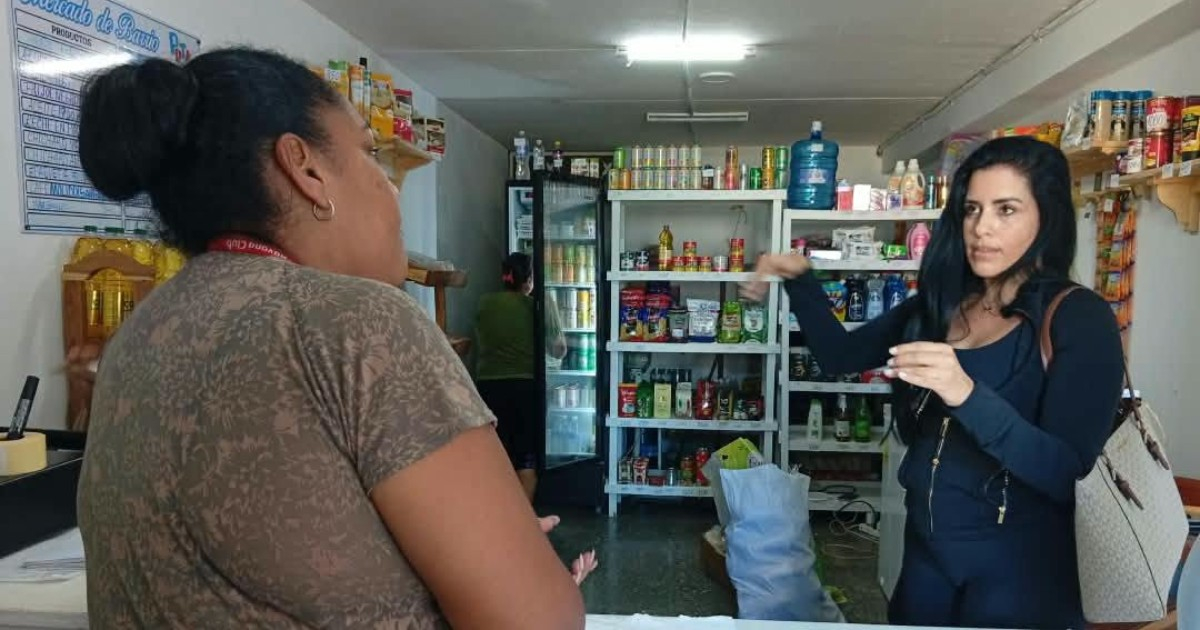
The Ministry of Domestic Trade (MINCIN) recently praised the progress of the Neighborhood Market located at 1st and 10th in Havana's Plaza de la Revolución district, managed by the small business Café Carmesí, through a social media post. However, the Cuban public quickly responded with strong criticism.
The government body highlighted several "achievements," including the use of electronic payments, a board displaying local and reference prices, the availability of rice and sugar in packages under a kilogram, and improved wages for former bodega clerks. Despite these claims, the post provoked a flood of comments that dismantled the official narrative.
"This is just another huge lie for the people," commented one user. Another was even more blunt, suggesting the market should be renamed "the market for the wealthy."
Reality vs. Official Discourse
The price board at the 'Cárnicos del Mercado de Barrio' starkly contrasts official statements with reality: five pounds of processed chicken cost 4,250 Cuban pesos (CUP) compared to a reference price of 4,500 CUP; bath soap is priced at 530 CUP versus 600 CUP; toothpaste is 450 CUP against 608 CUP; and Ridal detergent is 1,100 CUP compared to 1,200 CUP. The actual discounts range from 7% to 12%, falling short of the initial promise of 15% to 30% when the program launched in July.
"There's barely any price difference compared to other small businesses—what a great 'achievement'," another Cuban sarcastically remarked. Some users reported even worse situations, noting that oil, which averages 2,600 CUP per liter in other markets, is sold for 3,000 CUP in some Neighborhood Markets, a 30% increase.
The Struggle of Everyday Cubans
One user noted, "In Ayestarán and 19 de Mayo, it started off well, but prices began to rise after a few weeks, affecting items like rice, canned tomato puree, and more. You have to check weekly."
A Cuban woman highlighted the dire economic reality: "A retiree with 3,206 pesos can only afford a liter of oil and a pound of rice for the entire month. It's simple math." With the minimum wage at 3,210 CUP per month and the lowest pension at 3,056 CUP, even basic shopping becomes an impossible task.
The Neighborhood Markets program launched as a pilot in Plaza de la Revolución on July 23, 2026, promising affordable basic goods through small business and cooperative management in repurposed state facilities. By the end of October, 62 markets were operating across 12 provinces.
Despite these efforts, MINCIN admitted in October that the markets had yet to achieve noticeable price reductions for consumers. Even a state media journalist criticized the pricing, suggesting they be renamed "Affluent Neighborhood Markets" and noting that some goods were cheaper from self-employed vendors.
Understanding Cuba's Neighborhood Markets
What is the purpose of the Neighborhood Markets in Cuba?
The Neighborhood Markets program was designed to offer basic goods at accessible prices through small business and cooperative management in repurposed state facilities.
Why are Cubans criticizing these markets?
Cubans have criticized these markets because the promised price reductions have not materialized, and some goods are even more expensive than in other markets.
How do the prices at the Neighborhood Markets compare to expectations?
The actual discounts offered are significantly lower than the promised 15% to 30%, with some products being more expensive compared to other vendors.