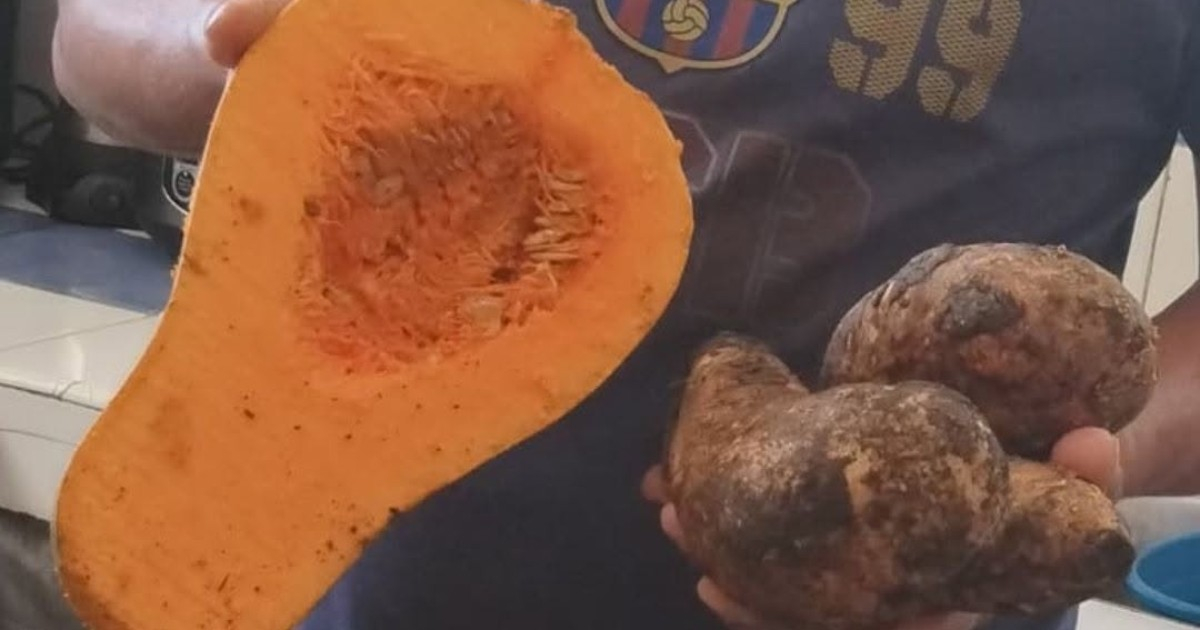
On Friday, Ernesto Lima, a resident of Cienfuegos, took to Facebook to share a photo of himself holding a piece of pumpkin and three sweet potatoes, highlighting that these basic foods cost him 1,300 Cuban pesos. This stark image captures the dire situation faced by millions of Cubans amid an unrelenting food crisis.
"Living in Cuba has become incredibly challenging. This piece of pumpkin and these three sweet potatoes cost me 1,300 pesos. How long will this continue, Cuban government?" Lima expressed his frustration in his post.
Many Cubans have echoed the outrage over skyrocketing prices across the island. "A pound of peppers costs 1,000 pesos. So it's not surprising," commented one individual. Another shared that four and a half pounds of sweet potatoes set them back 560 pesos on the same day. A third person reported paying 1,200 pesos for a chicken thigh with back, labeling it as "utter exploitation."
Widespread Discontent with the Regime
The frustration is also directed squarely at the regime. "The leaders know that with a minimum wage or a pension, you can't buy anything to eat. They know it, and I'm sure they see the social media posts and read the comments. People can't bear this misery anymore," remarked one user.
Another commenter was more blunt: "All the leaders ever say is to resist. Where is that resistance when there's no water, we've been without power for months, and on top of that, we have to improvise just to eat? Here, you either die or have a heart attack."
Soaring Food Costs Across Cuba
Earlier this month, Cuban Bárbaro Miranda Hernández went viral with a video showing a pumpkin priced at 2,700 pesos, about 84% of the monthly minimum wage. Reports from Camagüey mentioned onions costing 400 pesos each, while in Sagua de Tánamo, chicken reached 900 pesos per pound and a carton of eggs soared to 3,500 pesos.
The disparity between prices and income is staggering. The Cuban minimum wage, set at 3,210 pesos since July 2026, is woefully inadequate against the backdrop of persistent inflation. As of Friday, November 6, 2026, the dollar traded at 928 pesos in the informal market. An economist estimated in July that a single person needs approximately 96,000 pesos monthly to meet basic needs, roughly 30 times that minimum wage.
In August, the regime introduced "neighborhood markets," promising prices 15% to 30% lower than the informal market. However, Cubans report these venues also charge unaffordable prices.
"This government has abandoned the people. Many are starving in every aspect of life. They are slowly killing us, and the problems remain unsolved: many measures, but we are either the same or worse," another Cuban lamented about the high prices.
Understanding Cuba's Economic Struggles
Why are food prices so high in Cuba?
Food prices in Cuba are soaring due to a combination of factors including inflation, economic mismanagement by the government, and limited supply of goods.
How does the minimum wage compare to the cost of living in Cuba?
The minimum wage in Cuba is vastly insufficient compared to the cost of living. Many basic necessities are priced far beyond what the average Cuban earns, making survival challenging.
What are 'neighborhood markets' in Cuba?
'Neighborhood markets' are government-initiated markets in Cuba that were intended to offer goods at lower prices than the informal market. However, many Cubans report that prices remain unaffordable.