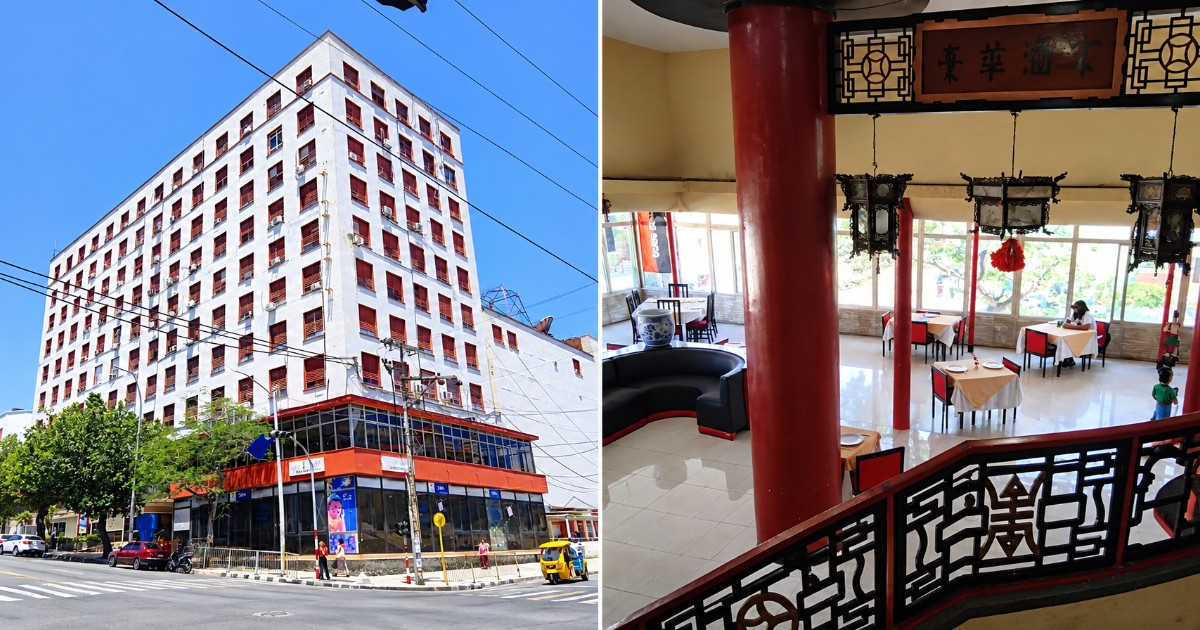
A retired resident of Havana recently visited El Mandarín, a well-known restaurant on La Rampa in Vedado, only to find it eerily empty, devoid of diners, with the mezzanine bar closed. Once a place where a meal was within reach of the average worker, a single dish now costs up to 2,200 Cuban pesos, as evidenced by the menu captured in photos at the location.
Cesareo Navas y Morlanes, a former audiovisual producer for the Cuban Institute of Radio and Television (ICRT), shared his reflections on Facebook. "Back in the '90s and the early 2000s, food and drink prices were affordable for everyone. We could enjoy a meal even if it wasn't a special occasion—savoring Chinese dumplings, ravioli, fried rice, or just a bowl of Chinese soup or sweet and sour pork," he reminisced.
However, Navas lamented that under the so-called 'continuity' of Miguel Díaz-Canel’s regime, prices have skyrocketed: "Now, a dumpling is 750 pesos, sweet and sour pork 1,400 pesos—it's terrifying," he stated, referencing the term used to describe Díaz-Canel's continuation of Raúl and Fidel Castro's policies.
On El Mandarín's menu board, items like pork chunks are priced at 2,200 pesos for 145 grams, and appetizers at 1,300 pesos for 188 grams. Considering the minimum pension in Cuba is 4,000 pesos per month, a single serving of sweet and sour pork at El Mandarín consumes 35% of that pension.
"Due to rampant and uncontrollable inflation and other harmful effects we Cubans face, especially retirees, we are barred from enjoying restaurants or other tourist venues. We are shut out. 'It's there, but not for us,'" Navas expressed his frustration. Restaurant and hotel prices in Cuba saw a 39.11% year-on-year increase in September 2026, outpacing the official general inflation rate of 28.44%, as reported by the state statistics office.
Navas fondly recalled the mezzanine bar at El Mandarín—fondly referred to as "the mezzanine office" by ICRT workers—as a gathering spot for directors, cameramen, sound engineers, actors, and producers. It was a place where teams were formed and artistic projects took shape amid cigarettes, rum, and beers. Such gastronomic and cultural life on La Rampa now belongs to another era.
"I decided to go up to El Mandarín, not to eat or drink—my wallet is both present and absent—but just to see the place again: What a disaster, like dragging a corpse! An empty dining room, no patrons, and most sadly, the bar closed," the retiree wrote.
El Mandarín is a historic restaurant in Havana, even featured in the film Memories of Underdevelopment (1968) by Tomás Gutiérrez Alea. Navas concluded his post with a sentiment shared by many Cubans: "What a shame of a country we have! This misery can't last much longer."
Impact of Economic Changes on Cuban Dining Culture
Why have prices at El Mandarín increased so significantly?
The increase in prices is attributed to rampant inflation and economic policies under the current Cuban regime, which have made dining out unaffordable for many locals.
How does the cost of dining at El Mandarín compare to a typical Cuban pension?
With the minimum pension being 4,000 pesos a month, a single dish like sweet and sour pork at El Mandarín can take up to 35% of a pensioner's monthly income.
What role did El Mandarín play in Havana's cultural scene?
El Mandarín was not just a restaurant but a cultural hub where artists and media professionals gathered, fostering creativity and collaboration.