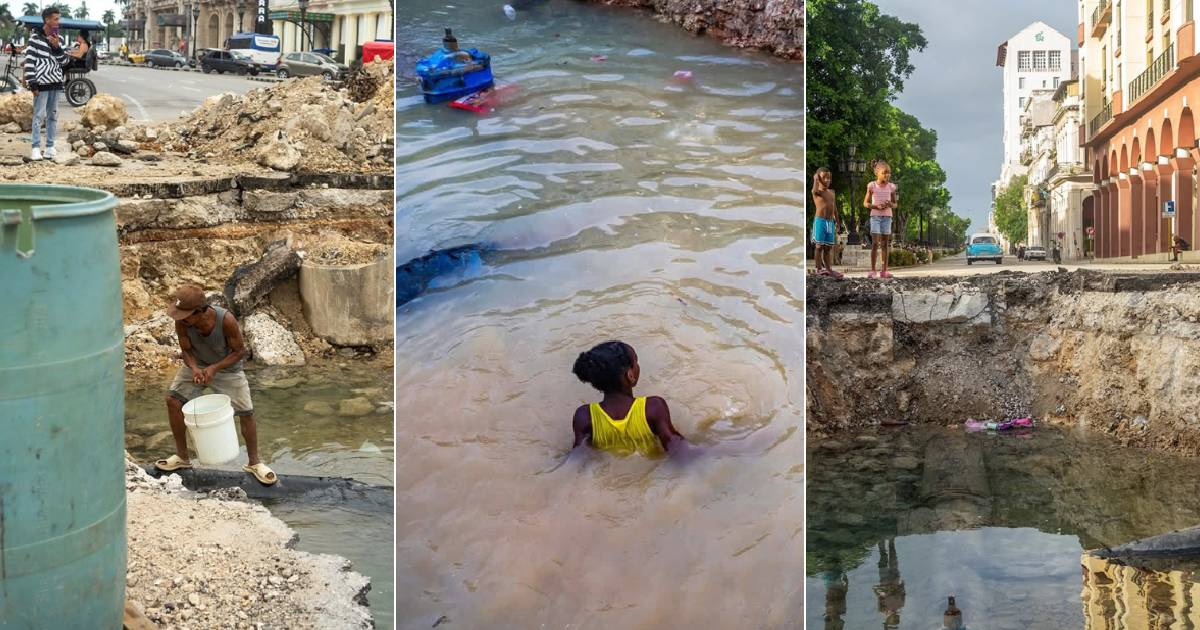
A massive pit filled with water has been left unaddressed for weeks at the intersection of Prado and Neptuno streets in central Havana. This open excavation has become a makeshift playground where children swim and play without any safety measures.
On Thursday, photographer Alina Sardiñas shared on Facebook her visit to the site, documenting people gathering water from a pipe that emerges from the center of the pit. Some individuals filled large containers using buckets, utilizing the water for consumption or sale.
"Everyone is finding ways to survive amidst the chaos," Sardiñas remarked, noting how the presence of children temporarily turned a scene of decay into one of amusement.
While capturing images of the water collectors, Sardiñas observed children treating the large hole as a beach, lake, or river within the city. Her photos show young ones playing and bathing in the accumulated water.
Sardiñas was reminded of an image of Syrian children playing in a bomb crater filled with water. However, she drew a distinction, noting that in Prado and Neptuno, the disaster stems from infrastructure decay and poor governance, which she argues condemns the populace to hardship.
"For children, there's often a way to escape the harsh realities—be it bombings or the mismanagement that inflicts suffering on a nation," she expressed.
The photographs reveal a pit between two and three meters deep, with exposed pipes, debris, and stagnant water. The area lacks signage or safety barriers, located just meters from the Hotel Parque Central and Parque Central, in one of Havana's most iconic intersections.
Writer and journalist Jorge de Mello also highlighted the issue on Facebook, describing the pit as further evidence of Havana's decline. "Havana has long ceased to resemble the elegant capital we once knew; it now looks like any city in Haiti," he wrote.
A passerby expressed outrage over a leaking pipe, while Sardiñas responded to De Mello, stating that the nation is regressing, making the situation particularly dire.
The pit also underscores the contradiction of a city where water scarcity forces residents to exploit any available source, even amid crumbling infrastructure.
This issue is part of a broader crisis affecting Havana's water network. Originally constructed between 1908 and 1914 for a population of 600,000, it now serves nearly two million people with about 1,755 kilometers of outdated pipes.
Main water lines are 60 to 70 years old and inadequately maintained, with over 40% of pumped water lost to leaks before reaching homes.
In October, a similar sinkhole appeared in the Cerro municipality, featuring accumulated water, displaced grates, and broken asphalt. In August, a 78-inch pipe break at the Cuenca Sur source cut off supply to several Havana districts.
Neptuno Street has also faced numerous complaints about its poor conditions. In June, a video showed the street nearly blocked by trash and debris, with recent reports highlighting waste, maggots, and rodents in the Centro Habana area.
President Miguel Díaz-Canel has acknowledged the "real, grave, and complex" nature of Cuba's water crisis, stating that it cannot be resolved with a single measure or speech. The government has announced plans for rehabilitation projects, promising improvements without specifying timelines for the city center.
At the start of November, 2,681,770 people nationwide were experiencing water supply disruptions, with about 536,000 of them in Havana, according to the National Institute of Hydraulic Resources.
Havana's Water Infrastructure Crisis: Key Questions Answered
What is the main cause of the water crisis in Havana?
The water crisis in Havana is primarily due to outdated infrastructure. The water network was built for a much smaller population and has not been adequately maintained, leading to significant water loss due to leaks.
How are residents coping with the water shortage?
Residents are finding alternative water sources, such as collecting water from emerging pipes in excavations, to meet their needs. Some sell the water while others use it for personal consumption.
What actions has the Cuban government taken regarding the water crisis?
The Cuban government has announced rehabilitation projects to improve the water infrastructure but has not provided specific timelines for these improvements, particularly in Havana's central areas.