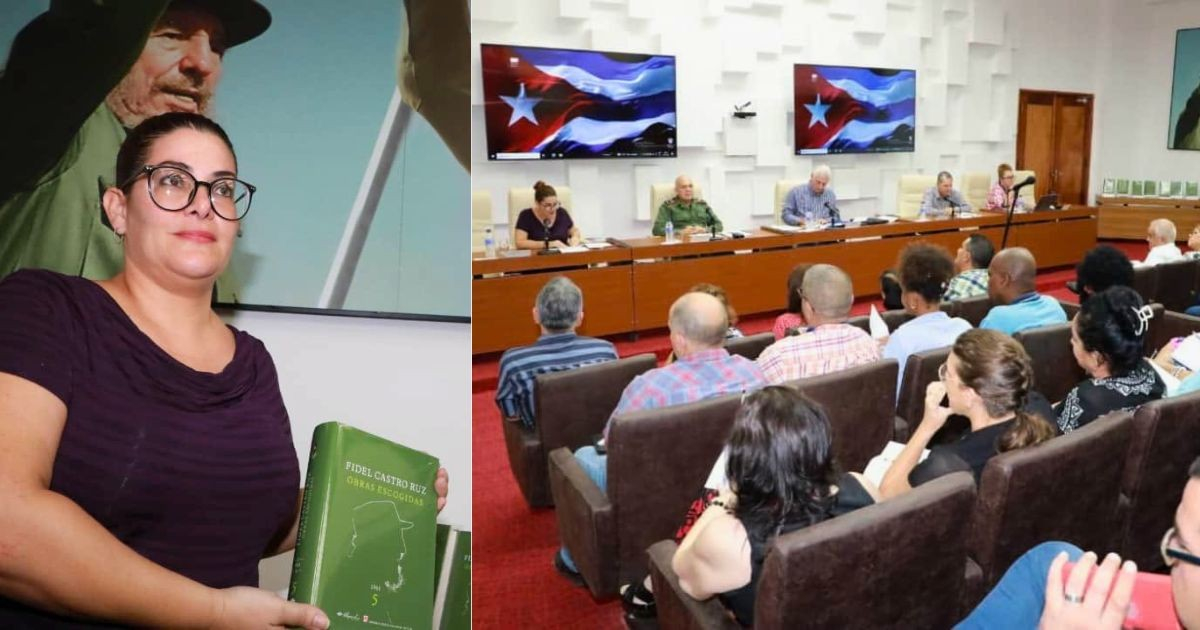
As numerous towns across Cuba endure over 20-hour daily power outages, the Communist Party of Cuba was busy hosting a grand event in Havana. On Friday, they introduced a 23-volume printed collection of Fidel Castro Ruz's Selected Works to the Central Committee's auxiliary structure, with Miguel Díaz-Canel prominently seated alongside Political Bureau member Roberto Morales Ojeda.
The collection is indeed a massive paper monument: 23 volumes encompassing nearly 16,000 pages, 690 documents, and more than 12,000 footnotes. These texts, ranging from 1940 to 2016, are prefaced by Raúl Castro, encapsulating the rhetoric that has led the nation to its current dire state.
Ironically, the 3,000 physical copies were not produced in Cuba. Instead, they came from Vietnam, courtesy of the Vietnamese Communist Party and its National Political Publishing House. This is a stark reminder of Cuba's paper shortages.
The Cuban Book Institute faces an unprecedented crisis, lacking paper, ink, and funding. Since March, the newspapers Granma and Juventud Rebelde have been published only on Tuesdays, with just eight pages. Provincial newspapers have entirely ceased to exist in print form.
Despite these challenges, official enthusiasm was undeterred. Sissy Abay, deputy director of the Fidel Castro Center and presenter of the event, described the texts as more than a historical record. She claimed they were a roadmap for a nation reinventing itself amidst adversity—a manual for political strategy and leadership during crises. She also called them a chronicle of how a small island nation defied the odds to control its destiny.
Fast forward to November 2026, and the nation's outlook remains bleak: an electricity deficit frequently exceeding 2,000 MW daily, over 2.6 million people lacking regular access to clean water, and an official food inflation rate that surpassed 42% annually in September.
Compounding these issues are severe governmental difficulties in providing liquefied gas, forcing many to resort to costly charcoal or firewood for cooking in the informal market.
According to the Communist Party's official publication, this "human-centered national project" coexists with a housing deficit exceeding 800,000 homes. Nearly 1,000 buildings collapse annually in Havana alone, and only 7,427 homes were completed across the country in 2024. The Economic Commission for Latin America and the Caribbean (ECLAC) projected a contraction of over 10% in Cuba's GDP for this year, the worst in Latin America.
This Friday's event was part of the "Year of the Centenary of the Commander in Chief," declared by the regime in December 2025 to commemorate Castro's birth on August 13, 1926. The campaign included caravans, international colloquiums, and the slogan "Fidel is eternal," which sparked sarcastic responses on social media in August. Cubans associated eternity not with Castro but with blackouts, shortages, and bread lines. Meanwhile, official propaganda continues unabated as the nation struggles.
The island's population decreased to 9,434,593 by the end of 2025—313,414 fewer than the previous year—with 68,064 births compared to 136,214 deaths. Hundreds of political prisoners remain incarcerated, according to independent organizations.
At least one thing seems inexhaustible in Cuba: the leaders' determination to keep celebrating the "eternal legacy" of a bygone tyrant.
Understanding Cuba's Current Challenges
What are the main causes of Cuba's current electricity crisis?
Cuba's electricity crisis is primarily due to outdated infrastructure, lack of investment, and insufficient fuel supplies, leading to frequent power outages.
Why were Fidel Castro's works printed in Vietnam?
Due to severe paper shortages in Cuba, the decision was made to print the works in Vietnam through the Vietnamese Communist Party's National Political Publishing House.
How has the housing deficit in Cuba impacted the population?
The housing deficit has resulted in overcrowded living conditions, increased homelessness, and deteriorating infrastructure, exacerbating the daily struggles of Cuban citizens.