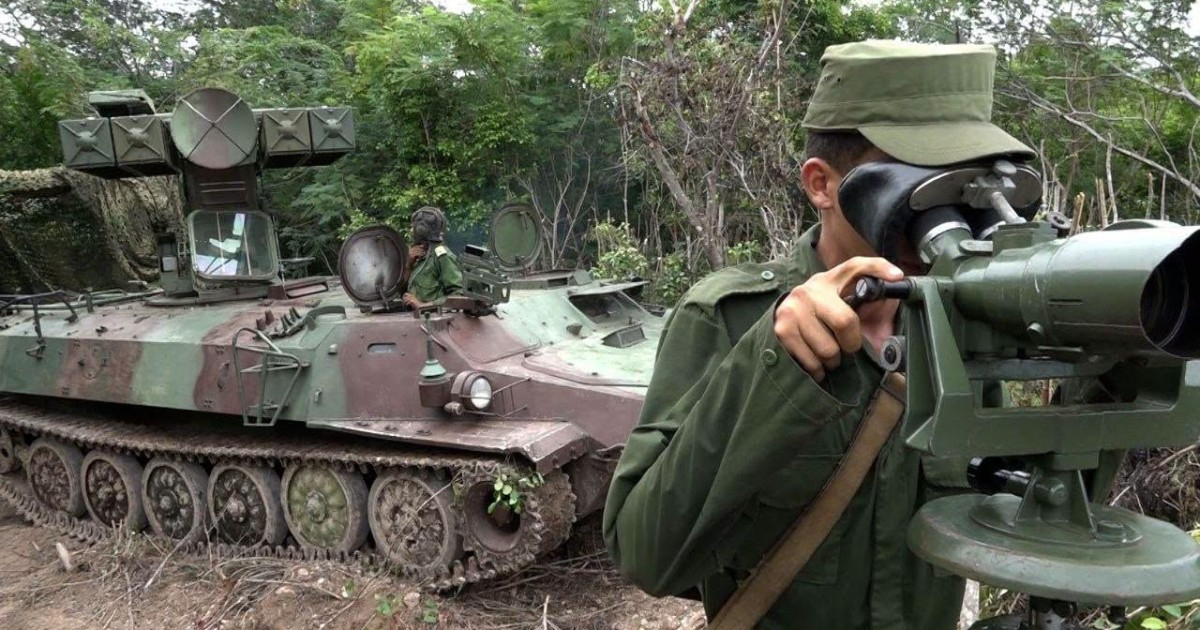
The U.S. State Department announced on Thursday punitive measures against two Chinese companies for providing military components and equipment to Cuba's Ministry of the Revolutionary Armed Forces (MINFAR). This move is part of a broader set of sanctions affecting eight entities, two individuals, and five vessels now considered blocked property, according to the State Department's official release.
Among the targeted Chinese firms are China National Electronic Import and Export Company (CEIEC), a state-owned exporter of defense electronics and security systems, and Beijing H&C Technologies Co., Ltd., a subsidiary of China Electronics Technology Group Corporation International based in Beijing's Xicheng district. These companies engaged with the Cuban military through Sociedad Mercantil Duna S.A., a Cuban firm previously sanctioned on August 6 for facilitating arms imports from China and Russia to MINFAR.
CEIEC is no stranger to U.S. authorities. In November 2020, the Treasury Department sanctioned the company for assisting Venezuela's then-government, led by Nicolás Maduro, with digital surveillance technology akin to a commercial version of China's "Great Firewall" to restrict internet access and target dissidents. The State Department's current designation underscores a consistent pattern of support for authoritarian regimes allied with Beijing in the Western Hemisphere.
First-Time Sanctions for Beijing H&C Technologies
Beijing H&C Technologies has been sanctioned for the first time in relation to Cuba, marking a significant escalation in the U.S. response to Chinese involvement with the Cuban military.
Additional Sanctions on Oil Transport Networks
Beyond the two Chinese companies, the sanctions extend to oil transport networks linked to the Cuban regime. Designated individuals and entities include Guillermo Faustino Rodríguez López-Calleja and four maritime companies: CAROIL Transport Marine Ltd (Cyprus), TENTACOOL Commercial Inc (Panama), Internacional Marítima S.A., and PETROMARCA, both based in Cuba. The five blocked vessels are the Esperanza, Gloria C, Maria Cristina, Emilia, and Lourdes.
The State Department has also sanctioned Any Rodríguez Lastres, daughter of Ania Guillermina Lastres Morera, the head of the military conglomerate GAESA. Lastres Morera had already been designated. Rodríguez Lastres served as commercial director of the Mariel Container Terminal S.A. The statement highlights how regime insiders and their families continue to profit from the dictatorship's control over Cuba's economy through opaque networks associated with GAESA.
Impact on Cuban State Entities and Broader Implications
Two Cuban state-owned technology entities, CUBAELECTRÓNICA and TECNOSIME, have also been added to the list. CUBAELECTRÓNICA imports supplies for the electronics industry, while TECNOSIME engages in commercial and technical services that generate revenue for the state.
Simultaneously, the Treasury's Office of Foreign Assets Control (OFAC) issued a determination expanding the potential reach of these measures: any foreign person operating in Cuba's manufacturing, technology, electronics, and maritime sectors can now face sanctions. The State Department clarified that these measures target the regime and its facilitators, not the Cuban people, and that humanitarian trade—such as food, medicine, and medical devices—remains permitted.
All designations were made under Executive Order 14404, signed by President Trump on May 1, 2026, which authorizes sanctions against individuals linked to repression in Cuba and threats to U.S. national security. This action is part of an escalating campaign against the regime's oil and military networks that Washington has intensified throughout 2026, supported by the State Department's July report "Cuba: The Capital of 21st Century Communism," which details China's operation of three out of 18 known Cuban signal intelligence facilities, depicting this presence as an "acute risk" to U.S. military operational security.
Understanding U.S. Sanctions on Chinese Companies in Cuba
Why were the two Chinese companies sanctioned by the U.S.?
The companies were sanctioned for supplying military components and equipment to Cuba's Ministry of the Revolutionary Armed Forces, which violates U.S. policies against supporting authoritarian regimes allied with Beijing.
What other entities were affected by the recent U.S. sanctions?
In addition to the two Chinese firms, the sanctions also targeted oil transport networks, including maritime companies and vessels linked to the Cuban regime, as well as individuals connected to military conglomerate GAESA.
How do these sanctions affect the Cuban people?
The sanctions are specifically aimed at the Cuban regime and its facilitators rather than the Cuban population. Humanitarian trade, including food, medicine, and medical devices, remains allowed.