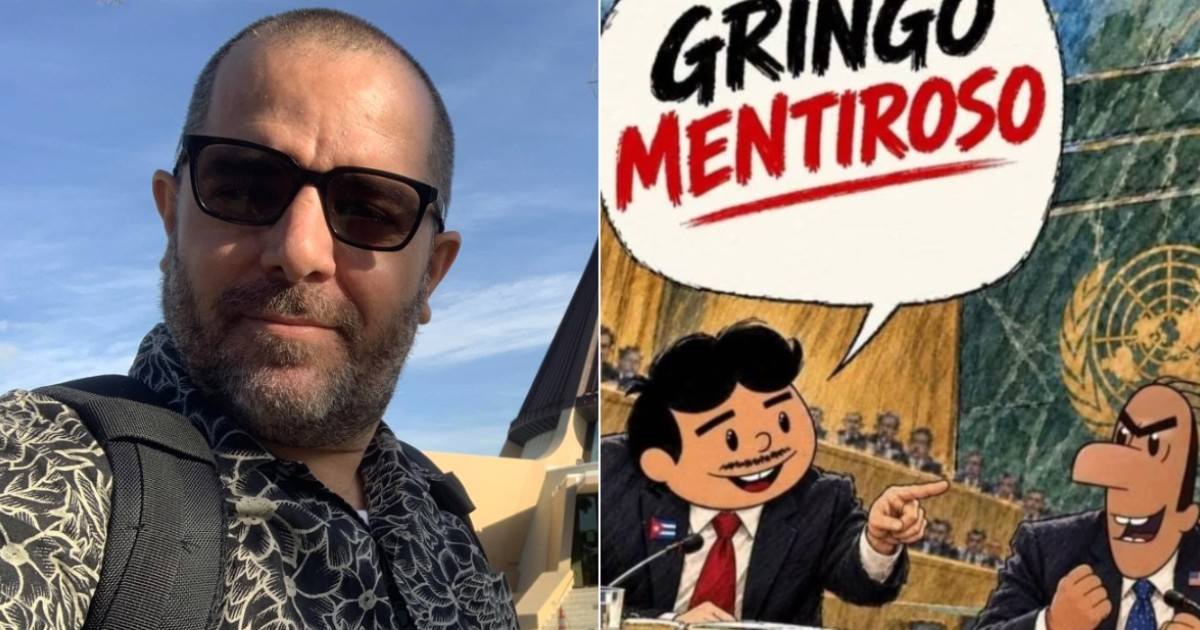
Filmmaker Ian Padrón has publicly criticized the unauthorized use of the animated character Elpidio Valdés by the Cuban regime, following the dissemination of a cartoon by government officials depicting the iconic mambí in a diplomatic clash at the United Nations.
The illustration, credited to user JaimeDOVA and shared by Cuba's ambassador to the UN, Ernesto Soberón Guzmán, features Elpidio Valdés and his nemesis Mr. Chains in a symbolic confrontation between Cuban and U.S. delegations at the UN General Assembly. Elpidio is shown wearing a black suit, red tie, and a Cuban flag pin, pointing at an enraged Mr. Chains, portrayed as a U.S. delegate, with the caption "LYING GRINGO" above him.
Mr. Chains represents U.S. economic influence in Cuba during the 19th-century wars of independence. The cartoon adapts this character for current diplomatic tensions by placing him behind a microphone labeled "United States."
The cartoon was also shared by Miguel Díaz-Canel, who posted it on October 28 alongside a message from Foreign Minister Bruno Rodríguez Parrilla with the slogan "Cuba is not a threat, the blockade is," adding his own comments labeling the U.S. stance at the UN as "miserable work."
Ian Padrón directly addressed Soberón's post with an unequivocal denunciation: "This is yet another outrage—one of many committed by the Cuban dictatorship—using the character Elpidio Valdés (Juan Padrón, 1970) without authorization for propaganda or political positioning. I hope that in a future Cuba, this will be punished and there will be respect for Cuban creators' copyright."
Sharing his response on his own Facebook page, Padrón added, "Cuban bureaucrats only wish they had the popularity and affection that thousands of Cubans feel for this cartoon character." He further emphasized, "In any state governed by the rule of law, copyright would be respected."
The Diplomatic Standoff at the UN
This image surfaced in the context of a tense standoff at the UN on October 27, when Rodríguez Parrilla and other Cuban mission members approached the podium where U.S. Ambassador Mike Waltz was speaking, prompting Assembly President Khalilur Rahman to temporarily suspend the session.
The following day, the U.S. expelled Cuban diplomat Richard Tur de la Concepción, first secretary of Cuba's Permanent Mission to the UN, for attempting to seize the phone of Waltz's spokesperson. This action was ordered by Secretary of State Marco Rubio.
Following these incidents, the regime circulated the Elpidio Valdés cartoon as part of its narrative of "victory" over Washington, once again disregarding the position of the character's creator's heirs.
Ian Padrón's Ongoing Battle for Elpidio Valdés
This is not the first time Ian Padrón has faced such a situation. In August 2024, he responded to Díaz-Canel when the leader appropriated the character's symbolism for the 54th anniversary of its creation, and he did so previously in 2019 during the constitutional referendum and again in 2023 during parliamentary elections.
Throughout these incidents, Padrón has maintained a consistent stance: "We, the heirs of Padrón, have the authority to decide, because our father entrusted us with that power. We are the ones who can determine the use of that character, and we have strived to prevent any political association."
Elpidio Valdés was created by Juan Padrón—born in Matanzas in 1947 and who passed away in Havana on March 24, 2020. The character first appeared in the children's magazine Pionero on August 14, 1970. Ian Padrón has pointed out that "Cuba's copyright law is quite draconian, offering little protection for the true rights of creators," enabling the regime to continue exploiting others' works with impunity.
Understanding the Elpidio Valdés Controversy
What is the significance of Elpidio Valdés in Cuban culture?
Elpidio Valdés is a beloved animated character created by Juan Padrón, symbolizing Cuban resistance and national pride during the wars of independence in the 19th century.
Why is Ian Padrón opposed to the regime's use of Elpidio Valdés?
Ian Padrón opposes the regime's use of Elpidio Valdés because it is unauthorized and exploits the character for political propaganda, disregarding the creator's and heirs' rights.
What actions have been taken regarding the misuse of Elpidio Valdés?
Ian Padrón has publicly condemned the misuse and called for future legal protections for creators' rights in Cuba, though no legal actions have been reported yet.