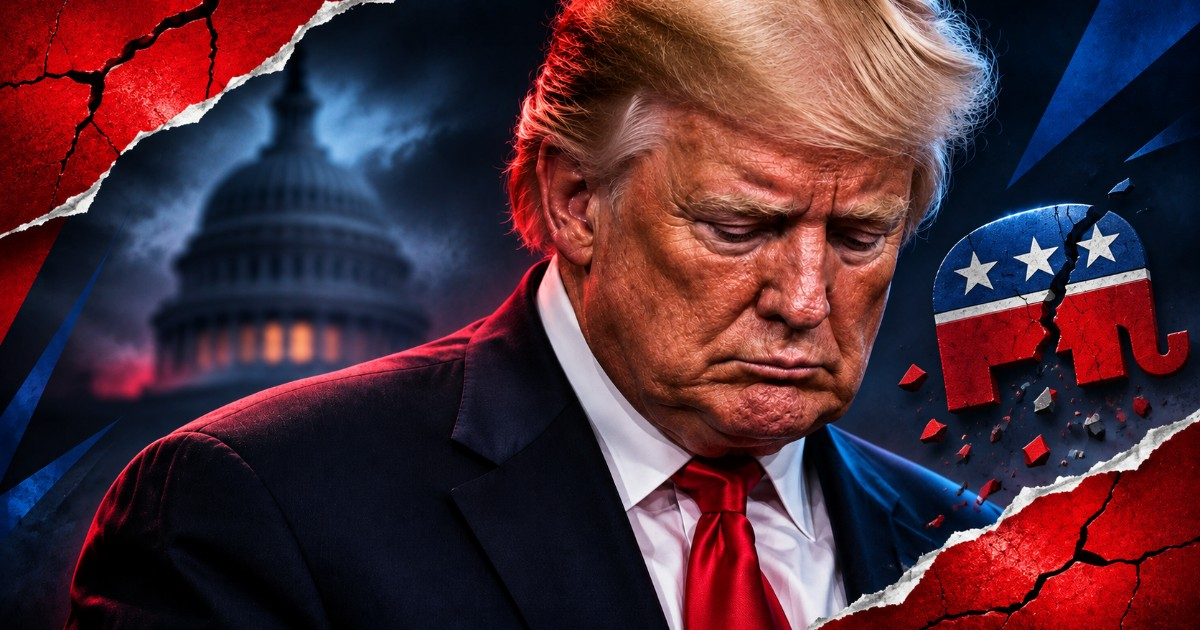
The internal discord within the Republican Party erupted after Tuesday's legislative elections in the United States. Key figures, strategists, and White House allies are laying the blame squarely on President Donald Trump for the loss that allowed Democrats to reclaim control of Congress.
According to a report by BBC News, published on Wednesday, the initial shock over the election results quickly turned to anger among Republican circles. Many are questioning the President's decisions, his political priorities, and his neglect of economic issues impacting American families.
"The responsibility lies with him. It belongs to no one else. It is a complete and absolute rejection of President Trump," declared Bill Miller, a prominent Republican lobbyist from Texas.
Miller described the situation as a "major disaster" that caught everyone off guard, emphasizing that the results represent a direct rebuke to Trump's presidency.
Unexpected Democratic Victories
Criticism mounted after Democrats secured wins in traditionally Republican states such as Texas, Kansas, and South Carolina, outcomes that exceeded the expectations of leaders from both parties.
Republican strategist Gregg Peppin from Minnesota criticized the administration's direction and attributed part of the defeat to the unpopularity of Trump's policies. "It was one mistake after another," Peppin stated. "Clearly, in many states, people didn't like the President's policies."
The BBC interviewed several Republican Party members, campaign officials, and individuals linked to the White House. Many spoke under anonymity to express their disagreements with Trump's electoral strategy.
Internal Party Frustrations
An ally of the administration pointed to the government's stance on Iran, tariffs, and immigration measures as contributing factors to a "perfect storm" that ultimately harmed Republican candidates. "There is palpable frustration within the party over how events have unfolded," said the source, describing the anger against Trump as "sky-high."
Critics also noted that the President seemed more focused on personal projects and construction works in Washington, while voters voiced concerns over rising prices, especially gas costs. In the months leading up to the elections, Trump promoted various remodeling projects in the U.S. capital, including a ballroom in the White House, a helipad, and a commemorative arch near Arlington National Cemetery.
Republican Convention Tensions
The Republican convention held in September in Dallas also sparked discontent among party leaders who hoped for more exposure for their legislative candidates. Instead, Trump dominated much of the attention during the event and made surprising comments about Ken Paxton, then a Republican Senate candidate from Texas, questioning his appearance and charisma while endorsing him.
Robin Armstrong, a member of the Republican National Committee from Texas, acknowledged that these remarks did not aid the campaign. "Obviously, that never helps," Armstrong said. "You can't stop what President Trump says. We just have to accept it."
Paxton ultimately lost the election to Democrat James Talarico, whose campaign was praised even by some Republicans interviewed after the polls.
Calls for Change within the Party
Despite the criticism, not everyone agreed. Other party members defended Trump's work and deemed it unfair to place all the blame on him for the electoral setbacks. Krish Mathrani, president of the Republican youth committee in Michigan, highlighted the President's need to juggle presidential duties alongside the campaign and praised his ability to mobilize supporters.
"He's the president. He's not going to spend his time campaigning 24/7," Mathrani stated.
Some White House allies also pointed out that the party fielded weak candidates in key states and reminded that historically, midterm elections tend to disadvantage the party holding the presidency.
In response to losing Congress, Trump took to his social media platform, Truth Social, to distance himself from the outcome. "I wasn't on the ballot, and if I had been, we would have won by a landslide!" he wrote.
Later, in interviews with The New York Times and Fox News, Trump said he would accept the results, admitting to being "a bit surprised," but noted that governing parties often lose ground in legislative elections.
The Party's Future Beyond Trump
The election outcome has also reignited discussions within the Republican Party about its future after Trump and the need to present a different agenda for the 2028 presidential elections. Steve Scheffler, a member of the Republican National Committee in Iowa, mentioned potential figures for the upcoming elections, including Vice President JD Vance, Secretary of State Marco Rubio, and Senator Ted Cruz.
Peppin was more direct in calling for political renewal within the party. "I sincerely hope we've moved past the Trump era and that going forward, we have new players, new issues, and a new focus," the Republican strategist expressed.
However, the criticism against Trump didn't start with Tuesday's defeat. On October 18, exiled Cuban doctor Manuel Guerra, identifying as a Republican, predicted that his party might lose the House of Representatives and possibly the Senate, blaming Trump for unfulfilled promises and government decisions.
"Being Republican doesn't mean being a subject of Donald Trump. A party's principles should be above any president's ego," Guerra stated at the time.
The doctor criticized the administration's economic, immigration, and foreign policies and warned against confusing loyalty to conservative values with personal obedience to the President.
Several Republican lawmakers had publicly distanced themselves from Trump over his agreement to import Russian diesel, a decision they questioned as it provided revenue to Moscow while the war in Ukraine continued.
Among those expressing dissent were Senators John Kennedy and Lisa Murkowski, along with Representatives Michael McCaul, Brian Fitzpatrick, and Don Bacon. The rejection also came from former Vice President Mike Pence, who demanded that Trump rescind the energy deal with Russia and reinstate sanctions against Vladimir Putin's government.
Ahead of the elections, polls already indicated challenges for Republican candidates, especially due to the cost of living, high fuel prices, and the unpopularity of the war with Iran.
Before voting took place, Trump had warned that if Democrats regained Congress, he would use his veto power to block opposition initiatives and force negotiations, a strategy he described by saying he would become "Mr. Veto."
Key Questions on Republican Party Dynamics
What were the main reasons Republicans blamed Trump for the electoral defeat?
Republicans cited Trump's unpopular policies, his focus on personal projects over economic issues, and decisions like the Russian diesel import agreement as key factors in the electoral loss.
How did the election results affect the future of the Republican Party?
The results sparked discussions on the need for a new agenda and leadership beyond Trump, with potential figures like JD Vance, Marco Rubio, and Ted Cruz being mentioned for future elections.
What were some internal criticisms voiced by Republicans regarding Trump's leadership?
Republicans criticized Trump's handling of economic and foreign policies, his focus on personal projects, and his controversial comments during the Republican convention.