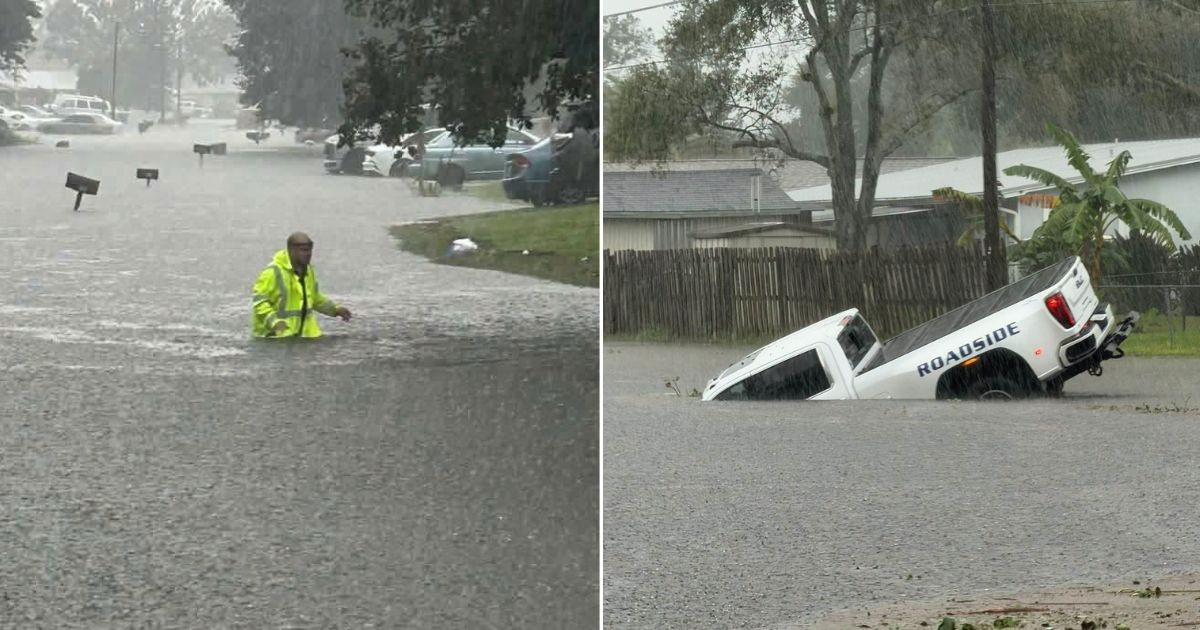
Over the span of just 48 hours, certain areas of Florida were deluged with rainfall equaling nearly six months' worth of typical precipitation. This deluge resulted in over 600 millimeters of rain, causing significant flooding in homes, trapping vehicles, and leading to road closures.
Matt Devitt, a notable American meteorologist, reported on Facebook that the southern region of Brevard County experienced approximately 24 inches of rain, translating to 61 centimeters, over the previous two days.
He highlighted that this amount is nearly equivalent to half a year's typical rainfall for the region.
Preliminary figures released by the National Weather Service's Weather Prediction Center confirmed the extent of the event: from 10:00 AM Sunday to 9:00 AM Tuesday, Malabar recorded up to 24.10 inches, while Grant-Valkaria saw 23.69 inches, both located in Brevard County.
These figures, roughly 612 and 602 millimeters respectively, placed these communities among the hardest hit by the storm.
Palm Bay experienced 20.60 inches, and Melbourne Beach reported 19.80 inches. Further south, some West Palm Beach stations recorded up to 22.20 inches, according to preliminary data from the meteorological agency.
Devitt's report also noted substantial accumulations in Palm Beach Gardens, Sebastian Inlet, Sebring, Port St. Lucie, Zolfo Springs, Sunrise, Okeechobee, and Cape Canaveral, based on measurements and estimates from various state locations.
The sheer volume of rain led Devitt to estimate that approximately three trillion gallons of water fell on Florida over the 48-hour period.
By his calculations, this amount could fill Lake Okeechobee, one of Florida's largest freshwater bodies, about three times over.
The extraordinary rainfall resulted from the convergence of several meteorological factors. A nearly stationary atmospheric convergence zone focused storm activity, while a disturbance created favorable conditions for moist air to rise, leading to further precipitation.
This was compounded by an unusually high level of tropical moisture and a phenomenon known as "training storms," where successive rain cells repeatedly pass over the same areas.
This combination caused prolonged rainfall over already flooded communities, exacerbating damage and complicating water drainage.
Devitt emphasized that this incident occurred at the start of November, typically one of the driest months in much of Florida.
The downpours led to significant flooding across central and southeastern Florida. Water infiltrated homes, immobilized vehicles, and forced road closures due to impassable conditions.
On Monday, the National Weather Service declared a flash flood emergency in Palm Bay, West Melbourne, and parts of Grant-Valkaria, warning of a potentially life-threatening situation and possible catastrophic damage.
Authorities reported that some areas had already experienced between 15 and 20 inches of rain, with more expected on already saturated ground.
Images from Brevard County illustrated streets transformed into canals, cars partially submerged, and residents using small boats and surfboards to navigate the flooded areas.
In response to the severe situation, Governor Ron DeSantis declared a state of emergency in seven counties: Brevard, DeSoto, Hardee, Highlands, Indian River, Martin, and St. Lucie.
This declaration, enacted through Executive Order 26-227, enables the mobilization of extraordinary resources and accelerates assistance to affected communities, as well as response and recovery efforts.
Frequently Asked Questions about Florida's Record Rainfall
What caused the heavy rainfall in Florida?
The intense rainfall was caused by a combination of meteorological factors, including a stationary atmospheric convergence zone, a disturbance providing favorable conditions for moist air to rise, unusually high tropical moisture, and "training storms," where rain cells repeatedly pass over the same areas.
How much rain fell in Brevard County during the storm?
Brevard County was significantly impacted, with Malabar recording up to 24.10 inches and Grant-Valkaria seeing 23.69 inches over the 48-hour period.
What is the impact of the rainfall on local communities?
The heavy rainfall led to severe flooding, causing water to enter homes, trapping vehicles, and forcing road closures. It also resulted in a flash flood emergency in several areas, posing a life-threatening situation and potential catastrophic damage.
How did the state government respond to the flooding?
Governor Ron DeSantis declared a state of emergency in seven counties, allowing for the mobilization of extraordinary resources and expedited assistance to the affected communities.