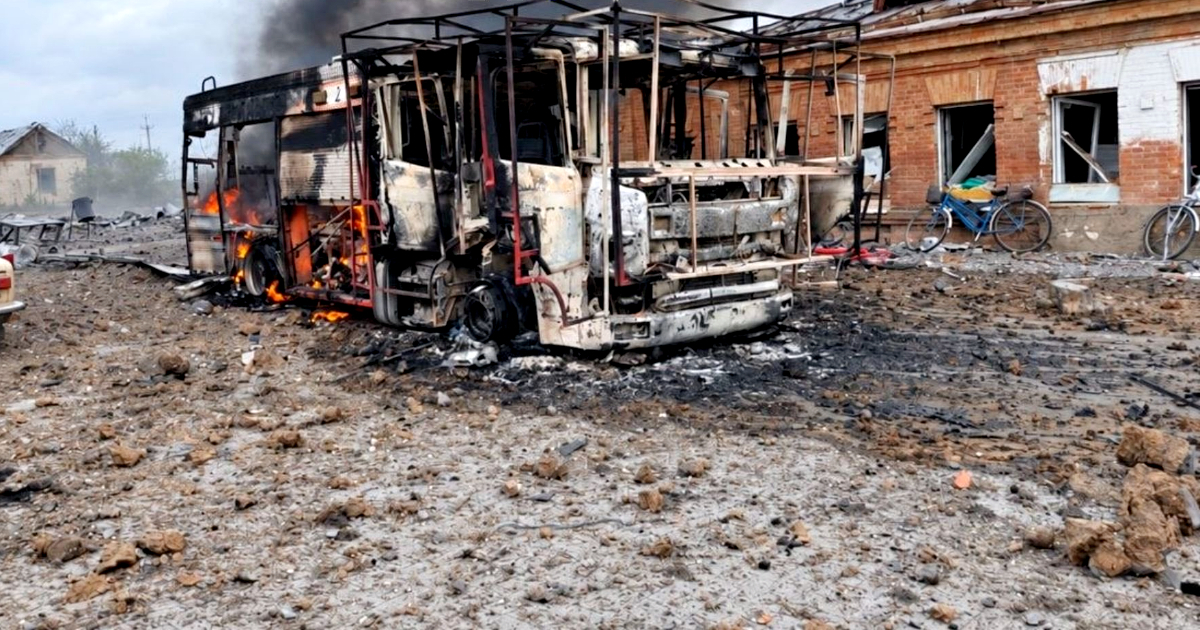
In a devastating act of aggression, at least 33 individuals lost their lives, and about 50 remain unaccounted for following a Russian strike on a Ukrainian school repurposed as a humanitarian center in Komyshuvakha, a town in the southeast region of Zaporizhzhia.
According to CNN, Ukrainian President Volodymyr Zelensky condemned the assault, which occurred on Monday, as "one of the deadliest of this war."
Originally not being used as a school due to the advancing warfront, the building functioned as a local administrative hub and a critical point for distributing humanitarian aid. Despite its reinforced basement, constructed with European Union funds in 2025 to ensure educational activities could continue amidst conflict, the structure succumbed to the intense bombing, resulting in a fire.
Regional Governor Mykhailo Semikin elaborated on the attack, stating that Russia deployed KAB-500 bombs initially, followed by FAB-3000 bombs. "To put it into perspective, this is a three-ton air bomb containing nearly 1.5 tons of explosive material, designed primarily to obliterate heavy concrete fortifications and bunkers," he explained on Ukrainian national television.
Impact of the Double Strike Tactic
The assault followed the notorious "double strike" pattern, where a first wave lures emergency responders, making them subsequent targets. Tragically, first responders Denys Konovalenko and Oleksiy Sushchevsky, both aged 44, were killed while responding to the initial blast.
Additionally, four police officers—Mykhailo Buzhenko, Mykola Balanda, Mykhailo Romanov, and Dmytro Besedin—were also among the deceased. They had been assisting locals in seeking refuge within the school when the subsequent treacherous attack ensnared them.
Humanitarian Aid and International Law Violations
The prior announcement of humanitarian aid distribution led the UN Human Rights Monitoring Mission to scrutinize Russia's actions. Danielle Bell, the mission's director, criticized the attack, stating that it either demonstrated a willful disregard for the ongoing humanitarian efforts or a failure to conduct basic reconnaissance, thus breaching fundamental international humanitarian law principles.
Just hours after the Komyshuvakha bombing, Russia launched a massive offensive targeting Ukrainian energy infrastructure, deploying 289 drones, 17 ballistic missiles, and 59 cruise missiles across ten regions.
Three drones specifically targeted a substation vital to the Khmelnytskyi nuclear power plant, prompting Ukrainian Energy Minister Denys Shmyhal to notify the International Atomic Energy Agency, emphasizing the threat to Europe's nuclear safety.
Timing of Attacks and Diplomatic Efforts
Zelensky linked the timing of Moscow's actions to the U.S. midterm elections held on Tuesday, noting, "It's telling that this is happening on the day of the U.S. midterm elections. The Russians think America won't notice this signal. But this terror must be acknowledged and stopped."
Amid these tensions, fragile diplomacy initiated by the Trump administration is ongoing. U.S. envoy Steve Witkoff recently met with Zelensky in Oslo and Russian President Vladimir Putin in St. Petersburg, paving the way for upcoming trilateral technical negotiations in Abu Dhabi on November 10 and 11.
Meanwhile, Melania Trump facilitated a localized ceasefire in the occupied city of Oleshky, allowing the evacuation of approximately 800 people. The White House announced a meeting in Washington between Russian and Ukrainian representatives, describing it as "an extraordinary moment in American history."
Despite these diplomatic gestures, the scale of Monday's and Tuesday's attacks highlights the stark contrast between negotiation efforts and the harsh realities on the ground, where recent months have been especially brutal for Ukrainian civilians.
Understanding the Russian Bombing in Zaporizhzhia
What was the impact of the bombing on the Komyshuvakha school?
The bombing resulted in the death of at least 33 people, with around 50 more missing. The school, which had been converted into a humanitarian center, was destroyed, and a fire erupted due to the bombing.
How did the international community react to the bombing?
The UN Human Rights Monitoring Mission criticized the bombing, suggesting it violated international humanitarian law. The attack drew condemnation and concerns over the humanitarian situation and the safety of civilians.
What is the significance of the timing of these attacks?
Ukrainian President Zelensky noted the attacks coincided with the U.S. midterm elections, suggesting Russia might think the U.S. would overlook the aggression. It highlights the intersection of military actions and international political events.