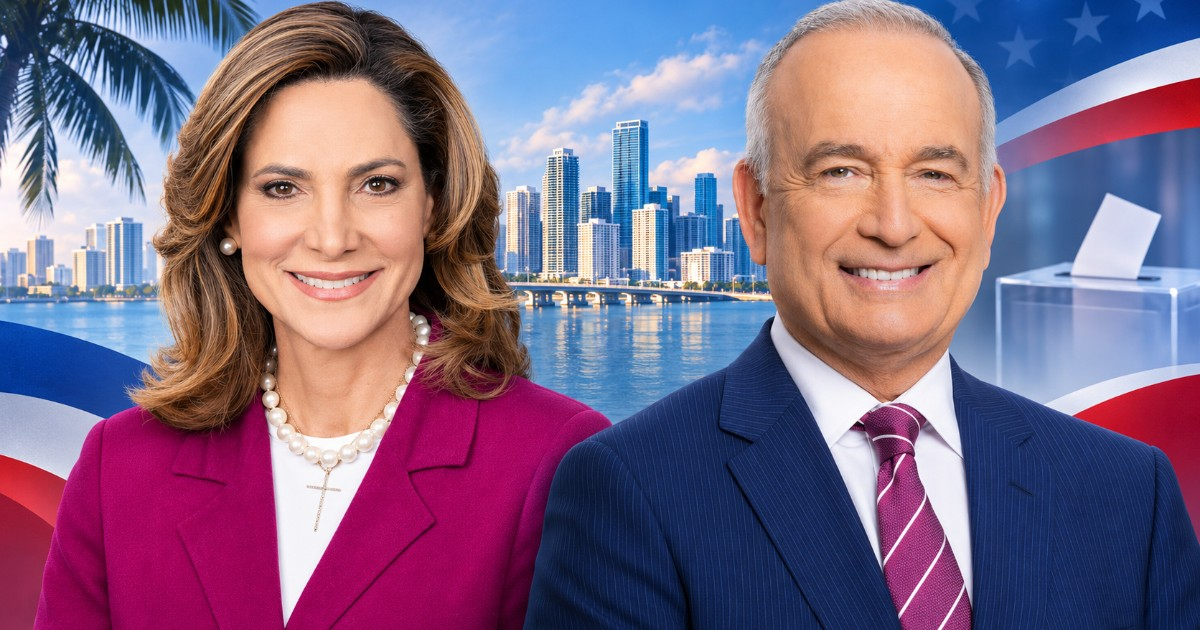
On Tuesday, November 3, Republican congresswoman Maria Elvira Salazar seeks a fourth term in the U.S. House of Representatives, representing Florida's 27th district. Her opponent in this highly watched South Florida race is Democrat Eliott Rodríguez, a former television anchor with Cuban roots.
Both candidates are children of Cuban immigrants, yet their paths diverged significantly. Salazar was born in Miami and spent years in Spanish-language television before joining Congress in 2021. In contrast, Rodríguez was born in the Bronx, New York, and built his journalism career in South Florida, working for outlets such as Local 10 and CBS Miami. Both attended Miami Dade College and the University of Miami, according to Local 10.
Immigration Policy and Trump Highlight Key Differences
Immigration policy has emerged as a pivotal issue in their contest. Rodríguez criticizes Salazar for supporting funding for Immigration and Customs Enforcement (ICE) and remaining silent about the detention center known as "Alligator Alcatraz." "She voted to fund ICE," the Democratic candidate told Local 10. In an interview with Tania Costa for CiberCuba, he also questioned her stance on the treatment of Cubans with I-220A status, as well as her voting record on Medicaid and the SNAP food assistance program.
Salazar defends her congressional record, emphasizing her initiatives on flood management and coastal resilience, along with the TAKE IT DOWN Act, which targets the non-consensual distribution of intimate images, including those generated by artificial intelligence. Additionally, she advocates for the Dignity Act, a proposed immigration reform yet to be enacted.
Despite some previous criticism of certain deportation policies from her party, former President Donald Trump lent his support to Salazar's reelection campaign in its final stages. Rodríguez, on the other hand, prioritizes comprehensive immigration reform, addressing living costs, and safeguarding Social Security and Medicare.
Tight Polls and Republican Fundraising Edge
A RedBox Research poll conducted between October 20 and 23 among 523 likely voters indicated Salazar holding a slight lead with 49% to Rodríguez's 46%, a gap within the survey's ±5.5-point margin of error. This poll was sponsored by the super PAC A Fight Worth Having, with polling conducted by RedBox.
In terms of campaign funds, Salazar has maintained a financial advantage. Reports to the Federal Election Commission, compiled by Decision Desk HQ, show that by October 14, Salazar had raised approximately $2.52 million, compared to Rodríguez's $1.57 million.
Miami-Dade polling stations close at 7:00 p.m. local time. Florida Election Watch plans to release preliminary state results starting at 8:00 p.m. once polling concludes across the state's time zones. Readers can follow the vote count for district 27 in CiberCuba's special election coverage.
Frequently Asked Questions on the Miami Electoral Contest
What are the main issues in the Salazar vs. Rodríguez election?
The key issues in the election include immigration policy, with Rodríguez criticizing Salazar's support for ICE funding, and broader topics such as Medicaid, SNAP, and living costs.
How do the candidates' backgrounds differ?
Maria Elvira Salazar was born in Miami and worked in Spanish-language television before joining Congress. Eliott Rodríguez, born in the Bronx, pursued a journalism career in South Florida.
What is the current state of polling in the election?
A recent poll indicates a close race, with Salazar leading at 49% and Rodríguez at 46%, within the margin of error.
Who has the financial advantage in the campaign?
Maria Elvira Salazar has a financial edge, having raised approximately $2.52 million compared to Eliott Rodríguez's $1.57 million.