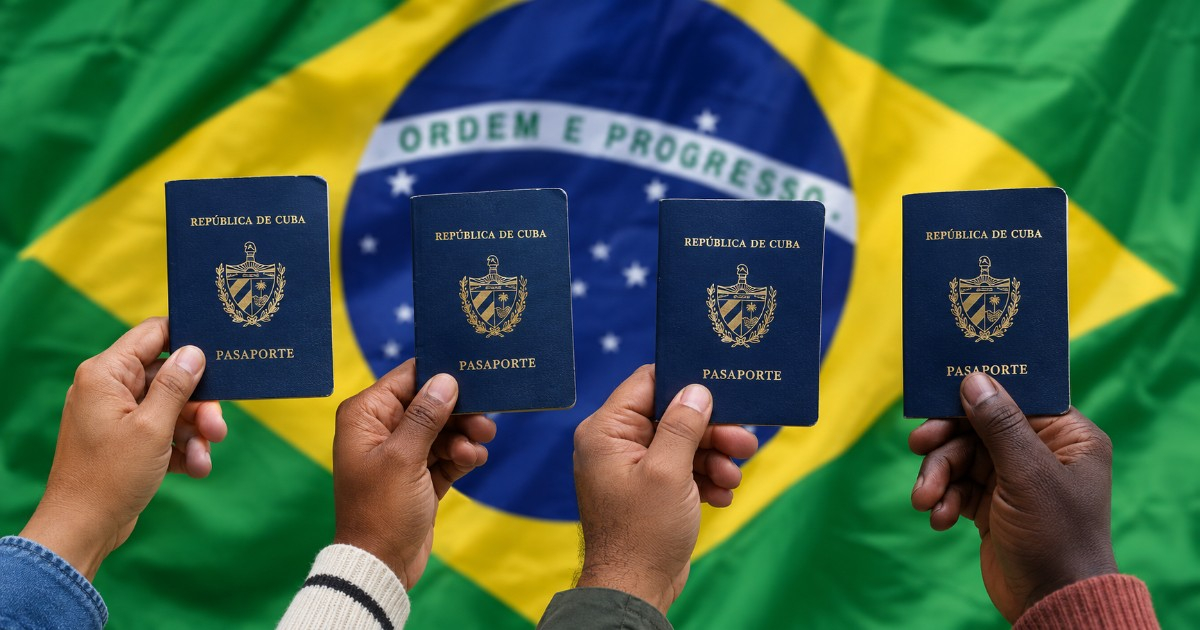
Between January and September of 2026, Brazil received an astonishing 33,185 asylum applications from Cuban nationals, as reported by the International Migration Observatory (OBMigra) under Brazil's Ministry of Justice and Public Security.
The number of applications steadily increased throughout the year, starting with 3,448 in January and peaking at 4,885 in September, marking the highest monthly record within the nine-month period.
This surge in September represented a 13.8% increase over August and a 19.6% rise compared to the same month in 2025, when 4,084 applications were recorded.
Cubans overwhelmingly led the asylum-seeking demographic in Brazil during that month, with their 4,885 applications comprising 62.9% of the 7,772 total requests from all nationalities.
Out of the September submissions, 2,513 were from men and 2,371 from women.
By the end of that month, there were still 99,306 Cuban cases pending, making up 58.7% of the 169,136 unresolved asylum requests from all nationalities—a backlog reflecting years of delayed responses.
Obtaining formal refugee status is notoriously challenging in Brazil. The process through the National Committee for Refugees (CONARE) can take over five years, and during the first quarter of 2026, no Cuban was granted this status.
This trend is part of a sustained increase. In 2024, Cubans submitted 22,288 asylum requests in Brazil; this number soared to 41,919 in 2025, an 88.1% jump, surpassing Venezuelans as the top nationality seeking refuge for the first time in a decade.
The exodus is largely driven by two major factors: Cuba's internal collapse, marked by chronic blackouts, food and medicine shortages, and an economy that has shrunk by more than 15% since 2020, and the closure of the migration route to the United States following stricter immigration policies implemented by the Trump administration in January 2025.
This closure redirected a significant flow of migrants towards South America. The Darién Gap, once the continent's busiest migration corridor, saw only 280 crossings in the first half of 2026, compared to 201,063 during the same period in 2024.
The primary route begins with a flight from Havana to Georgetown, Guyana's capital—South America's only country not requiring visas from Cubans—followed by an overland journey to Lethem and an irregular crossing of the Tacutu River into Brazil's Roraima state.
The International Organization for Migration (IOM) estimates that around 3,000 Cubans enter Brazil monthly via this route, warning that human trafficking networks charge between $1,200 and $10,000 per migrant.
In the formal job market, OBMigra data recorded 39,212 hirings and 26,075 dismissals of Cuban workers between January and August 2026, yielding a positive employment balance of 13,137 jobs, indicating active labor integration.
Additionally, Brazil issued 4,331 visas to Cuban citizens in the first nine months of the year; the 497 visas granted in September represented a 51.1% increase over the 329 issued in September 2025.
The Brazilian Ministry of Justice estimates that around 84,000 Cubans currently reside in the country, with Curitiba—the capital of Paraná state—emerging as the main settlement hub, so much so that local media have dubbed it "the new Miami."
If the current trend continues, Brazil is poised to become the primary destination for Cuban migrants in South America. As summarized by the IOM: "This route has gained significance as Brazil welcomes a growing number of Cubans seeking international protection and economic opportunities."
Cuban Migration to Brazil: Key Questions and Answers
Why are so many Cubans seeking refuge in Brazil?
Cubans are fleeing due to severe economic collapse and political repression in Cuba, compounded by the closure of migration routes to the United States.
What challenges do Cuban asylum seekers face in Brazil?
Gaining formal refugee status in Brazil is challenging, with processes extending over five years and a significant backlog of pending cases.
How has the migration route to Brazil changed for Cubans?
The route now typically involves flying to Guyana, traveling overland to Brazil, and crossing into Roraima state, reflecting a shift from the previously popular Darién Gap route.