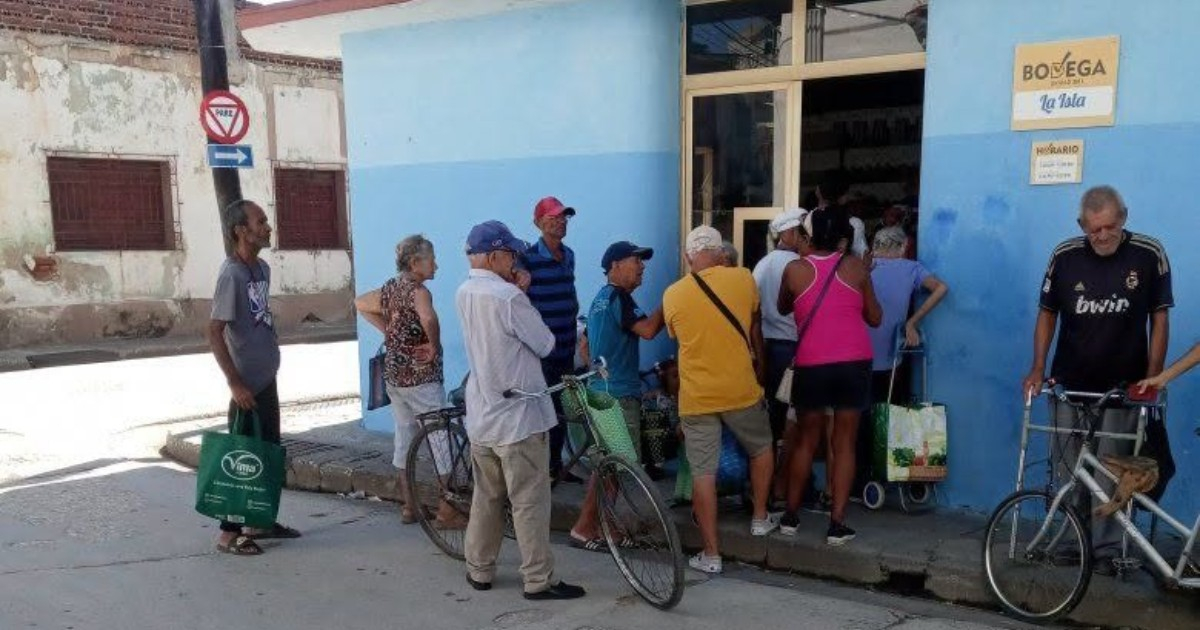
A retired teacher from Bayamo, located in Granma province, has publicly voiced his frustration over being classified as vulnerable yet finding himself absent from the beneficiary list at the designated food distribution center.
Enrique Barcaz Millán, a senior citizen suffering from heart disease and living alone, took to Facebook to share his ordeal. After being visited by a social worker who registered him as vulnerable, he was informed he could collect a food package at La Isla — formerly known as Almiral. The package included 10 pounds of rice, two pounds of peas, and two pounds of turbinated sugar. However, upon arrival, his name was missing from any list.
"It's absolutely unbelievable that after being registered as 'vulnerable' by a social worker at my home, I went to La Isla, only to find my name absent from any list," the retiree wrote.
"Not even Franz Kafka with his absurd tales could capture the essence of such a situation. What can we expect? Nothing. Every day things get worse, and tasks are done backwards. It's outrageous that so many are left out, needing so much or so little to live. It's an unsustainable situation, and I can't find the right words to describe it. Who can survive on such meager pensions with exorbitant prices? Are we 'vulnerable'?" he questioned.
He further commented, "In San Juan and El Cristo neighborhoods, they were registered to fetch 'state benevolence groceries' from this sole store, while others will become private enterprises."
Similar stories emerged from across Cuba. In Ciego de Ávila, one person shared, "Here in my Primero de Enero municipality, it was the same. My dad is vulnerable, an elderly man living alone with a grandson, yet he received nothing." In Pinar del Río, another individual echoed, "I'm in the same situation as you, not on any list. I went to the labor office, they took my information again, told me to wait for a social worker, and I'm still waiting. No one cares about our pain."
Widespread Issues with New Social Assistance Scheme
This scenario highlights a recurring issue in the new targeted social assistance program approved by the National Assembly in June 2026. This initiative replaced universal subsidies with aid modules aimed at those deemed vulnerable. In Bayamo, distributions began between October 23 and 25, identifying 66,510 highly vulnerable individuals in Granma province.
The crux of the problem is that being counted in a home census does not guarantee inclusion on the final list. Social workers must verify if family members can support the individuals, and final lists are reconciled by the Oficodas with municipal labor departments. This second administrative validation often leads to unmet expectations.
A similar incident was reported in Santiago de Cuba, where an elderly individual was denied aid because his daughter resides in Brazil. No official criteria for such exclusion have been published in the official Gazette.
The Pension Crisis Underlying the Issue
Underlying these challenges is a dire pension crisis in Cuba. The country is home to approximately 1,774,310 pensioners, with a minimum pension of 4,000 Cuban pesos, equivalent to just seven to ten dollars on the informal market. Meanwhile, the basic food basket costs between 12,000 and 30,000 pesos per person monthly. In June 2026, the Granma provincial government admitted lacking the funds to pay its more than 111,000 retirees, with a need for over 400 million pesos just to cover one month's pensions.
Understanding Cuba's Social Assistance Challenges
What is the new social assistance program in Cuba?
The new program, approved in June 2026, replaced universal subsidies with targeted aid modules for individuals classified as vulnerable. It aims to distribute food and other necessities to those in need.
Why are some vulnerable individuals not receiving aid?
Issues arise because being registered in a census does not guarantee inclusion on the final aid list. Social workers must verify familial support, and lists are finalized through administrative processes that often result in discrepancies.
What are the financial challenges faced by Cuban pensioners?
Cuba's pensioners struggle with low pensions, which are inadequate to cover basic living costs. The minimum pension is only 4,000 pesos, far less than the cost of a basic food basket, creating significant financial strain.