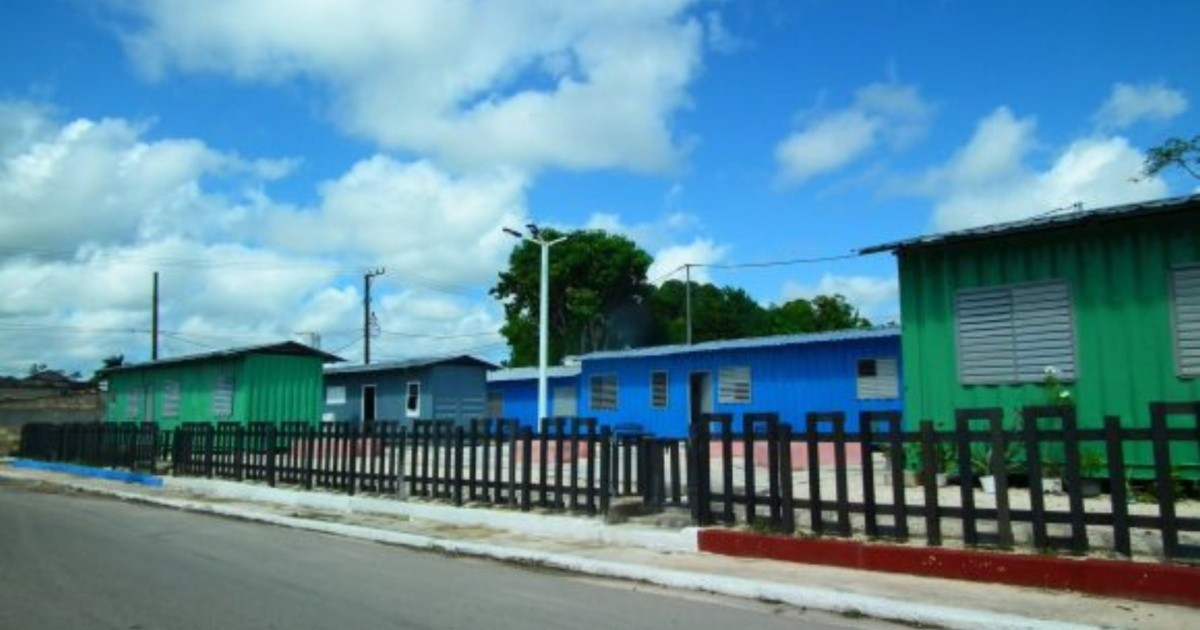
The state-run media outlet Cubadebate released a glowing report this Sunday on the so-called "metallic" housing project in San Sebastián, located in the Pueblo Nuevo district of Matanzas. Here, seven underprivileged families received homes constructed from recycled shipping containers as part of the Cuban government's housing initiative.
The article, penned by Arnaldo Mirabal Hernández, includes triumphant testimonies from the beneficiaries. The most revealing comment came from Aneity Sosa, who resides in the complex with her son suffering from West Syndrome and celiac disease: "For having nothing, this is super good! The house I lived in before even had a cesspool in the middle of the living room."
This statement, far from praising the program, starkly highlights the extreme poverty many Cubans endure after decades of dictatorship: a mother expresses gratitude for living in a 270-square-foot metal container because her previous living conditions were even worse.
Another recipient, Ana Lidia Gutiérrez, aged 64, admitted her initial reaction to the news of the allocation was rejection: "Living in that piece of metal?!" Her granddaughter, Yelay Naray, summarized their previous conditions: "We lived in a tiny room without the most basic living conditions, we didn't even have a bathroom."
Each unit includes two bedrooms, a tiled kitchen, a bathroom, interior thermal insulation, an exterior cover to reduce solar radiation, cross-ventilation, and an elevated water tank. The complex also features a park with photovoltaic lighting. Hidovaldo Díaz Martínez, Coordinator of Programs and Objectives for the Provincial Government of Matanzas, acknowledged there are "aspects to improve" such as the metal carpentry, and described the task of urbanizing the swampy terrain as "titanic," requiring peat extraction to find firm ground.
The containers come from packaging used to transport components from China for five photovoltaic solar parks built in the province. Matanzas has 100 of these structures available.
What the official report omits is the true context of the program. Prime Minister Manuel Marrero Cruz announced the initiative in December 2025 with the goal of converting over 3,500 containers into homes, yet progress has been minimal: by April 2026, only 133 units had been delivered nationwide and just 19 were fully completed.
In Cuba, the housing deficit exceeds 929,000 homes, and in 2025 only 2,382 units were built out of the 10,795 planned, meeting just 22% of the yearly goal.
The cost is also unmentioned. Each container home costs approximately one million Cuban pesos, financed through loans, compared to roughly 225,000 pesos for a conventional masonry house. In Ciego de Ávila, the conversion can reach 1,830,000 pesos.
Architect Abel Tablada warned in May 2026 that metal containers could reach extreme temperatures under Cuba's tropical climate without permanent air conditioning, a near impossibility in a country suffering from power outages lasting over twenty hours daily. On social media, Cubans have already dubbed these homes "the Microwave."
The adolescent Mónica, a resident of the complex, inadvertently provided the most telling detail of the report by explaining why she enjoys the illuminated park: "especially sitting in the evenings to chat in the lighted park when the power goes out."
While the government boasts of these deliveries as housing achievements, Aneity Sosa hopes for something more tangible: a small refrigerator to store the special foods her celiac son requires. "Even if it's a small one, like those mini-bars that are all over the place," she requested.
Understanding Cuba's Housing Crisis
What is the "metallic" housing initiative in Cuba?
The "metallic" housing initiative involves converting recycled shipping containers into residential units for underprivileged families as part of the Cuban government's housing program.
How has the housing deficit affected Cuba?
Cuba faces a severe housing deficit, with over 929,000 homes needed. In 2025, only 2,382 of the planned 10,795 homes were built, fulfilling just 22% of the annual target.
What are the challenges of living in container homes in Cuba?
Container homes can reach extreme temperatures under Cuba's tropical climate without permanent air conditioning, which is challenging due to frequent and prolonged power outages.