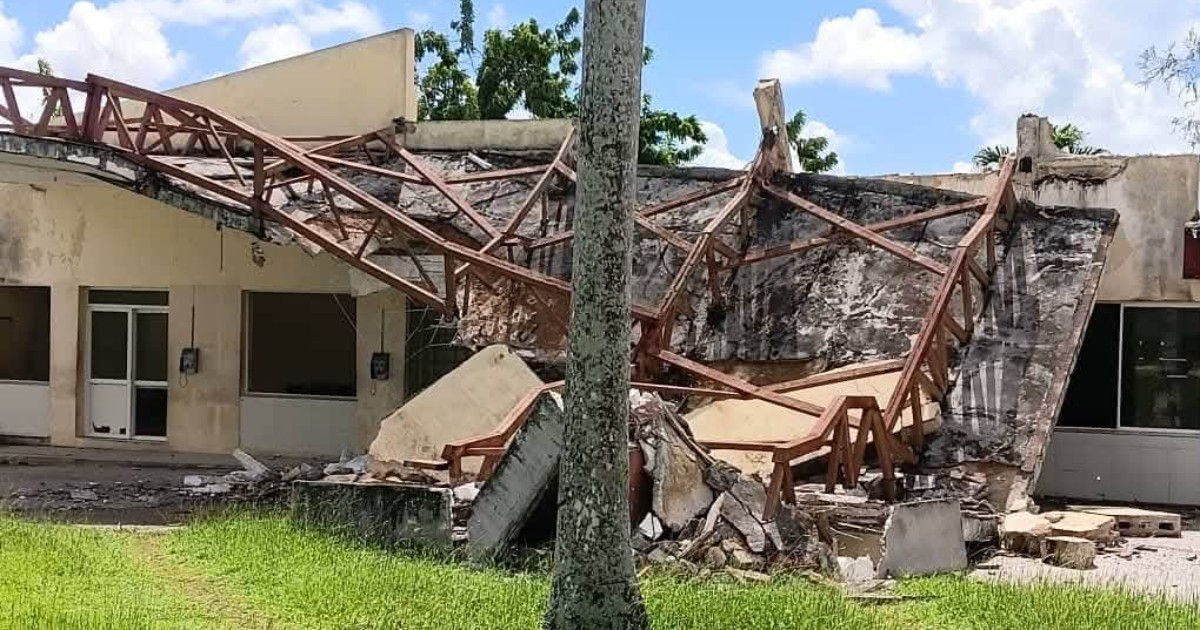
The front section of the Carlos Enrique Font Pupo Clinical-Surgical Teaching Hospital in Banes, located in Holguín province, collapsed on Sunday afternoon. Reports of the incident surfaced on social media and were confirmed by journalist Flabio Gutiérrez, a contributor to the provincial newspaper Ahora. Fortunately, no injuries were reported.
The compromised area was part of the hospital’s exterior where family members and patient companions typically wait. According to a 14ymedio report, this section had been closed off about three months prior—around August 2026—due to the risk of collapse, with the lobby being used as an alternative entrance for both patients and staff.
Despite the closure, there is no record of any repair work being done on the structure during that time.
A witness, Euvel Sarmiento Isla, confirmed in a Facebook comment, "There was a sign to prevent access to that area, but many ignored it for various reasons. I was among those who thought the structure wouldn't fall anytime soon, but it happened unexpectedly."
The incident did not come to light through official channels. The Ahora newspaper, where Gutiérrez has been a contributor for seven years, had not reported the event at the time the information was released. It was Gutiérrez himself who raised the alarm on social media, expressing relief that there were no casualties.
Gutiérrez was openly critical: "This hospital has been problematic since its inception. It’s unacceptable that it had leaks just days after its opening in 2001. Its comfort and service have always been under scrutiny."
One social media user encapsulated the frustration of many: "Unbelievable, a relatively new hospital with substantial resources and a lot of hype. Here we see the outcome, met with silence."
The incident in Banes is not an isolated case. In recent months, several Cuban hospitals have faced complaints about structural deterioration. In November 2025, part of the roof at Havana's Calixto García Hospital collapsed; that same month, Manuel Ascunce Domenech Hospital in Camagüey halted surgeries due to roof collapses in operating rooms; in April 2026, a fire affected Santiago de Cuba's Saturnino Lora Hospital; and in May 2026, another fire led to an evacuation at Havana's Manuel Fajardo Hospital.
The Pan American Health Organization has documented damage to at least 385 Cuban healthcare facilities, including collapsed roofs and wastewater under patient beds.
On the day of the collapse, Health Minister José Ángel Portal Miranda publicly acknowledged severe issues in hospitals and clinics across the country, including broken elevators, boilers, generators, laundry facilities, and water systems, alongside shortages of medicines and equipment. His remarks followed a visit by the Communist Party’s Central Committee, led by Miguel Díaz-Canel.
That same day, Díaz-Canel declared, "Health in our country is a fundamental human right, an achievement of the revolution, not a commodity or privilege." His words stand in stark contrast to the figures from Cuba's own National Office of Statistics and Information (ONEI), which in May 2026 admitted that 91.5% of medicines and medical supplies are missing from the country, a figure that has steadily risen from 50% at the end of 2021.
Understanding Cuba's Health Infrastructure Crisis
What caused the collapse at the hospital in Holguín?
The collapse was due to long-ignored structural issues that had been flagged months earlier, leading to the closure of the affected area. No repairs were undertaken during this period.
How are Cuban hospitals generally faring in terms of infrastructure?
Many Cuban hospitals are facing significant infrastructure problems, including collapsed roofs and outdated facilities, which have led to multiple complaints and incidents in recent months.
What has the government done to address these issues?
The government has acknowledged the issues, citing broken equipment and shortages of medicines but has yet to implement effective measures to resolve the ongoing problems.