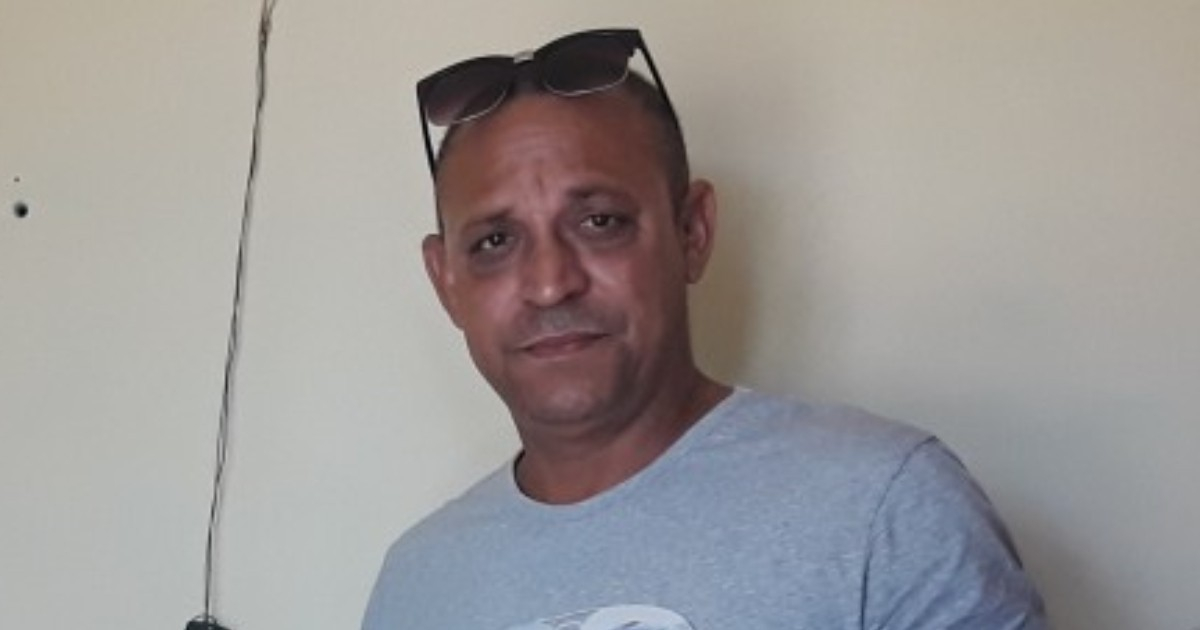
Independent journalist and political prisoner Jorge Bello Domínguez was reportedly transported from Guanajay's maximum-security prison to a hospital on October 30th, yet returned without receiving a medical examination, according to his mother in an interview with Martí Noticias.
Marta Domínguez Galero explained that the hospital doctor refused to see her son because the guards had failed to arrange an appointment in advance, as required. "They finally took Jorge to the hospital. When they arrived, the doctor didn't see him because she told the guard they knew they needed to schedule the appointment ahead of time. He came back, and no doctor examined him," she stated.
At 50 years old, Bello Domínguez has been awaiting surgery for over a year to address two painful testicular cysts causing bleeding and severe discomfort. This procedure had been recommended by a urologist while he was still detained at the Combinado del Este in Havana before his transfer to Guanajay in March 2025. The prison in Artemisa lacks urology specialists, and according to his mother, this failed attempt was the first time authorities tried to provide him specialized care.
Domínguez Galero expressed her outrage over the incident: "The situation with his testicular cysts remains unchanged, and Jorge is suffering through pain and crises. If they know an appointment needs to be scheduled in advance, how long will this abuse and disrespect continue? Even doctors now refuse to treat a prisoner just for opposing the dictatorship."
His health issues extend beyond this. According to Prisoners Defenders, Bello also suffers from type II diabetes, hypertension, and asthma. In June 2025, his mother reported that he had been without insulin or blood pressure medication for two months following his relocation to Guanajay.
In June 2026, Bello sent a letter from prison accusing officials of tampering with his insulin syringes and medication, naming Captain Camilo Ernesto Hernández Ortega and First Lieutenant Lis Marelis Ajete Suárez as responsible. "I know I'm walking on the edge of an abyss, and I'm certain something is being plotted against me," he wrote.
In March 2026, the Inter-American Commission on Human Rights (IACHR) issued Resolution 21/2026 (MC-203-26), granting precautionary measures in favor of Bello and three family members—his mother, his wife Yuleydi López González, and his daughter Yésica Bello—demanding that the Cuban regime provide comprehensive medical evaluation and specialized treatment. The Cuban state did not respond to this resolution nor provided information during the proceedings.
A member of the Cuban Institute for Freedom of Expression and Press (ICLEP) and an advocate for Cuba Decide, Bello Domínguez is serving a 15-year sentence handed down in April 2022 by a military tribunal for his involvement in the July 11, 2021 protests in Güira de Melena, Artemisa. His family and human rights organizations have highlighted irregularities in his trial, including the absence of physical evidence and reliance on testimony from a co-defendant collaborating with State Security.
This case is part of a broader trend; as of September 2026, Prisoners Defenders reported 1,351 political prisoners in Cuba, 476 of whom suffer from serious illnesses with limited or denied medical care.
Frequently Asked Questions about Jorge Bello's Situation
What medical conditions does Jorge Bello Domínguez suffer from?
Jorge Bello Domínguez suffers from testicular cysts, type II diabetes, hypertension, and asthma.
Why was Jorge Bello's surgery delayed?
Bello's surgery has been delayed due to the lack of urology specialists at the prison in Artemisa and the failure of the authorities to arrange necessary medical appointments.
What actions have international organizations taken regarding Jorge Bello's case?
The Inter-American Commission on Human Rights granted precautionary measures to Bello and his family, demanding comprehensive medical evaluation and treatment, but the Cuban state has not responded.