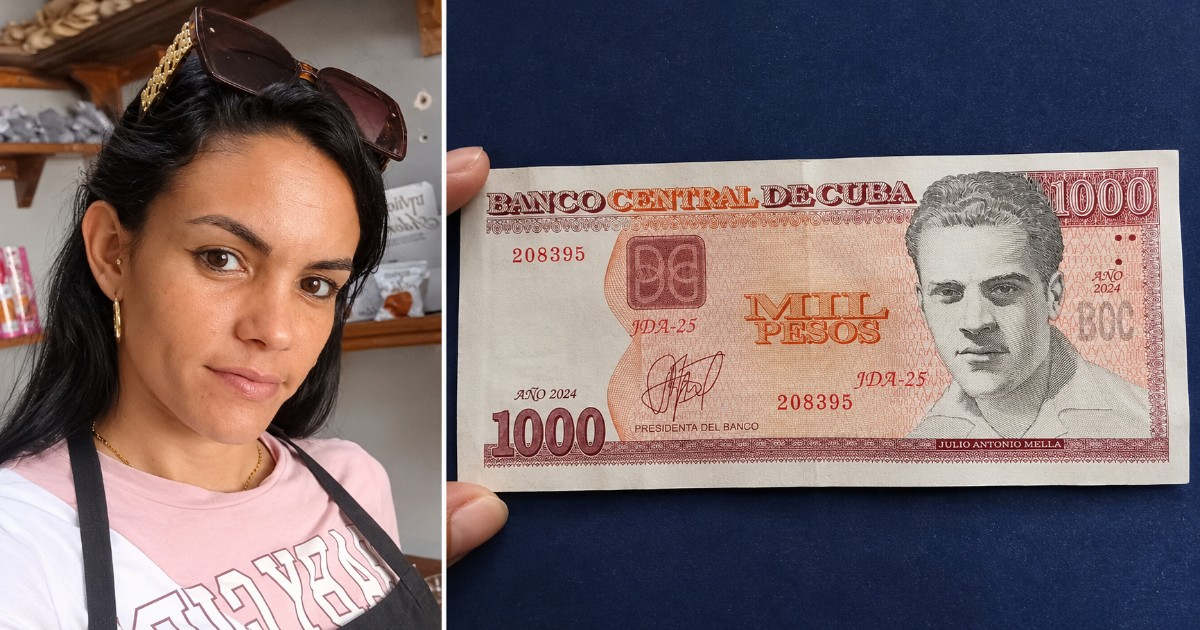
A Cuban worker recounted how she narrowly avoided losing 1,000 pesos while serving multiple customers when a stranger requested to exchange a bill to pay for a car ride. Thanks to the swift action of a colleague, she avoided accepting the money, which both deemed counterfeit.
Suzel Sanguinety shared her ordeal on Facebook last Friday, detailing that the incident took place during her work shift while several people were waiting for her assistance.
The man approached her, asking for help with exchanging a 1,000 Cuban pesos (CUP) bill, and at first, she did not suspect anything unusual.
It was her coworker, identified as Rachel, who took the bill and examined it against the light. Upon checking its watermarks, she warned the man that, in her opinion, the money was not genuine.
The worker explained that she could not determine if the stranger was deliberately trying to deceive her or if he himself had received the bill without knowing its potential counterfeit nature.
What was clear to her was the financial impact she would face if she had accepted it. She stated that she would have to account for the 1,000 pesos to the business owner, a sum that forms part of the money she earns to support her children.
The Cuban woman emphasized the sacrifices she makes to earn money for her children and, following the incident, decided to warn other customers about the importance of checking bills before accepting them.
The man accepted the explanation regarding the bill's alleged irregularities without any description of an argument or confrontation from the worker.
She highlighted that the warning and treatment towards the stranger were conducted respectfully.
The post sparked numerous reactions from people who appreciated the warning and shared similar experiences.
One user claimed her aunt lost merchandise and 30,000 Cuban pesos in change after accepting a 100-dollar bill that later turned out to be fake, according to her account.
Another person recounted receiving a counterfeit 50-dollar bill in a money transfer, only discovering the issue when attempting to use it in a store.
Comments also emerged from users who reported having issues with Cuban bills of 5,000 pesos.
Alerts about fake bills have recent precedents in Cuba.
In July 2026, a new method of counterfeiting 1,000 peso bills was reported in Guantánamo, involving authentic 200 CUP bills altered to appear as higher denominations.
In those cases, one indicator of forgery was examining the money against the light, which could reveal the original 200 peso denomination.
In September, authorities announced the arrest of six individuals in Manzanillo, Granma, for their alleged involvement in circulating fake 2,000 and 5,000 peso bills. Those denominations began circulating during 2026.
Counterfeiting of 1,000 peso bills is not a recent phenomenon.
In 2023, a public alert revealed bills of that denomination printed over previously bleached five peso notes, a technique that could retain some characteristics of the original currency paper.
The Central Bank of Cuba has advised checking the security features of cash, particularly watermarks, denominations visible against the light, and security threads.
For cases where doubts persist, the institution suggests visiting a bank office to verify the bill's authenticity.
Key Information on Counterfeit Cuban Currency
How did Suzel Sanguinety avoid losing 1,000 pesos?
Suzel avoided losing 1,000 pesos thanks to a colleague named Rachel, who examined the bill and identified it as counterfeit.
What advice does the Central Bank of Cuba give regarding counterfeit money?
The Central Bank advises checking the security elements of bills, such as watermarks, light-visible denominations, and security threads, and visiting a bank for verification if doubts remain.
What recent incidents of counterfeiting have been reported in Cuba?
Recent incidents include arrests in Manzanillo for circulating fake 2,000 and 5,000 peso bills, and reports of 1,000 peso bills counterfeited from 200 CUP notes in Guantánamo.