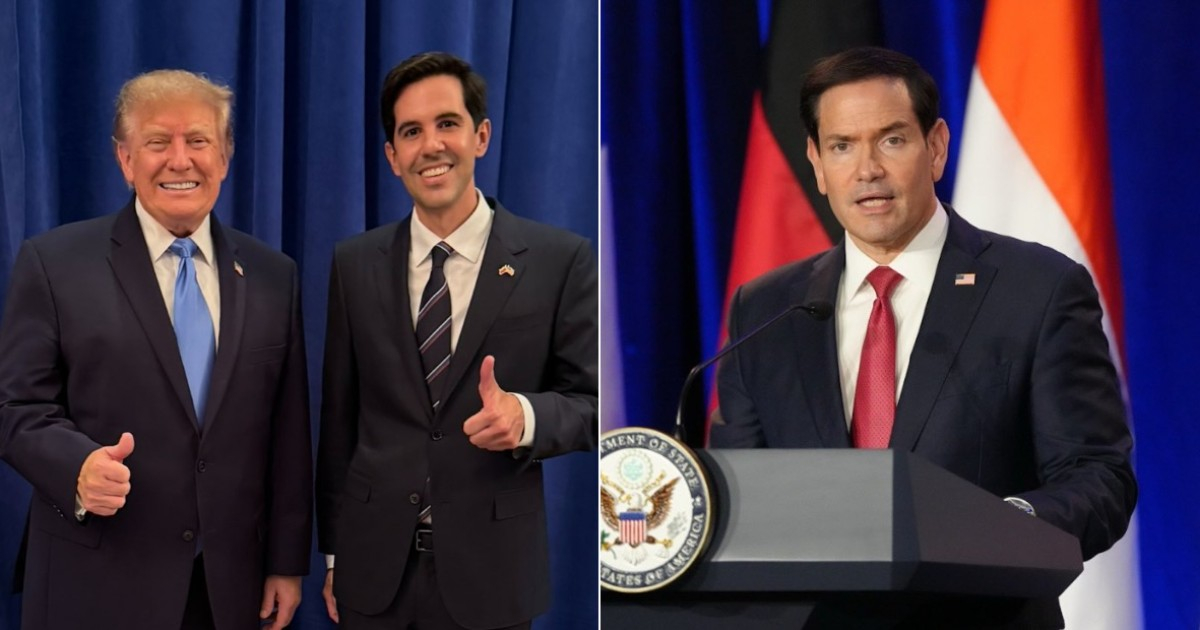
On Monday, Marco Rubio extended an invitation to Oliver Blanco, Venezuela's newly appointed Foreign Minister, marking the first diplomatic meeting between the two nations since the capture of Nicolás Maduro in January. This significant event took place at the U.S. State Department headquarters in Washington.
The meeting, which was publicly listed on the State Department's official schedule, was set for 10:00 AM local time (3:00 PM GMT). It occurred just four days after Delcy Rodríguez, the interim president, appointed Blanco to replace Félix Plasencia as head of Venezuela's Ministry of Foreign Affairs.
At 34, Blanco brings an unconventional background to the role, having been part of the opposition. He was involved with Acción Democrática and managed the campaign of diplomat Diego Arria during the 2012 opposition primaries.
Earlier this year, Rodríguez appointed Blanco as Deputy Minister of Foreign Affairs for Europe and North America. By late July, he was promoted to First Deputy Minister, shortly after Rodríguez took on her interim presidential role.
Félix Plasencia, who briefly held the Foreign Minister position, now leads the International Affairs Directorate of the Presidency. His new role focuses on reclaiming Venezuelan gold reserves held in the Bank of England.
Just before the scheduled meeting, Blanco had already met John Barrett, the U.S. Embassy's Chargé d'Affaires in Caracas. Barrett congratulated Blanco on his new position and expressed interest in progressing with the "three-phase plan" that Washington developed for Venezuela following Maduro's downfall.
Upon his appointment, Blanco stated, "Our challenge is to contribute to a more prosperous, democratic, pluralistic, and inclusive Venezuela, where mutual understanding and respect prevail, and no one feels excluded. Ultimately, we must strive to advance and succeed together as a unified team."
Rodríguez explained her decision to appoint Blanco with a message of openness: "I have decided to appoint Oliver Blanco as the Foreign Minister of the Bolivarian Republic of Venezuela. I hope this strengthened team continues to advance change and the geopolitical recovery of Venezuela through cooperative friendships with all nations."
This Monday's meeting is part of a rapid rapprochement between Washington and Caracas throughout 2026. It included a historic face-to-face meeting between Trump and Rodríguez in New York in September—the first between leaders of the two countries in over eleven years—and a landmark oil agreement granting North American Blue Energy Partners access to 65 billion barrels of proven reserves in 17 strategic fields.
The Trump administration also supports a negotiated roadmap between the Chavista government and an opposition bloc led by Dinorah Figuera. This plan includes renewing the Supreme Court of Justice and the National Electoral Council, with Rodríguez declaring the presidency vacant in 2027 to call for elections within six months.
María Corina Machado, an opposition leader and Nobel Peace Prize laureate, returned to Venezuela on October 25. Rubio credited this recent diplomatic meeting to direct negotiations between Washington and Venezuelan authorities.
The shift in Venezuela's political landscape has directly impacted Cuba. Following Maduro's capture and the tightening of U.S. sanctions, Venezuela halted fuel shipments to the island, exacerbating an energy crisis. Vicente de la O Levy, Cuba's Energy Minister, previously described the situation as a complete depletion of oil reserves.
Insights into the Venezuela-U.S. Diplomatic Engagement
What was the purpose of Oliver Blanco's visit to the U.S. State Department?
Oliver Blanco visited the U.S. State Department to engage in a diplomatic meeting with Marco Rubio, marking the first encounter between the two nations' diplomatic leaders since the restoration of relations following Nicolás Maduro's capture.
How has Venezuela's political change affected Cuba?
Venezuela's political shift led to the cessation of fuel shipments to Cuba, worsening the island's energy crisis, which had already been described as a complete depletion of oil reserves by Cuba's Energy Minister.
Who is Oliver Blanco, and why is his appointment significant?
Oliver Blanco, at 34, is an unusual choice for Venezuela's Foreign Minister due to his opposition background and previous involvement with Acción Democrática. His appointment signifies a shift towards broader political inclusion in Venezuela.