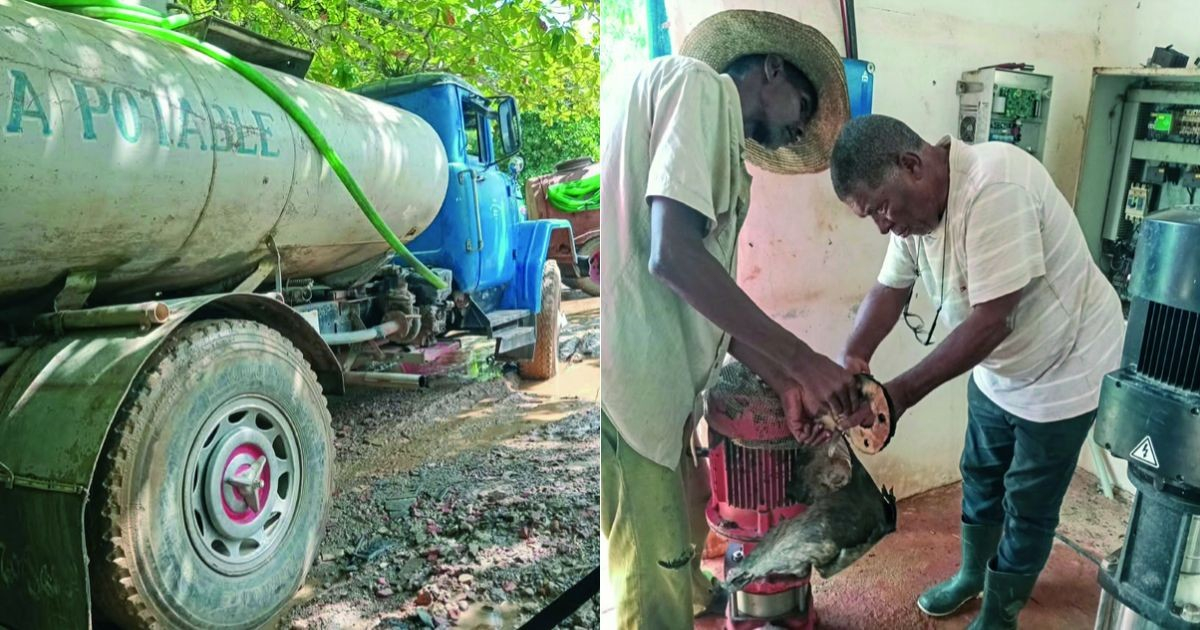
The head of the Provincial Water and Sewage Company in Pinar del Río, Robert Hechevarría Ramírez, has acknowledged the severe water crisis plaguing the area. Over 169,700 residents face disrupted access to water, with private water trucks charging exorbitant prices exceeding 15,000 pesos.
During an interview with the official newspaper Guerrillero, Hechevarría Ramírez highlighted two major issues exacerbating the crisis: the shortage of pumping equipment and the impact of power outages. The three main pipelines serving the provincial capital are severely compromised. The 20-inch pipeline is missing two pumps, the 30-inch pipeline, responsible for transporting water to the city tank, is operating at half capacity due to three out of six pumps being out of service, and the 36-inch pipeline is similarly short of two pumps. In total, 46 pumping units and six booster stations are malfunctioning, according to the director.
Adding to the challenges, a recent malfunction in the 36-inch pipeline near the Crucero de Maceo area required halting operations for draining and welding repairs. The director was clear: "Given this combination of energy limitations and equipment breakdowns or shortages, continuous water service delivery becomes practically impossible."
Impact on Local Communities
Some communities have reportedly gone over three months without water through the regular supply networks, forcing residents to resort to costly alternatives that strain household finances, often beyond the reach of most families.
Hechevarría Ramírez confirmed the "excessive and abusive pricing of water trucks, which roam the city, charging amounts exceeding 15,000 pesos," a figure that nearly equals five times the monthly minimum wage, set at 3,210 pesos since July 2026. He admitted that "this situation... is not foreign to the Company, as its own employees 'suffer' this reality daily in their communities."
Government Response and Initiatives
On October 24, Deputy Prime Minister Inés María Chapman Waugh visited the province with officials from the Electric Union and the National Institute of Hydraulic Resources. She emphasized the need for a "comprehensive water-energy program," though no specific timeline was provided.
Measures include distributing 20 tons of diesel to generators in all municipal capitals, starting October 28 in Consolación del Sur and the provincial capital, aimed at boosting the Anillo 1, Calero 3, and 10 de Octubre pumping stations. Efforts are also underway with a workshop in Mayabeque to repair at least one pump for each of the 20 and 30-inch pipelines.
The province has 77 solar-powered pump units for smaller supply sources of less than 10 kilowatts: 67 are functioning correctly, four have burned out, and six have controller card issues. Efforts are being made to identify an additional 34 sources ranging from 10 to 30 kilowatts that could transition to renewable energy in the medium term.
National Water Crisis Context
Pinar del Río's water crisis is part of a broader national issue, with the National Institute of Hydraulic Resources reporting on October 29 that 2.14 million Cubans face water supply disruptions, with power shortages and equipment failures accounting for about 88% of these incidents.
The article concluded by noting the irony of Pinar del Río's situation: despite having abundant, high-quality water sources, it suffers from one of the country's most extended delivery cycles.
Frequently Asked Questions about Pinar del Río's Water Crisis
What are the main causes of the water crisis in Pinar del Río?
The crisis is primarily due to a shortage of pumping equipment and power outages, which have severely affected the water supply infrastructure.
How much do private water trucks cost in Pinar del Río?
Private water trucks charge prices exceeding 15,000 pesos, which is nearly five times the monthly minimum wage in Cuba.
What measures are being taken to address the water crisis?
The government is distributing diesel to power generators and working on repairing pumping stations, as well as exploring the transition to renewable energy sources for certain water supplies.