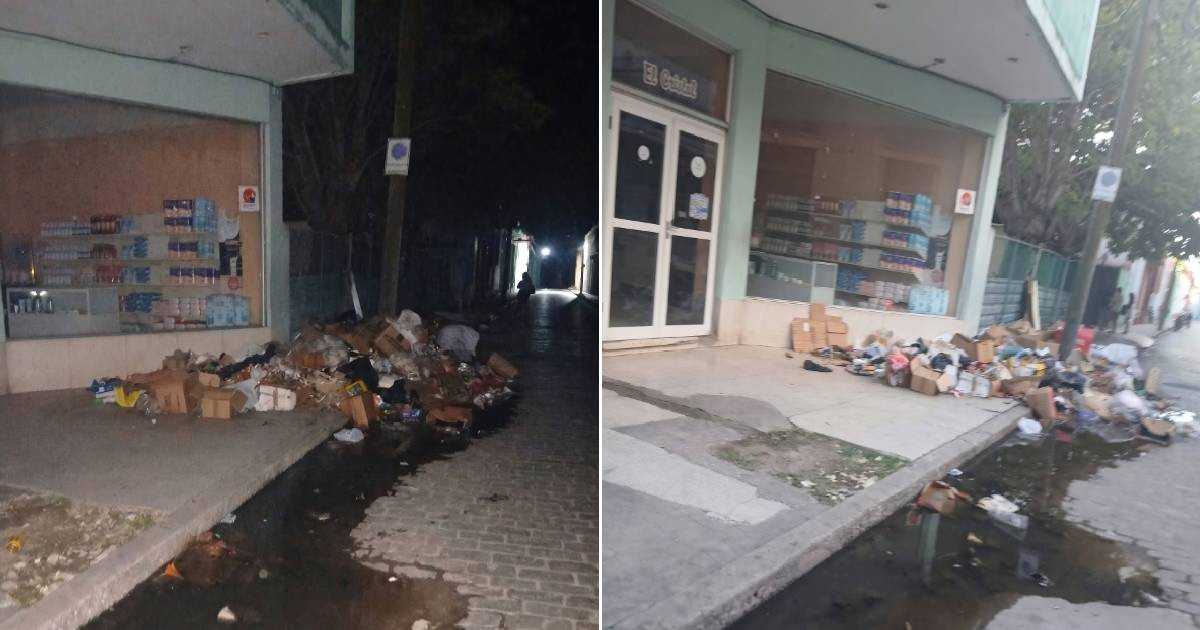
Independent journalist José Luis Tan Estrada brought attention on Sunday to a glaring issue: a garbage dump situated right in front of the Provincial Center for Hygiene and Epidemiology in Camagüey. This unsettling scene quickly sparked a wave of criticism across social media platforms.
Images shared by Tan Estrada on Facebook reveal piles of waste surrounding the institution, which is ironically tasked with ensuring sanitary conditions and preventing diseases in the province. This stark contradiction highlights a pervasive issue in a city increasingly plagued by waste management problems.
The public's response was one of frustration and fatigue over a situation that many claim affects numerous neighborhoods. "Every corner has a dump and a terrible stench," commented one resident. Another added, "The whole of Camagüey is like this," while a passerby remarked about the "horrible smell" experienced last Friday. Local authorities also faced direct criticism for their handling, or lack thereof, of the issue.
Some citizens pointed out that certain small private enterprises (mipymes) hired to collect waste only serve those who can afford to pay, leaving the rest of the community without a solution. "No street is spared anymore," lamented another user about the historic center.
Understanding the Depth of the Crisis
The garbage crisis in Camagüey is far from an isolated incident. Reports indicate that the municipal utility company, Servicios Comunales, manages to collect only 35% to 40% of the approximately 220 tons of waste the city produces daily.
Local officials have blamed the inefficiencies on a "severe fuel shortage" and the poor condition of the state-owned vehicle fleet. However, the problem has persisted throughout various parts of the city for the entire year.
On General Gómez Street, residents counted nine trash dumps, with one located adjacent to a children's daycare center. In August, a resident from Camujiro Street reported that garbage had gone uncollected for two months, completely blocking the road.
The Broader Impact on Camagüey
The neglect extends to Camagüey's Historic Center, a UNESCO World Heritage site. In October, two elderly citizens, nearly 80 years old, took it upon themselves to clear the trash in front of the Santa Ana church due to the absence of municipal services.
The accumulation of waste not only mars the urban landscape but also encourages the spread of mosquitoes, flies, and rodents, posing serious public health risks. In April, local authorities noted a significant rise in hepatitis A cases in the main municipality, though the Vice Minister of Public Health, Julio Guerra, denied any national epidemic.
In September, it was announced that the private company Almaley S.R.L. had officially begun the process of contracting to collect and manage solid waste in the Historic Center, amidst the ongoing struggles of state communal services.
Government Response and Public Outrage
One of the most infuriating incidents occurred on October 23, when an extraordinary garbage collection took place in the Sánchez Soto neighborhood, reportedly due to a visit by President Miguel Díaz-Canel. This sudden cleanup starkly contrasted with the residents' complaints, who have been waiting months for such services, fueling criticism about the government's ability to meet the population's everyday needs.
Addressing Camagüey's Waste Management Issues
What are the main causes of the waste crisis in Camagüey?
The primary causes include a severe shortage of fuel and deterioration of the state-owned vehicle fleet, which hinders waste collection efforts.
How has the local government responded to the trash problem?
Local authorities have attributed the challenges to resource shortages but have faced criticism for inadequate management and response to the crisis.
What impact does the waste accumulation have on public health?
The buildup of trash promotes the proliferation of disease-carrying pests like mosquitoes and rodents, increasing public health risks such as hepatitis A.