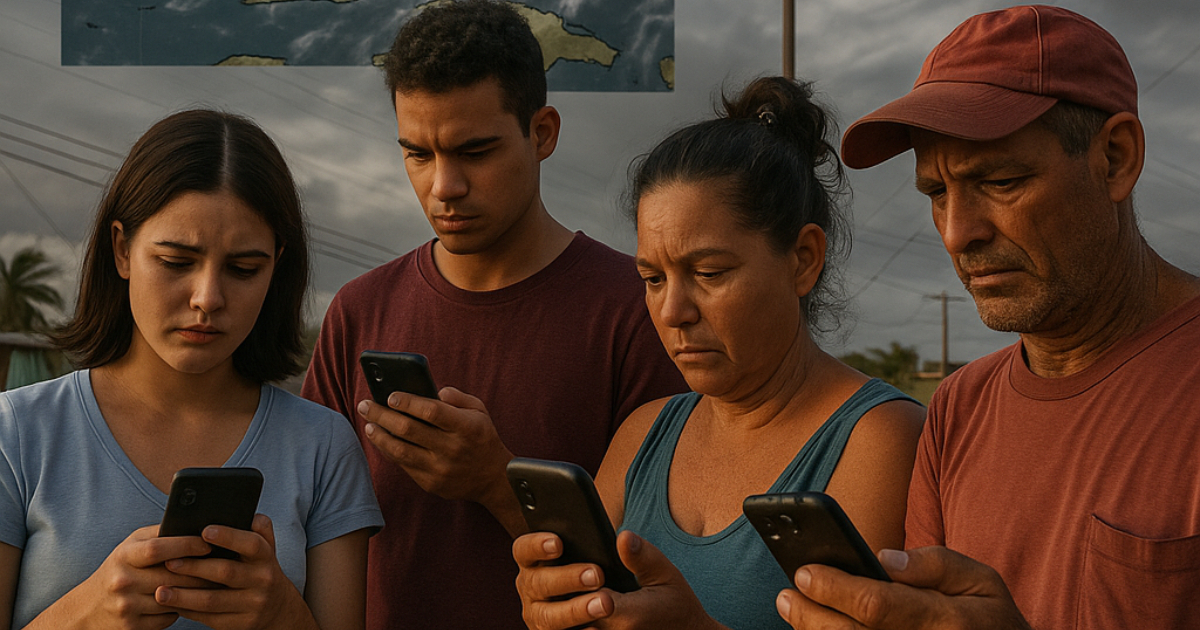
This past Sunday, ETECSA stepped in to clarify why some Cuban cell phone users found their devices displaying a different time than the official one. This confusion arose after Cuba chose not to set the clocks back on November 1st, a departure from the usual end of daylight saving time.
The root of this decision lies in Cuba's severe energy crisis. On October 24th, the Ministry of Energy and Mines (MINEM) and the Ministry of Labor and Social Security (MTSS) announced that Cuba would maintain daylight saving time (UTC−4) continuously until November 7, 2027. This move aims to mitigate an expected 126 MW increase in peak electricity demand, attributed to reduced artificial lighting needs (76 MW) and enhanced utilization of solar energy (50 MW).
As an additional measure, the Ministry of Education adjusted school and work start times, delaying them by 30 minutes from November 1, 2026, to March 14, 2027, to account for later sunrises during winter months under the current time setting.
Consequently, Cuba now finds itself one hour ahead of Miami, as Florida returned to standard time (UTC−5) this past Sunday.
ETCSA's Response and Public Reaction
In response, ETECSA released a statement on social media claiming that the telecommunications network was smoothly adjusted. "The equipment comprising our telecommunications network is set for automatic time changes, and in recent days, we've worked to ensure these systems operated as usual this Sunday, achieving this goal successfully," the state company stated.
However, they acknowledged the issue was on the users' end: "Many users might notice their cell phones did apply the time change, as their operating systems have Cuba's time zone pre-set and often prioritize it."
To address this, ETECSA provided a five-step guide: navigate to Settings/System, access Date and Time, disable Automatic Time, set the clock forward one hour, and confirm the correct time.
Cuban Citizens' Reactions
The Cuban public responded with a mix of sarcasm and disbelief on social media. While ETECSA declared success, comments painted a different picture. One user questioned, "They claim they achieved it satisfactorily? I haven't met anyone whose phone didn't switch to normal time. Every day there's something new to deal with."
Another user shared a complication: "My phone changed the time automatically, and I couldn't even activate mobile data. It wasn't until I adjusted the time that the data worked. Speechless." A third user tried ETECSA's steps without success: "I did that, and it still changed." Many jokingly asked what time it actually was.
The dark humor emerged swiftly. "It doesn't matter; time stopped in Cuba in '59," one internet user commented. Another summed it up with sharp wit: "They're playing at advancing by moving backwards..." Others were more blunt: "Cuba as always... swimming against the tide."
Impact of the Energy Crisis on ETECSA
This episode takes on additional significance considering Cuba's electrical crisis, which results in blackouts lasting over 20 hours daily in Havana and potentially consecutive days in other provinces.
ETCSA's infrastructure isn't immune to the energy crisis. During the nationwide blackout on September 18, 2026, over 80% of radio base stations went offline, with internet traffic plummeting up to 58% compared to similar periods, as acknowledged by the state company.
Of Cuba's approximately 2,520 radio base stations, only about half have any sort of backup power system, according to figures reported by Cuban media.
The next scheduled time change in Cuba is November 7, 2027, when the clocks are set to fall back one hour to return to standard time UTC−5, unless the government decides to extend the current arrangement once more.
Understanding Cuba's Time Change and Energy Crisis
Why did Cuba decide not to change the clocks back in November 2026?
Cuba opted to maintain daylight saving time to alleviate the energy crisis, preventing an increase in peak electricity demand by making better use of daylight and solar energy.
How did ETECSA respond to the time change confusion?
ETCSA adjusted its network settings to prevent automatic time changes and provided a guide for users to manually set the correct time on their devices.
What was the public's reaction to ETECSA's handling of the time change?
The public expressed skepticism and frustration, with many sharing stories of confusion and technical issues despite ETECSA's assurances of a smooth transition.