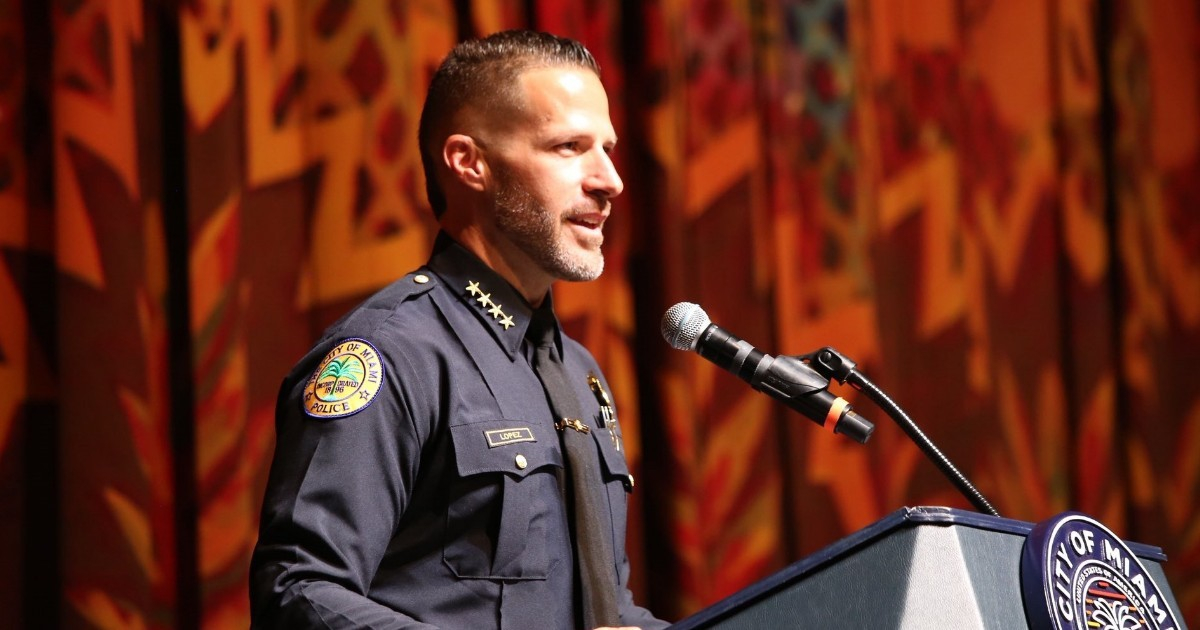
Edwin López, the Cuban-American head of the Miami Police Department, shared encouraging news during the assessment of his first 100 days in office: crime rates have declined in the city, according to department data.
The statistics, comparing the period from June 15 to September 22, 2026, with the same timeframe in 2025, indicate a 3% decrease in overall crime and a 7% reduction in violent offenses.
Significant reductions were observed in homicides, dropping from 10 to seven cases—a 30% decrease—robberies, which fell from 83 to 63 cases—a 24% reduction—and vehicle thefts, down from 285 to 215—a 25% decline. These figures come directly from the department and have not undergone independent verification.
Not all crime categories improved equally. Assaults and injuries saw only a 2% decrease, and thefts or larceny declined by just 1%, suggesting that certain crimes remain persistent challenges.
López credited these outcomes to a combination of factors: increased patrol presence, the use of technology like drones and surveillance cameras, and the foundational work laid by previous administrations.
During this period, the department also issued over 25,000 traffic citations and made more than 1,000 arrests for traffic violations.
The police chief personally visited all 13 neighborhoods in Miami during his initial 100 days to understand each community's needs firsthand, including areas with large Cuban-American populations such as Little Havana, Flagami, and Allapattah.
López, born in Miami to Cuban immigrant parents, was sworn in on June 15 as the 44th chief of the department, appointed by Mayor Eileen Higgins. He follows his predecessor, Manuel "Manny" Morales, another Cuban-American, who retired after 32 years of service. With over 28 years of law enforcement experience in South Florida, López leads approximately 1,400 sworn officers and 400 civilian employees in a city of nearly 500,000 residents.
Beyond crime statistics, López faces ongoing tension regarding his department's collaboration with federal immigration authorities. According to a report on migrant arrests in Miami-Dade, the Miami Police Department is the county's leading agency for detainees under the 287(g) program, with 451 arrests from August 2025 to August 2026, about 29% of which were Cuban nationals. This contrasts with López's initial statement upon swearing in, where he emphasized that immigration enforcement was not a priority.
An additional challenge is the potential passage of Florida's Amendment 3, voted on this Tuesday, which would expand property tax exemptions. If approved—it requires 60% of the vote—Miami-Dade could lose between $359 million and $445 million annually in revenue, jeopardizing the public safety budget.
Miami-Dade Mayor Daniella Levine Cava warned of the potential closure of up to 19 fire stations and the loss of over 600 positions. When asked how he would handle such a scenario, López stated that the department would address it when the time comes.
Looking ahead to the next 100 days, the police chief announced plans to maintain current patrol and technology strategies and hinted at additional public safety initiatives for the holiday season, though he did not provide specifics.
Key Insights on Crime Reduction and Challenges in Miami
What factors contributed to the reduction in crime in Miami?
The reduction in crime is attributed to increased patrols, the integration of technology such as drones and surveillance cameras, and the groundwork laid by previous administrations.
How has Edwin López engaged with Miami communities in his first 100 days?
Edwin López visited all 13 neighborhoods in Miami to understand community needs, focusing on areas with significant Cuban-American populations like Little Havana, Flagami, and Allapattah.
What are the potential implications of Florida's Amendment 3 for Miami-Dade?
If Florida's Amendment 3 is approved, Miami-Dade could face a loss of $359 million to $445 million annually in revenue, threatening public safety budgets and possibly leading to the closure of fire stations and job cuts.