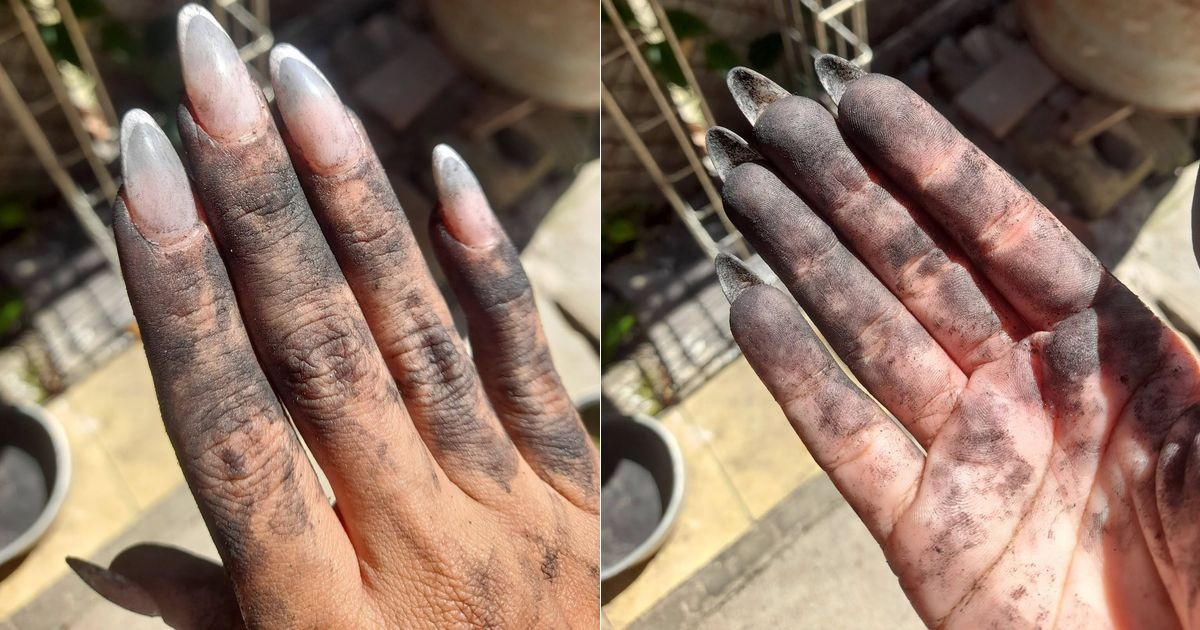
A Cuban manicurist who goes by the name Ela Nail struck a chord with many Cuban women on Friday when she shared two poignant images on Facebook. These photos encapsulate the daily paradox of life in Cuba: beautifully manicured almond-shaped nails, blackened by soot from the charcoal she used to cook.
The caption on the photos said it all: “Living the high life on Pinterest, but facing reality in Cuba.” This post triggered a flood of comments from Cuban women who not only laughed but saw themselves reflected in those soot-stained hands with pristine manicures.
“Hands covered in charcoal to cook, that’s our reality,” commented one follower. Another confessed to painting her nails black for practical reasons: “Saves me the trouble, I can’t deal with it otherwise.” A third lamented a more permanent damage: “My nails don’t even grow anymore, all because of the charcoal.”
Despite everything, the prevailing tone was one of humor-infused resilience: “Charcoal-stained but nails on point, that’s me,” noted another user. One woman summed up the thread’s spirit: “Poverty won’t swallow me; I choose to be.”
The Stark Reality Behind the Humor
The situation is no laughing matter. According to the 2025 National Food Security Survey by the Food Monitor Program, conducted between May and July 2025 and published in May 2026, 35% of respondents resorted to using wood or charcoal for cooking due to electricity and gas shortages. The study also uncovered that 80.4% of participants faced challenges in preparing food because of power outages. Since then, these statistics have only deteriorated.
Charcoal has become a relatively expensive necessity. A sack that cost between 900 and 1,400 pesos at the end of 2024 rose to between 3,200 and 5,000 pesos in various provinces by June 2026, against a state salary averaging around 7,000 pesos monthly at that time. The situation worsened when CUPET indefinitely suspended the distribution of liquefied gas in Santiago de Cuba and other eastern provinces earlier this year.
The Cost of Dignity
Maintaining manicured nails isn’t free in this environment. While in 2025, a basic manicure might have started at 500 pesos, and acrylic or polygel nails at about 950 pesos, the prices documented in businesses during 2026 show significantly higher rates: from 1,000 pesos for a simple manicure to 5,000 pesos for extra-long acrylic extensions in some places, with more elaborate services reaching 6,000 pesos or more.
For many Cuban women, this expense isn’t vanity; it’s a statement of dignity amid hardship. “Never lose the glamour, never,” one commenter summarized. “No matter what, we must always look fabulous,” added another.
Ela Nail’s post is not an isolated incident. Another post from the "Revolico Amancio" page featured two soot-covered hands adorned with metal rings, accompanied by the caption: “What Cuban woman doesn’t relate to this image?”
Comedian Mario Sardiñas, known as Chequera, described his neighborhood Arroyo Arenas as “a tribe,” cooking over wood fires without electricity or internet. Meanwhile, Idaneris Aguirre from the Isle of Youth shared a heartbreaking account: “I never imagined the future would find me cooking with charcoal, like in a century I wasn’t meant to live in.”
The Grim Context
The backdrop to these stories is harsh: the IX Report of the Cuban Observatory of Human Rights estimated in August 2026 that 94% of Cubans live in extreme poverty, and the Economic Commission for Latin America and the Caribbean (ECLAC) projects a 10.3% contraction in Cuba’s GDP in 2026, the worst in Latin America.
In this context, even the Forest House in Villa Clara has resorted to selling small bags of pine kindling for 250 pesos to start charcoal fires, described as “very much in demand.”
Understanding the Challenges of Daily Life in Cuba
Why is charcoal used extensively for cooking in Cuba?
Due to frequent electricity and gas shortages, many Cubans have turned to charcoal as an alternative for cooking. This trend has been exacerbated by recent suspensions in the distribution of liquefied gas.
How has the cost of living affected Cuban women?
The rising cost of essentials like charcoal and basic services has forced many Cuban women to make difficult choices. Maintaining personal grooming, like manicures, is seen as a way to maintain dignity despite economic hardships.
What does the economic forecast look like for Cuba?
The Economic Commission for Latin America and the Caribbean (ECLAC) projects a 10.3% contraction in Cuba’s GDP for 2026, marking it as the worst economic performance in Latin America for that year.