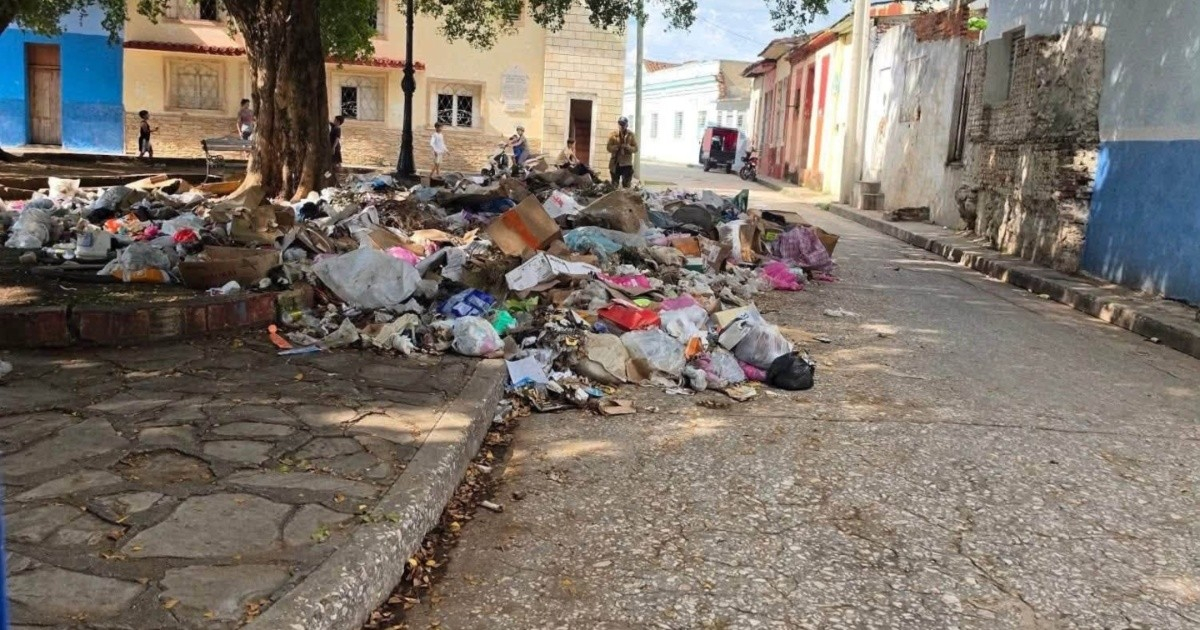
The historic Santana Park, a once-iconic location in Sancti Spíritus, has become a dumping ground, buried under heaps of plastic bags, cardboard, and household waste. This situation was highlighted by local resident Yanetsy Pino in a recent Facebook post at the end of October.
Photos accompanying the post reveal the park's cobblestone square blanketed with litter, with the backdrop of colorful colonial buildings and at least one person scavenging through the trash for recyclable materials.
"What you're seeing is a gigantic landfill, a disgrace, a mountain of garbage that's literally and figuratively drowning the neighbors," Pino wrote. She added that "beneath the shade of those beautiful trees that have witnessed so much history, all that passes now is the stench and flies."
Historical Significance of Santana Park
Santana Park is part of the historical center of Sancti Spíritus, recognized as a National Monument of Cuba since 1978. Founded in 1514, the city boasts landmarks like the Veracruz Chapel, built in 1690, and the San Francisco Convent, established in 1716. The park was restored in 2014 to celebrate the town's 500th anniversary.
"This park is a storied place, a piece of the historical heart of Sancti Spíritus. It once hosted fairs, was a rehearsal spot for one of the best comparsas in the city, and was a meeting point for families and lovers," Pino reminisced. The stark contrast with the present is heartbreaking: "It's a place that should breathe tradition, but now it only breathes decay."
Government's Role in the Crisis
The complaint's author absolved the neighbors of blame, pointing fingers directly at the regime: "It's not the neighbors' fault, who, 'in the absence of bread, eat cassava,' throw trash wherever they can because the truck simply doesn't come. The blame lies with a government that doesn't prioritize this issue."
Pino dismissed the official embargo rationale as an excuse. Referencing data from the United States-Cuba Economic and Commercial Council, she noted that from January to August 2026, U.S. fuel and petroleum product exports to Cuba totaled $231.7 million, with a peak of nearly $75 million in August alone. "Fuel is entering and being paid for, but the gasoline never reaches the community sanitation trucks, public transportation, or ambulances. Where is that fuel?" she questioned.
Widespread Waste Management Issues
The situation at Santana Park isn't unique to Sancti Spíritus. In June, a trash island emerged in front of the Yayabo Bridge—also a National Monument—and earlier, dumpsites were documented on Carlos Roloff Street and its intersection with Tello Sánchez.
The waste collection crisis is a nationwide problem. In Havana, only 44 out of 106 garbage trucks were operational at the start of the year, leaving more than 20,000 cubic meters of waste uncollected daily. This past Saturday, a massive trash pile was reported on the main avenues of Camagüey, a city whose historical center is a UNESCO World Heritage Site.
"It's a disgrace, a crime against public health and our heritage. People want solutions, cleanliness, and dignity," Pino concluded.
Waste Management Issues in Cuba
What is the current state of waste management in Havana?
As of the beginning of the year, only 44 out of 106 garbage trucks in Havana were operational, resulting in more than 20,000 cubic meters of waste being uncollected daily.
How has the government responded to the waste crisis?
The government has not prioritized resolving the waste crisis, and local residents are forced to discard trash wherever possible due to irregular waste collection services.
What historical significance does Santana Park hold?
Santana Park is part of the historical center of Sancti Spíritus, recognized as a National Monument of Cuba. The park area is home to landmarks such as the Veracruz Chapel and the San Francisco Convent.