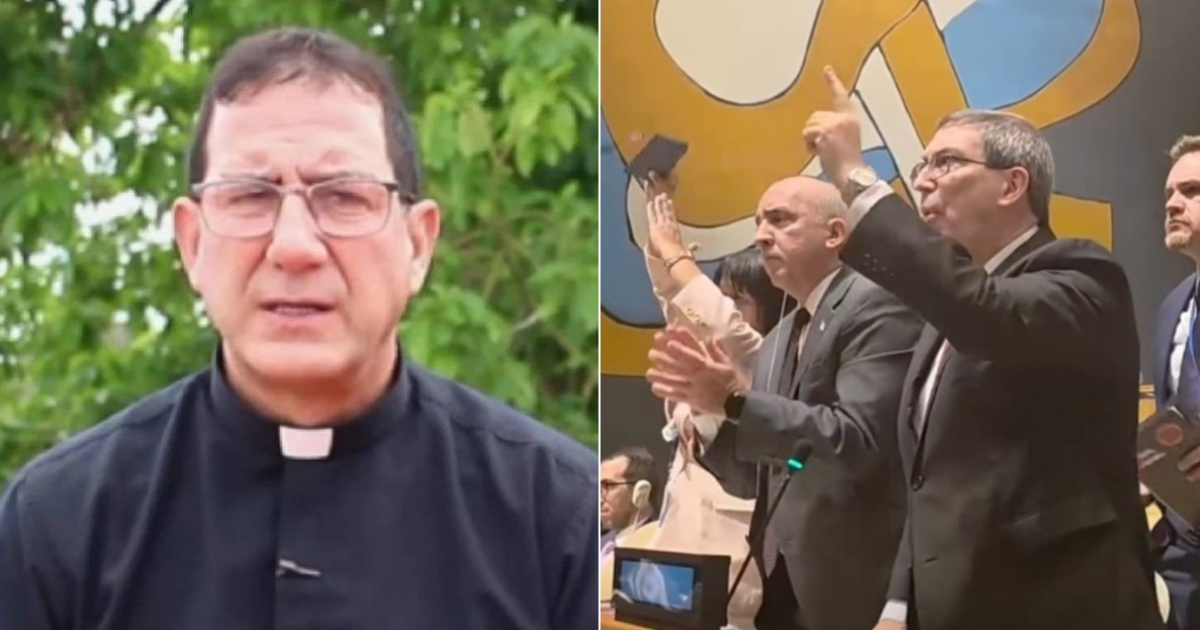
Cuban priest Alberto Reyes Pías, a persistent critical voice from within the Island, shared the 181st installment of his weekly column "I've Been Thinking" on Facebook this Saturday. His piece aims to dismantle the regime's triumphant narrative following Foreign Minister Bruno Rodríguez's outburst at the UN General Assembly.
Reyes described the actions of the Cuban delegation as a "shameful incident" during which Rodríguez interrupted U.S. Ambassador Mike Waltz's speech—where Waltz showcased images of the Castro family's assets—by approaching the podium and labeling him a "liar."
While the regime portrayed this scene as a "defense of Cuba," the parish priest from Esmeralda, Camagüey, sees it as just one side of the story.
Overlooking the Real Suffering
"There are countless individuals on the other side of the equation, people whom no one acknowledges, because when the priority is to outshout the adversary, it's impossible to hear the suffering of an entire nation," wrote the priest.
In his reflection, Reyes contrasts the diplomatic scene with real-life cases he knows: women stealing to feed their children, mothers begging with tears in their eyes, another who, in utter desperation, killed her daughter with Down syndrome before taking her own life, and two young boys, aged nine and eleven, making charcoal to survive.
"Millions of Cubans are in dire need of electricity, food, medicine, freedom, and hope—needs that won't be resolved by any media victory," he asserted.
The Root of the Problem
Reyes delves beyond the diplomatic episode, targeting the regime's fundamental nature. He claims that "the Cuban people remain unimportant to anyone," and even if the embargo were lifted tomorrow, "the people's situation would remain the same, or perhaps worsen," because the government "neither wants nor can allow the people to prosper."
His reasoning is clear: "Any minimal prosperity for the people signifies a loss of power, an opportunity for individuals to claim their rights, and that would mark the beginning of freedom, the path toward democracy—essentially, the forbidden road."
Despite facing summons from State Security, threats of legal action, and a travel ban, Reyes remains undeterred by these pressures.
A Call for True Defense
His Saturday column ends with a statement that encapsulates his stance: "The genuine defense of Cuba will begin when the dignity of the everyday Cuban matters more than the pride of any government, when truth is no longer seen as a threat, and when the goal ceases to be a statistic meant to slap the enemy."
The UN altercation didn't end with Bruno Rodríguez's intimidation tactics. Richard Tur de la Concepción, the first secretary of the Cuban mission, attempted to seize the phone from Waltz's spokesperson, hitting him as he recorded the confrontation.
After being expelled by the United States, Tur returned to Havana, where he was welcomed with honors by the Cuban Foreign Ministry, a gesture the regime used to bolster its confrontational narrative.
Understanding Cuba's Diplomatic Incidents
What was Alberto Reyes's reaction to the UN incident?
Alberto Reyes criticized the Cuban delegation's actions as a "shameful incident," viewing it as part of the regime's attempt to overshadow the real issues faced by the Cuban populace.
How did the regime portray Bruno Rodríguez's actions at the UN?
The regime presented Rodríguez's interruption as a "defense of Cuba," using it to reinforce their confrontational stance against perceived adversaries.
What are the main challenges faced by ordinary Cubans, according to Reyes?
Reyes highlighted that millions of Cubans need electricity, food, medicine, freedom, and hope, which are not being addressed by the current regime's actions or narratives.