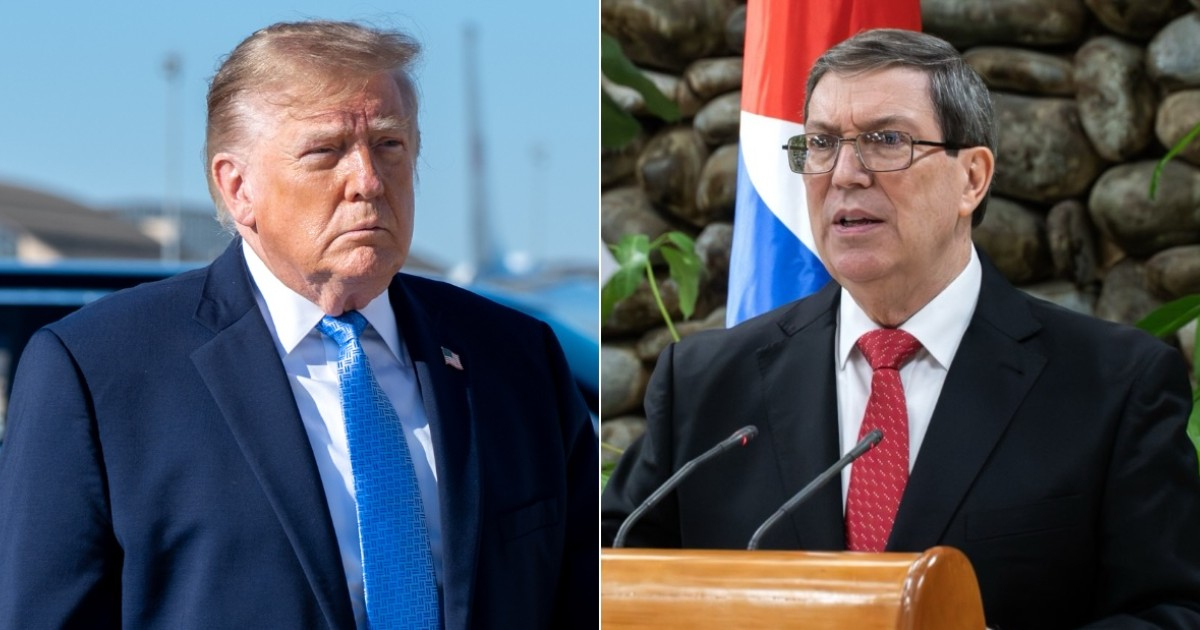
In an exclusive interview with The New York Times, Cuban Foreign Minister Bruno Rodríguez Parrilla expressed the regime's commitment to withstand the pressure campaign from the Trump administration, regardless of how long it may take. He remains confident that Washington will eventually alter its approach.
"For as long as it takes," Rodríguez Parrilla asserted from Cuba's mission at the United Nations in New York. "The United States' policy towards Cuba will change. It must change; it's inevitable."
Rodríguez's argument is rooted in sixty years of history: "For six decades, the U.S. policy against Cuba has been ineffective. Conversely, Cuba’s strategy of resistance and adaptation to this aggression has been successful."
Despite his extensive experience, having led the Foreign Ministry for 17 years, Rodríguez, now 68, acknowledged that he has never before faced such intense U.S. pressure.
Since January 2026, the Trump administration has imposed sanctions on over 40 entities and at least 38 individuals linked to Cuba's military, energy, and financial sectors, in addition to enforcing a petroleum blockade.
Escalating Tensions and Diplomatic Struggles
The interview occurred shortly after a heated confrontation at the UN. Last Tuesday, Rodríguez exchanged heated words with U.S. Ambassador Mike Waltz during the embargo debate, marking his third interruption of a U.S. diplomat in a year. A Cuban delegate shouted "You are a liar!" at Waltz, who retorted, "Get back to your seat! Do you understand who you're dealing with?" The following day, Washington expelled a Cuban diplomat involved in the incident.
On that Wednesday, the annual UN resolution against the embargo secured only 130 votes in favor—the lowest since 1995—compared to 165 in 2025. Votes against doubled to 17, and abstentions increased from 12 to 25. Colombia, Costa Rica, and Ecuador shifted their stance to oppose Cuba, while Germany abstained for the first time since 2002.
Economic Reforms Amidst Political Standoff
Disregarding Secretary of State Marco Rubio's public call to recruit informants in Cuba, Rodríguez dismissed it as unserious and somewhat childish. Meanwhile, Rubio reiterated that "Cuba needs a drastic change," distinguishing it from the Venezuela situation. State Department spokesman Tommy Pigott labeled the Cuban government as a "failed regime" that "continues to blame the U.S. and others for its own incompetence and corruption."
Despite ongoing discussions with U.S. officials—encompassing face-to-face meetings, calls, and WhatsApp messages—the foreign minister admitted progress is challenging: "It's very difficult to make headway in talks that are consistently accompanied by threats."
While asserting resilience, the Cuban regime has enacted economic changes. In June, it approved a set of 176 economic measures—the most radical since 1959—including private banks, the sale of state enterprise shares, and foreign investment in private businesses. Rodríguez emphasized these are not responses to U.S. pressure: "It opens numerous new opportunities for private capital, foreign investors, and companies from various countries. However, the Cuban economy will remain socialist."
Independent analysts question the feasibility of this strategy. Ric Herrero, director of the Cuba Study Group, remarked, "It's easy for Bruno to claim they're holding out when the Cuban people are the ones truly suffering." His prognosis for the island's future is stark: "The harsh reality is that Cuba is isolated. They can endure, but it's merely a controlled decline. Ultimately, they're headed towards the abyss."
Understanding the Current Cuban Situation
How has the Trump administration increased pressure on Cuba?
Since January 2026, the Trump administration has sanctioned over 40 entities and 38 individuals tied to Cuba's military, energy, and financial sectors, alongside enforcing a petroleum blockade.
What recent economic changes has the Cuban government implemented?
In June, Cuba introduced a package of 176 economic measures, including private banking, sale of state enterprises, and foreign investment in private businesses, marking the most significant reforms since 1959.
What was the outcome of the latest UN resolution against the U.S. embargo on Cuba?
The resolution received only 130 votes in favor, the lowest since 1995, with votes against doubling to 17 and abstentions increasing from 12 to 25.