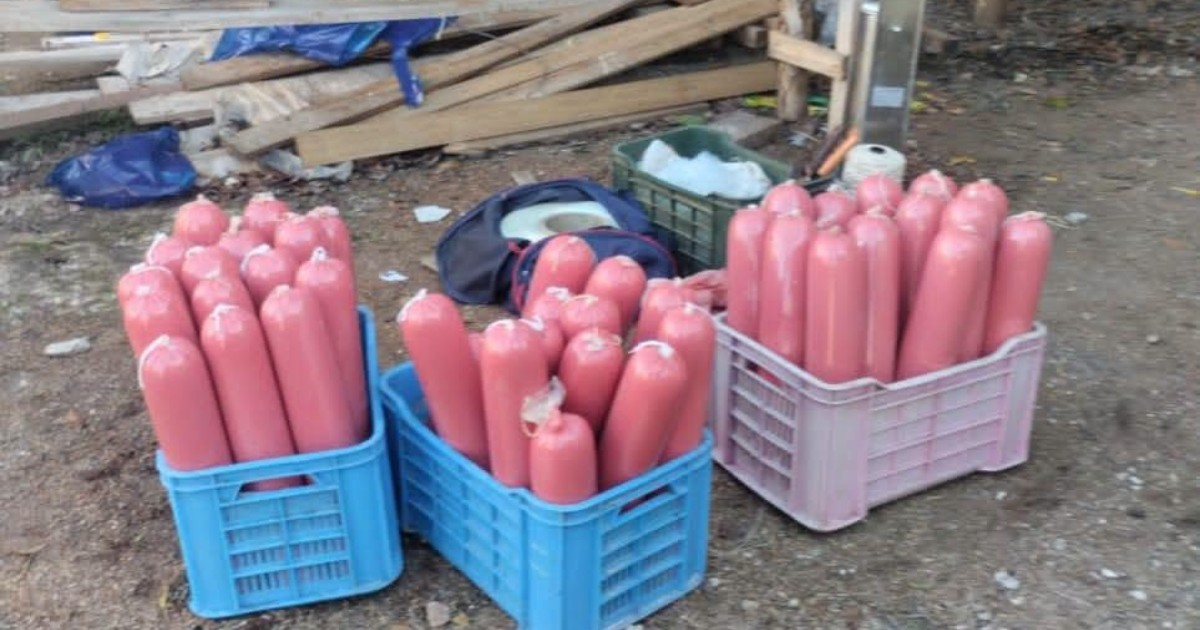
Cuban officials dismantled what they claim was an illegal sausage factory in the heart of Ciego de Ávila on Wednesday. This news was revealed through a Facebook post by Luis Alberto Medina Vega, a regime supporter who frequently uses hashtags like #MinitCiegodeÁvila and #CreoEnTi. The announcement has ignited a fiery public discourse, intertwining health concerns with frustration over food scarcity and entrepreneurial hurdles.
Interestingly, the raid came just a day after the same Facebook profile reported the confiscation of local cheese from a bus in Chambas, also in Ciego de Ávila, headed to Havana. This peculiar sequence did not go unnoticed, with one Cuban jokingly remarking, "Now they have the ham and the cheese... yesterday the cheese and today the ham, what a coincidental surprise."
Medina Vega defended the operation, citing potential public health issues: "Health is no laughing matter, and the recklessness of a few can impact many." He also acknowledged, "We support our citizens' entrepreneurial spirit, but everything must be done within legal frameworks." Details such as the factory's address, the volume of seized products, involved authorities, any arrests, or imposed sanctions were conspicuously absent. Additionally, no health analyses were shared to substantiate any contamination claims regarding the sausages.
Photographs released depict plastic crates—two blue and one pink—filled with pink cylindrical items resembling sausages, alongside makeshift machinery with rusty pulleys and a person near large steaming metal containers, all set in a rural setting.
Public Reaction and Concerns
Many reactions criticized the shutdown of an operation that, amidst a food crisis, supplies the community. "Those who make sausages know the exact proportions of all ingredients, including curing salts and seasonings, and they don’t use spoiled meat because it’s for their families and the community. What they do is help us all a bit more," a user commented.
Others highlighted the systemic barriers driving producers into informality: "If there weren’t so many obstacles and instead of dismantling, they were given the necessary permits, with all required hygiene supervised by MINSAP, things would be different, and food wouldn’t be so expensive and hard to find."
There was also criticism of police priorities. "Why are so many armed robberies unsolved? Where are the famed law enforcement forces?" one netizen questioned, referencing the ongoing security issues in the province during 2026.
Some supported the health inspections, albeit with reservations. "We’re not against people thriving, but when it becomes a health issue: NO," one user noted. Another echoed that "food production should be verified for health benefits, but illegality often comes with high taxes on private businesses, opportunistic inspectors' harassment, and numerous hurdles set by institutions and the government."
The Bigger Picture: Food Scarcity in Cuba
Cuba relies on imports for 70% to 80% of its food consumption, and domestic production has plummeted between 2018 and 2023: pork production fell by 95%, rice by 87%, and beans by 70%, according to official statistics gathered by the World Food Programme. The year-on-year food inflation reached 42.66% in September 2026.
So far, the authorities have not independently confirmed the details of the operation in Ciego de Ávila or the final destination of the seized products.
Frequently Asked Questions about Cuba's Food Crisis
Why was the alleged illegal sausage factory shut down?
Authorities cited potential public health issues as the reason for the shutdown, although specific details about contamination were not provided.
How has food production in Cuba changed recently?
Between 2018 and 2023, domestic food production in Cuba drastically declined, with pork production down 95%, rice 87%, and beans 70%.
What are the public's main concerns regarding the shutdown?
The public is concerned about the loss of a food source during a crisis, systemic barriers to legal production, and the prioritization of law enforcement efforts.