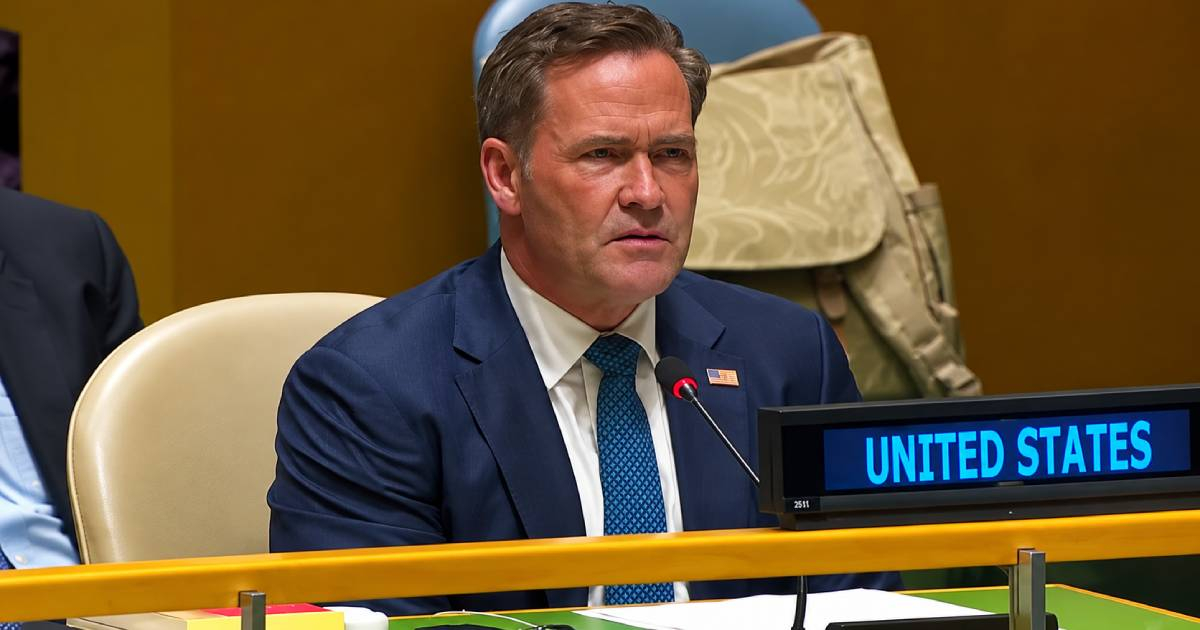
The United States Ambassador to the United Nations, Mike Waltz, issued a stern warning to the Cuban regime on Wednesday, October 28. He made it clear that any future aggression towards a U.S. diplomat within the UN would lead to repercussions. This declaration came amid the General Assembly's debate on the embargo against Cuba.
"If you lay a hand on a U.S. diplomat in this body, there will be consequences," Waltz stated during his speech to the General Assembly.
The warning followed a heated exchange between the U.S. and Cuban delegations on Tuesday, October 27. Richard Tur de la Concepción, the First Secretary of Cuba's Permanent Mission to the UN, was accused of attempting to seize the phone and assault U.S. spokesperson J.P. Freire during a recording of an altercation.
On Tuesday evening, Waltz announced on television that Secretary of State Marco Rubio had authorized the expulsion of the Cuban diplomat, who was required to leave the United States within 24 hours.
Consequences for Diplomatic Misconduct
During his address to the General Assembly on Wednesday, Waltz reiterated the incident and confirmed that the Cuban official would be sent back to Havana that day. He emphasized that the actions violated host country agreement rules governing diplomatic missions at the UN.
Criticism of Cuban Leadership Privileges
Waltz raised critical questions about the privileges enjoyed by Cuban leaders, the finances of the military conglomerate GAESA, and the working conditions of Cuban doctors on international missions. He criticized the Cuban elite for their luxury watches, yachts, mansions, and even private islands, while the general population suffers from power outages and shortages of food and medicine.
Waltz pointed out that in the first eight months of 2026, American companies exported $876 million worth of goods to Cuba, including $250 million in fuel. He argued that the U.S. is Cuba's leading supplier of fuel for its private sector, contradicting Havana's narrative on trade restrictions.
He expressed a desire for the fuel to benefit Cuban farmers and citizens, rather than being used for the Castro family's luxury yachts.
Cuban Foreign Minister's Response
Cuban Foreign Minister Bruno Rodríguez Parrilla dismissed the U.S. accusations and condemned what he termed the "disrespectful and provocative" behavior of the Washington delegation. He accused U.S. officials of harassment and unauthorized filming during Tuesday's incident.
Rodríguez demanded the expulsion of opposition figure Orlando Gutiérrez-Boronat, present in the gallery as a guest of the U.S. mission. The Cuban government lists him as a wanted individual for alleged terrorist acts.
Gutiérrez-Boronat responded on Facebook, "The dictator's foreign minister demands my expulsion from the United Nations. What an honor. Cuba will be free."
The confrontation occurred alongside a significant drop in international support for Cuba's resolution against the embargo. On Wednesday, it was approved with 130 votes in favor, 17 against, and 25 abstentions. The initiative lost 35 votes compared to 2025, marking its least favorable outcome since its introduction in 1992.
Despite the decrease in favorable votes, the Cuban Foreign Ministry celebrated the approval as a "victory for Cuba," while Washington continued to hold Havana accountable for the economic hardships faced by the Cuban populace.
Key Questions About U.S.-Cuba Diplomatic Tensions
What prompted the U.S. to warn Cuba about consequences?
The warning came after an incident where a Cuban diplomat allegedly tried to seize the phone of a U.S. spokesperson during a confrontation at the UN, leading to accusations of aggression.
What actions did the U.S. take following the incident?
The U.S. expelled the Cuban diplomat involved in the incident, requiring him to leave the United States within 24 hours.
How did the Cuban government respond to the U.S. accusations?
Cuban Foreign Minister Bruno Rodríguez Parrilla rejected the accusations, accusing the U.S. of disrespectful behavior and demanding the expulsion of opposition figure Orlando Gutiérrez-Boronat.