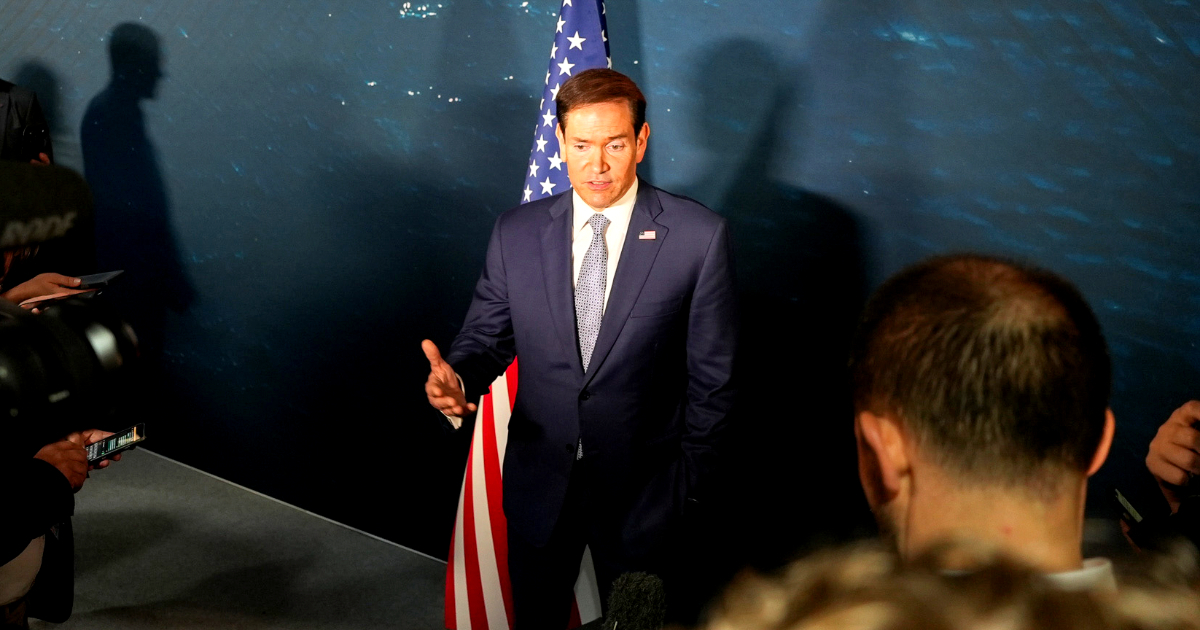
On Tuesday, Secretary of State Marco Rubio dismissed the idea that Delcy Rodríguez's administration could use stalling tactics to indefinitely delay Venezuela's political transition. He expressed his personal goal to see the matter resolved well before the end of his tenure.
These remarks were made during a teleconference, the transcript of which was released by the State Department. Rubio was responding to a query from Vera Bergengruen of the Wall Street Journal, who asked whether Caracas might simply wait out the current U.S. administration.
Rubio was unequivocal: "What if they just try to run out the clock on us for two years? That's not going to happen."
The Secretary emphasized that there are agreed-upon deadlines, which Venezuelan authorities have adhered to despite setbacks, such as the June 2026 earthquake that claimed over 5,000 lives and prompted a national emergency declaration.
He explained that Washington holds a significant leverage point: Venezuela remains under a sanctions regime, and the economic activities permitted are contingent upon exemptions and general licenses, which the U.S. government can alter or revoke at any time.
"The truth is, the United States has substantial influence over the direction these talks take and the outcomes we achieve," Rubio stated.
Rubio warned that if the transition process fails, Venezuela would revert to a baseline of full sanctions, losing current economic incentives. This alternative path could potentially lead to violence or civil war.
He asserted that commitment to the transition must be complete, including from interim authorities: "I don't know what alternative they have, because if they don't cooperate with this, obviously... that's why we've lifted some of these sanctions."
Washington's Roadmap for Venezuela
Rubio acknowledged his own time constraints: "At best, I have two years and two months left in this position. So, clearly, I intend to see this project settled long before I leave."
The transition plan championed by Washington includes a specific institutional sequence: firstly, the renewal of the Supreme Court with 32 new justices, whose names must be submitted to the National Assembly by December 11, 2026; secondly, restructuring the National Electoral Council to transform it into a technical body without the authority to disqualify candidates or parties; and thirdly, Rodríguez declaring the absolute vacancy of the presidency, triggering a constitutional six-month period to call elections.
The Judicial Nominations Committee, consisting of 23 members—11 lawmakers and 12 civil society representatives—was sworn in on October 22 and is already working against this timeline.
Rubio has emphasized that Venezuela's electoral infrastructure was designed to rig elections under Maduro's government and must be replaced before any vote can be deemed legitimate.
The transition process was formally announced by Rubio on July 20, 2026, during a joint forum between the 2015-elected National Assembly and the interim government, with dialogue between Chavismo and the opposition beginning in August of that year.
"I am very optimistic that we will meet these deadlines and get to where we need to be," Rubio concluded.
Key Questions on Venezuela's Political Transition
What leverage does the U.S. have over Venezuela's transition process?
The U.S. holds significant leverage through sanctions, exemptions, and general licenses affecting Venezuela's economic activities, which can be modified or withdrawn at any time.
What are the key steps in Washington's transition plan for Venezuela?
The plan involves renewing the Supreme Court with 32 new justices, restructuring the National Electoral Council, and declaring the presidency vacant to trigger elections within six months.
Why is Venezuela's electoral infrastructure a concern?
Rubio asserts that the current electoral infrastructure was designed to rig elections under Maduro's regime and needs to be replaced to ensure legitimate voting.