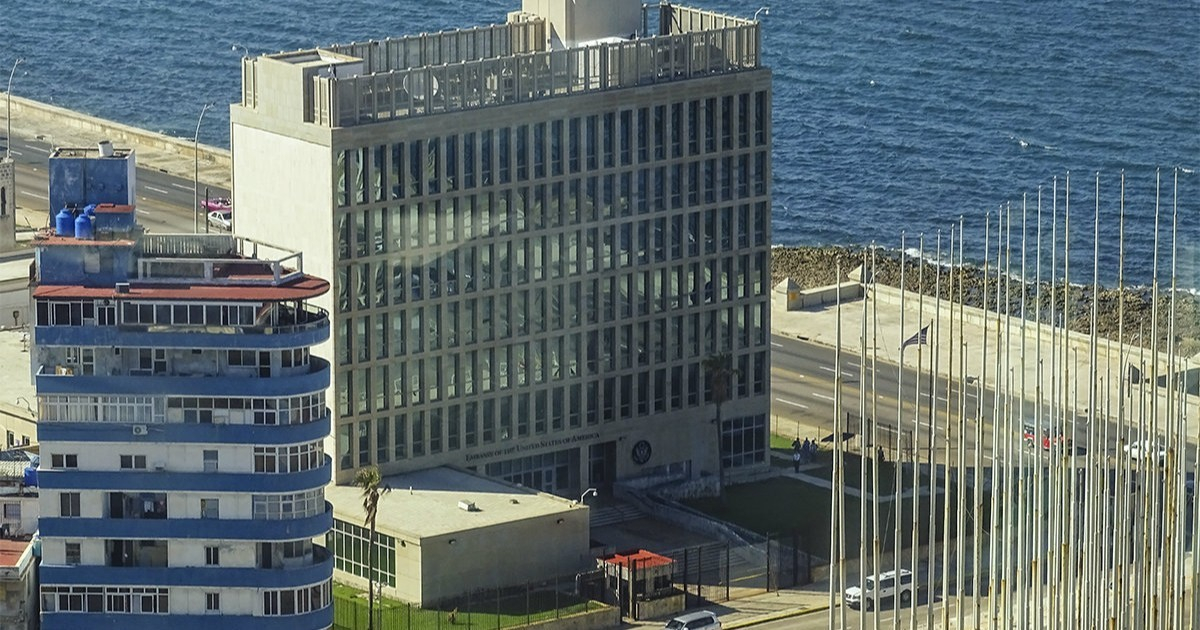
This Wednesday, the U.S. Embassy in Havana released an official alert announcing the suspension of in-person services for U.S. citizens starting at 11:00 a.m., due to a protest scheduled for later in the day at the José Martí Anti-Imperialist Plaza, located along Havana's Malecón, right in front of the embassy.
The alert highlights an increased police presence, traffic diversions, and potential disruptions in the vicinity of the diplomatic mission.
U.S. citizens in Cuba are advised to "steer clear of demonstrations and crowds, maintain a low profile, stay alert to their surroundings, and follow local news for updates."
Those in need of consular assistance can reach out by calling +(53) 7 839-4100—after hours, press 1 followed by 0—or by emailing ACSHavana@state.gov.
The alert does not specifically mention visa interviews or other consular services unrelated to U.S. citizen services, so it remains unclear whether these are also suspended.
This protest occurs amidst the most strained U.S.-Cuba relations of 2026. On Tuesday, Cuban Foreign Minister Bruno Rodríguez Parrilla advanced toward the podium at the UN General Assembly while U.S. Ambassador Michael Waltz was speaking, leading to a brief suspension of the session by its president.
During the incident, a member of the Cuban mission, Richard Tur de la Concepción, attempted to seize the phone of Waltz's spokesperson while recording the event. Secretary of State Marco Rubio promptly signed his expulsion, sending the diplomat back to Havana within 24 hours.
On the same day, the General Assembly passed its annual resolution against the embargo with only 130 votes in favor, 17 against, and 25 abstentions—the least favorable outcome for the Cuban regime since these votes began in 1992—compared to 187 supports in 2024 and 165 in 2025.
Cuban President Miguel Díaz-Canel responded on the social network X, asserting, "Cuba will not back down, especially in the face of Yankee pressures and orders," while congratulating the Cuban delegation for its performance in New York.
The mobilization to the Anti-Imperialist Plaza follows the regime's typical pattern of organizing anti-U.S. gatherings during periods of diplomatic tension or internal pressure. The most recent instance was on May 22, when the regime summoned military, police, and state workers to the same location in response to federal criminal charges filed in Miami against Raúl Castro. During that event, an internal document from the Havana Electric Company mandated the forced mobilization of 971 workers, divided among 41 business units, with transportation starting at 5:00 a.m.
For Cuban-Americans and U.S. citizens with pending processes, the suspension of services adds to an already challenging situation: Presidential Proclamation 10998, effective January 1, 2026, continues to suspend the issuance of B-1, B-2, F, M, J, and immigrant visas for Cuban nationals, with exceptions for permanent residents, holders of valid visas prior to that date, and dual citizens.
The Embassy issued a similar alert on May 21 in response to the day's gathering, indicating that such warnings have become routine whenever the regime mobilizes its supporters outside the U.S. diplomatic mission.
Key Concerns Surrounding the U.S. Embassy in Havana
What prompted the U.S. Embassy in Havana to suspend its services?
The suspension was due to a protest scheduled at the José Martí Anti-Imperialist Plaza, located directly in front of the embassy, leading to safety concerns and potential disruptions.
How can U.S. citizens in Cuba seek assistance during the suspension?
U.S. citizens needing assistance can call +(53) 7 839-4100 or email ACSHavana@state.gov for consular support.
What is the significance of the recent diplomatic tensions between Cuba and the United States?
Recent tensions, highlighted by incidents at the UN General Assembly and a challenging vote on the embargo, reflect a deterioration in relations, impacting diplomatic interactions and policies.